

Several years ago, my client, Megan, worked briefly for No Dogs Left Behind (NLDB), a dog-rescue led by Jeffrey Beri. In late 2024, a fire broke out at a NDLB building, killing 44 dogs. This resulted in a considerable amount of online criticism of NDLB and Beri, which Beri took exception to. Beri got it into his head that Megan was in some way involved in this online criticism and thus filed a lawsuit against her and ten John Does apparently as part of a fishing expedition to identify and crack down on his critics.
At first glance, the idea that you could file a lawsuit against someone for allegedly criticizing a dog-rescue that set 44 dogs on fire seems strange. Don’t we have a First Amendment in this country? Aren’t people allowed to freely speak their minds?
Increasingly, the answer to that question is actually no, at least when it comes to anyone who has ever employed you. These days employers regularly require everyone they employ to sign agreements containing non-disclosure, non-disparagement, and confidentiality provisions that prohibit them from ever criticizing the employer, its executives, its officers, and a long list of similar sorts of parties. These “NDAs” typically have no expiration date, meaning that employees are bound to them for the rest of their lives, potentially decades after they stopped working at the company.
Megan had signed such an agreement, which gave Beri the legal peg he needed to come after her. He filed a breach-of-contract claim against Megan in a New York state district court alleging that she had violated her non-disparagement provision.
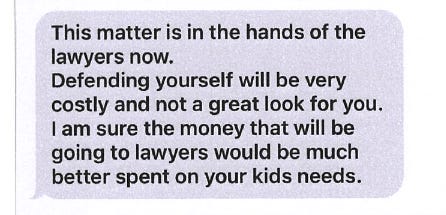
Employers don’t usually have to sue former employees to shut down their speech in this way. They typically just hire a lawyer to send threatening letters and employees just do whatever they are asked to do so as to avoid the potentially crushing expenses of a lawsuit. This is true even if the employee never actually violated their NDA. In Megan’s case, this dynamic was stated overtly at one point in a text she received from an NDLB-affiliated individual named Candy Udell:
Remarkably, Megan decided to actually defend herself from the lawsuit pro se, meaning without an attorney. After about a year of that, I was brought into the case to help.
I have litigated four of these kinds of cases in the last few years and, in each of them, I do the same thing. I file a charge at the NLRB alleging that the NDA, on its face, violates the NLRA under Stericycle and McLaren Macomb and that the employer has filed a preempted lawsuit that seeks the illegal objective of enforcing an NDA that facially violates the NLRA (Bill Johnson’s Restaurant). Depending on the specifics, I may also allege that the lawsuit is retaliatory and baseless.
After filing a charge, I file a motion to stay or dismiss the court case on the theory that it is preempted under the Garmon preemption doctrine. This doctrine states that if the relevant conduct at issue in the court case is arguably prohibited or arguably protected by the NLRA, courts must generally stay or dismiss the case until the NLRB has had a chance to decide on whether that conduct is actually prohibited or protected by the NLRA. So here, the argument is that the NDA is arguably prohibited by the NLRA, the parties have an active NLRB proceeding over the NDA, and so the court case should be stayed or dismissed until the NLRB has decided that issue.
Normally, once I finish filing the charge and the motion, the other side figures out that they are in a bad position and the case is voluntarily dismissed or settled on very favorable terms. This can take a while as the lawyers who typically file these lawsuits are not labor lawyers and most are typically surprised that you can defeat these lawsuits this way.
In this case, however, opposing counsel did not withdraw the case or offer to settle. Instead, he filed a very brief answer in which he claimed that the filing of the NLRB charge “is, on its best day, a ruse.” So, in a first for me, the judge had to actually issue a decision on the Garmon motion. As expected, Judge Farley’s decision was that the NDA at issue in the case arguably violates the NLRA and that therefore the case should be stayed until the completion of the NLRB proceeding.
It is nice to get this sort of concrete confirmation that this legal argument works. I am not the first to succeed at it, of course, but oftentimes I get the sense from other lawyers I talk to about it that they view it as exotic and unlikely to succeed.
Ultimately, this is not a real solution to the underlying policy problem though. The vast majority of workers threatened in this way are going to give in rather than pay a lawyer to use this strategy, if they can even find one who is aware of it. Additionally, NLRB GC Carey is gearing up to try to overturn Stericycle and McLaren Macomb, which are key to making this strategy work.
If we really want to make sure that workers are free from coercion and able to speak freely about their employers, we need legislation explicitly banning employers from using these kinds of agreements and we need monetary penalties for those who continue to do so.