
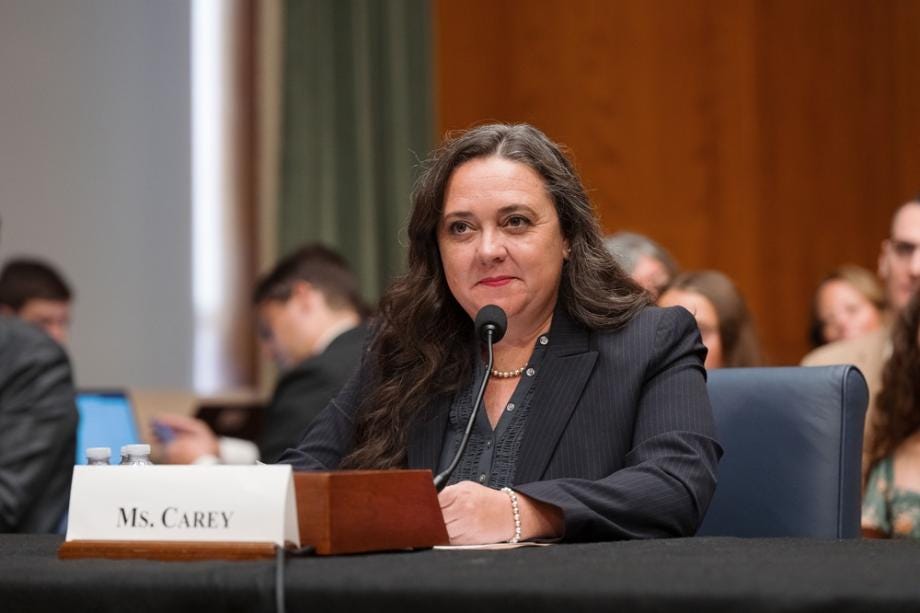
Since General Counsel Crystal Carey was sworn in on January 7, 2026, the GC’s office has filed at least four briefs urging the Board to overrule or substantially modify recent precedent, targeting decisions in three overlapping areas: severance agreement restrictions, the standard for evaluating facially neutral work rules, and employer speech during organizing campaigns. The filings reflect a consistent posture of agreeing with respondent employers that post-2022 Board precedent swung too far toward finding liability, and of proposing more employer-friendly replacement standards.
Severance Agreements: Overruling McLaren Macomb
The GC urges overruling McLaren Macomb, 372 NLRB No. 58 (2023), which held that proffering a severance agreement containing provisions that limit employees' Section 7 rights violates Section 8(a)(1) whenever those provisions are not narrowly tailored, regardless of whether any other unlawful conduct accompanied the proffer. The GC has pressed for overruling McLaren Macomb in two separate cases now pending before the Board.
In Valley Radiology, P.A. (10-CA-324512, May 5, 2026), Counsel for the General Counsel filed an answering brief in which the GC expressly agreed with the respondent employer that McLaren Macomb should be overturned. The same position was advanced in Honeywell International, Inc. (09-CA-327389, June 1, 2026), again in response to an employer's exceptions.
The GC's argument in both cases is that McLaren Macomb erred by treating any "chilling tendency" in a severance agreement's language as equivalent to an actual relinquishment of Section 7 rights, without requiring proof that the provision explicitly waives those rights. That framework, the GC contends, disregards the Board's longstanding policy favoring private resolution of workplace disputes and renders routine non-disparagement and confidentiality provisions unlawful even where employees were not discharged or subjected to other coercive conduct.
The GC's primary proposed replacement standard would find severance agreement provisions unlawful only if they contain an explicit, non-narrowly-tailored waiver of Section 7 rights. Under this test, broadly worded or ambiguous provisions would not automatically constitute a waiver. As a fallback, the GC urges the Board to overrule McLaren Macomb and reinstate the framework from Baylor University Medical Center, 369 NLRB No. 43 (2020), and IGT d/b/a International Game Technology, 370 NLRB No. 50 (2020), under which the proffer of a severance agreement is unlawful only when accompanied by unlawful discharges or other coercive circumstances.
Applying the proposed explicit-waiver standard to the facts of Valley Radiology, the GC concluded that the non-disparagement provision was still unlawful because it expressly barred the employee from assisting others with claims before the Board, but that the confidentiality of agreement provision was lawful.
Facially Neutral Work Rules: Overruling Stericycle
The GC has urged overruling Stericycle, Inc., 372 NLRB No. 113 (2023), in both the Honeywell and Starbucks Corporation (13-CA-322871, June 17, 2026) proceedings.
Stericycle held that a facially neutral workplace rule is presumptively unlawful if a reasonable employee who is economically dependent on the employer and who contemplates Section 7 activity could read the rule as coercive, even if a non-coercive reading is also available. The employer may rebut that presumption only by showing the rule advances a legitimate and substantial business interest that cannot be served by a more narrowly tailored rule.
The GC's criticism in both cases is that this standard encourages reading workplace rules in isolation from their evident purpose, stretches Section 7 beyond its congressional scope, and creates a climate of regulatory uncertainty that falls particularly hard on smaller employers. The GC argues that Stericycle fails to account for employers' parallel legal duties under federal and state law to maintain safe, harassment-free, and confidential workplaces, effectively pitting those duties against the Act. In the Honeywell brief, the GC also noted that the Stericycle framework produced a finding of liability against a standard employment confidentiality provision that, read in context, a reasonable employee would not understand to restrict Section 7 activity.
Neither brief specifies a precise replacement test. Both call for a "balanced and common-sense approach" that weighs employees' Section 7 rights against employers' legitimate business interests without presuming unlawfulness from the mere possibility of a coercive reading.
Union Insignia and Dress Codes: Overruling Tesla
In a Starbucks case (June 17, 2026), the GC filed exceptions to an ALJ decision that applied Tesla, Inc., 371 NLRB No. 131 (2022), and found that Starbucks had demonstrated the "special circumstances" necessary to justify its neutral dress code restricting logos and graphics on employee shirts. The GC does not dispute the outcome favorable to Starbucks but objects to the framework used to reach it.
Tesla requires employers to prove "special circumstances" whenever a facially neutral dress code limits the display of union insignia, effectively treating such policies as presumptively unlawful. The GC argues that this inverts the proper analysis by requiring employers to justify neutral, evenhandedly applied attire policies that do not single out union insignia at all. The GC further argues that Tesla misreads Republic Aviation Corp. v. NLRB, 324 U.S. 793 (1945), which calls for context-specific balancing rather than a categorical presumption of illegality. The GC also points to the practical consequences: the same Starbucks dress code has produced conflicting ALJ rulings at different store locations, illustrating how the "special circumstances" standard lacks administrable contours.
The GC urges the Board to overrule Tesla and return to Wal-Mart Stores, Inc., 368 NLRB No. 146 (2019). Under Wal-Mart, the GC argues, neutral and nondiscriminatory dress codes are lawful on their face; liability attaches only where a policy targets union insignia, discriminates in enforcement, or restricts insignia beyond reasonable size, placement, and presentation limits. Applying that standard, the GC contends Starbucks' policy is lawful without resort to a special-circumstances analysis.
Employer Campaign Speech: Urging Reversal of Amazon.com and Siren Retail
A fourth set of overrule requests appeared as footnotes in the GC's motion to withdraw exceptions in UPS Supply Chain Solutions, Inc. (32-CA-295913 and 32-CA-297314, May 13, 2026). There, Counsel for the General Counsel withdrew all exceptions filed under prior GC Jennifer Abruzzo, including exceptions concerning captive audience meetings and employer predictions about the impact of unionization, on the ground that the Board's intervening decisions in Amazon.com Services LLC, 373 NLRB No. 136 (2024), and Siren Retail Corp. d/b/a Starbucks, 373 NLRB No. 135 (2024), had effectively resolved those issues against the GC's position. Both decisions were given prospective-only effect.
While withdrawing the exceptions, the GC stated in footnotes that the current office urges the Board to reverse both decisions. With respect to Amazon.com, which held that mandatory employee meetings about unionization violate Section 8(a)(1) unless employees are informed their attendance is voluntary and carries no threat of retaliation, the GC urges reversion to Babcock & Wilcox, 77 NLRB 577 (1948), which the brief describes as "properly decided . . . more than seven decades ago." With respect to Siren Retail, which created a new test for evaluating whether employer predictions about the impact of unionization on the individual employee-employer relationship constitute unlawful threats, the GC urges reversion to Tri-Cast, Inc., 274 NLRB 377 (1985). The GC characterizes Tri-Cast as correctly decided and frames both Amazon.com and Siren Retail as departures from well-settled law.
These filings represent a coordinated effort by the current GC's office to present the Board with vehicles for revisiting a cluster of decisions issued between 2022 and 2024. With the exception of the Starbucks dress code case, in which the GC filed its own exceptions after an ALJ ruling favorable to the employer, each brief was filed in response to a respondent employer's exceptions to an adverse ALJ ruling. In each instance, rather than defending the ALJ's application of existing precedent, the GC has joined the employer in arguing that the underlying rule should be changed.