
When Crystal Carey was sworn in as the NLRB General Counsel in January of this year, she was faced with a daunting backlog of unfair labor practices. In her first GC memo, issued on January 18, 2026, Carey indicated that, at least initially, her priority would be “to address the backlog of cases.”
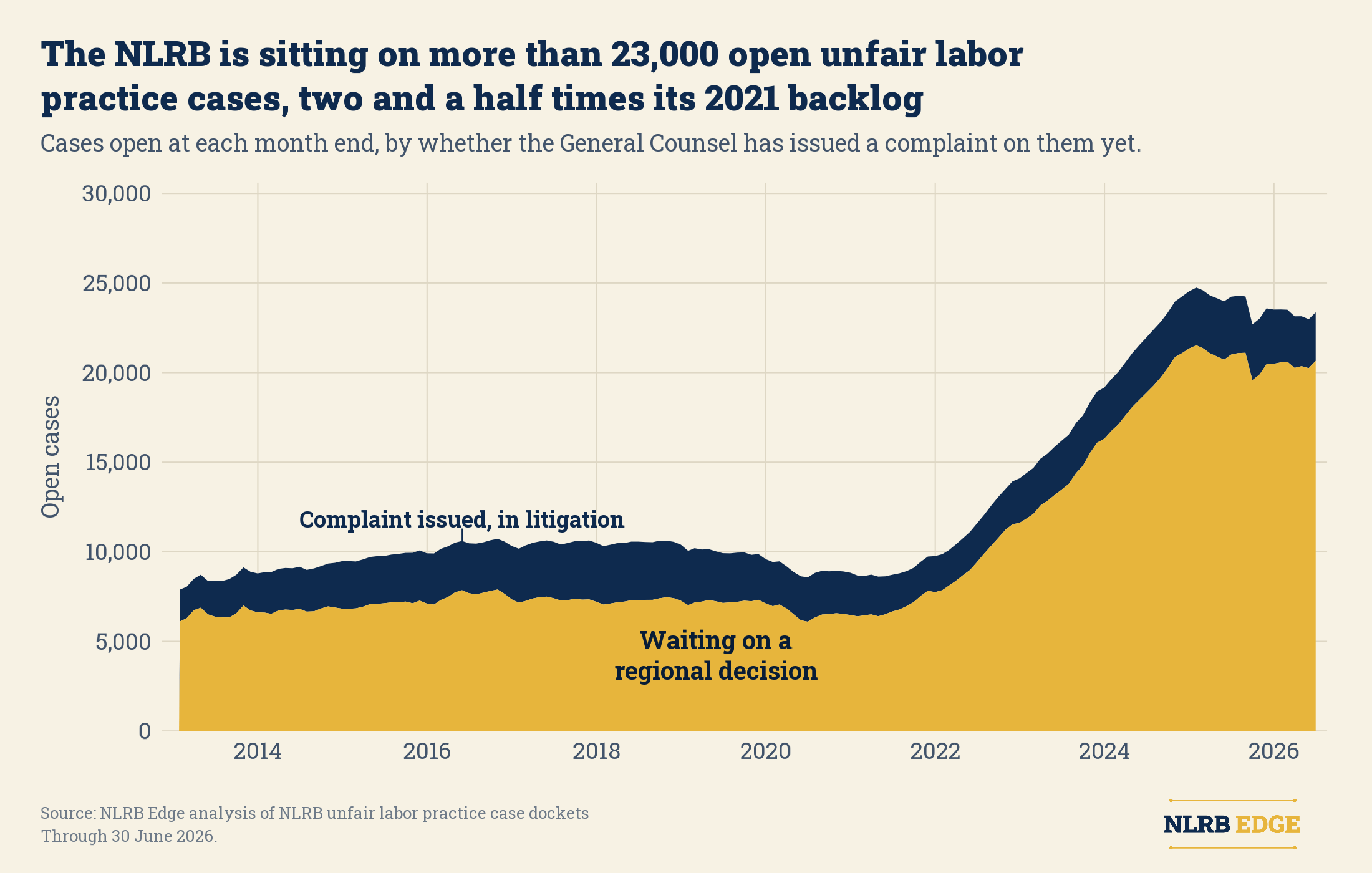
At the time the memo was issued, it was hard to figure out how exactly Carey would be able to do this. The only way for the backlog to decline is for the agency to close cases at a faster rate than new cases are filed. But the NLRB does not have the budget necessary to hire a bunch of new Board agents to pull this off.
Acting GC Cowen, who preceded GC Carey, had already made two changes aimed at the backlog.
The first move was to require charging parties with deferred cases to file biannual status reports or else have their cases dismissed. This resulted in a one-off mass case closure event in September of last year (visible in the graph above). In March of this year, the next biannual status report deadline passed, but it did not yield nearly as many closed cases.
The second move was to require parties who file unfair labor practice charges to also quickly submit a timeline of relevant events, a witness list, and documentary evidence or else have their cases dismissed. This does not seem to have had any noticeable effect. Among other things, even if a case were dismissed for these paperwork reasons, there would be nothing stopping a party from refiling once it assembled these materials.
For her part, GC Carey claimed that one of the ways she would pursue backlog clearance would be by not spending her resources on trying to overturn existing Board precedent. This restraint only lasted a short period of time. By May of this year, GC Carey was filing exceptions briefs urging the Board to overturn a variety of precedents regarding employer campaign speech, dress codes, and coercive rules.
According to my comprehensive dataset of NLRB docket entries, which I maintain as part of my NLRB Research project, GC Carey has pursued backlog clearance primarily by reallocating agency labor away from litigating unfair labor practice cases and towards closing cases in the backlog.
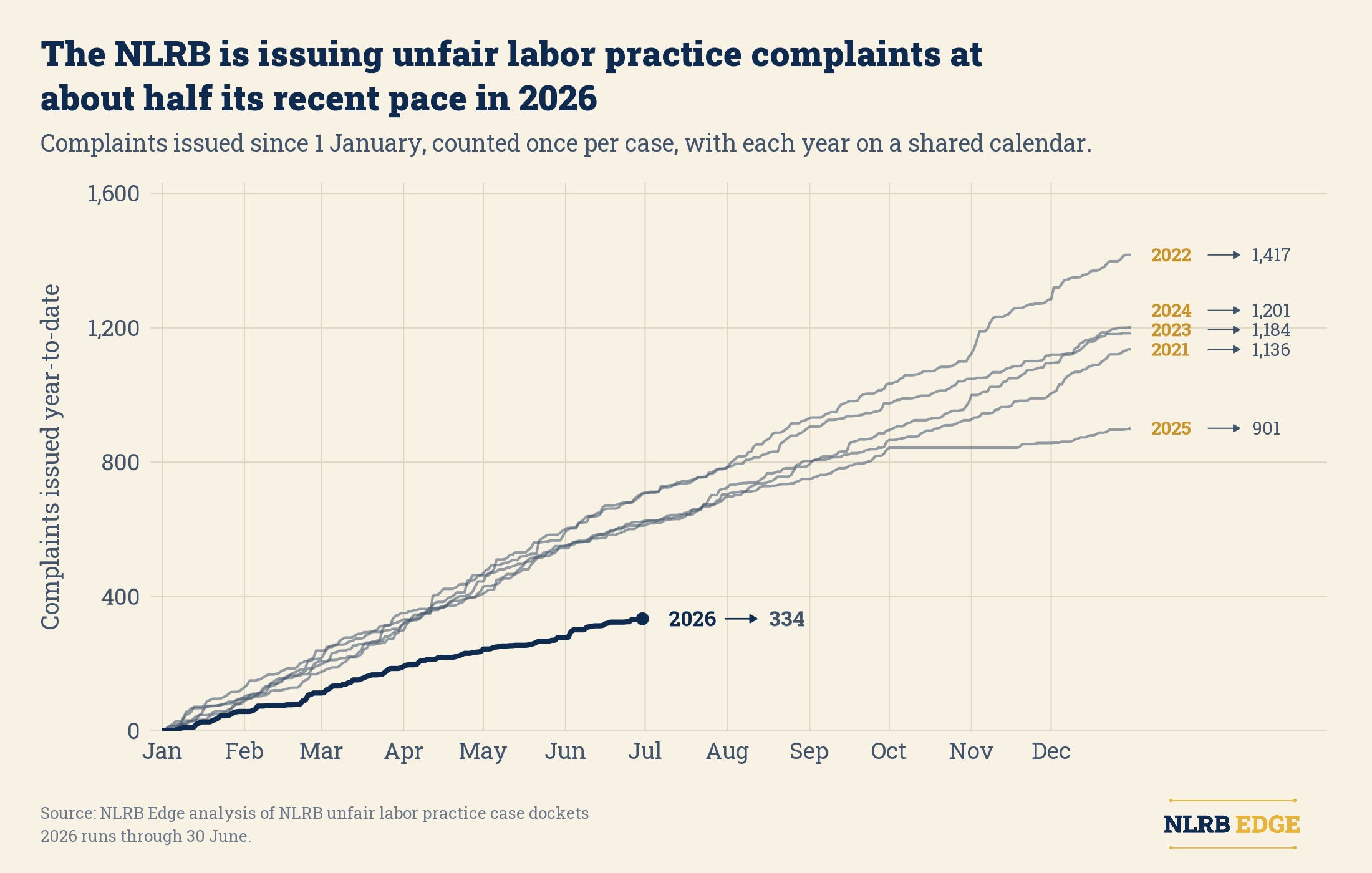
In the graph below, I compare the cumulative number of complaints issued by the GC in 2026 to the number of complaints issued in the four prior years. By the end of June, GC Carey had issued only 334 unfair labor practice complaints, which is about half as many complaints as were issued in the earlier years.
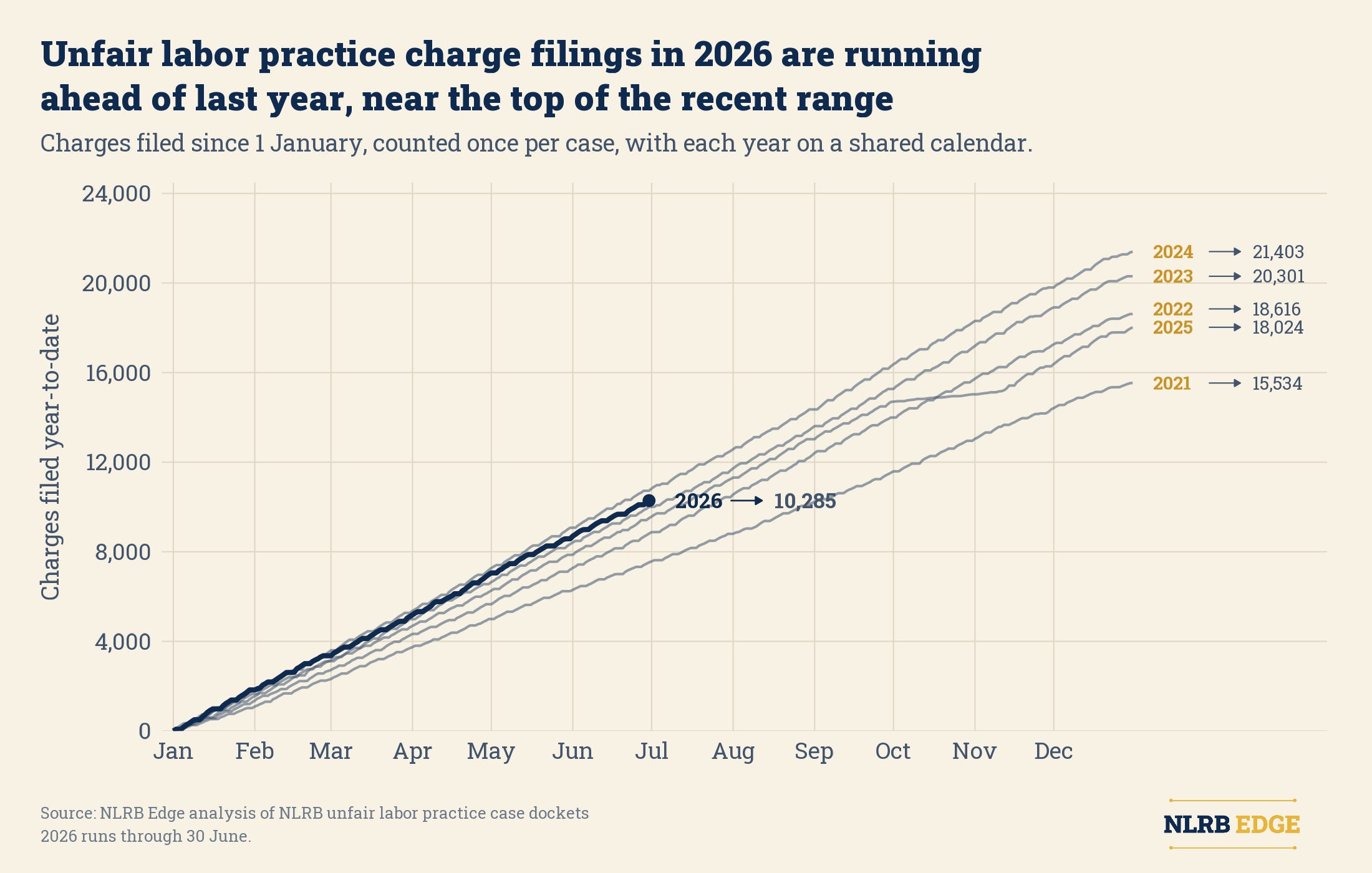
This dip is not the result of a major decline of unfair labor practice charges coming into the agency. The number of ULP charges being filed has not declined at all and is, if anything, on the higher end of the normal range.
What appears to be happening is that the GC has pushed Regions to spend more of their resources dismissing cases. By the end of June, 4,418 cases had been dismissed, which far exceeds the number that had been dismissed in prior years, even in 2025 when there was also a management-side GC.
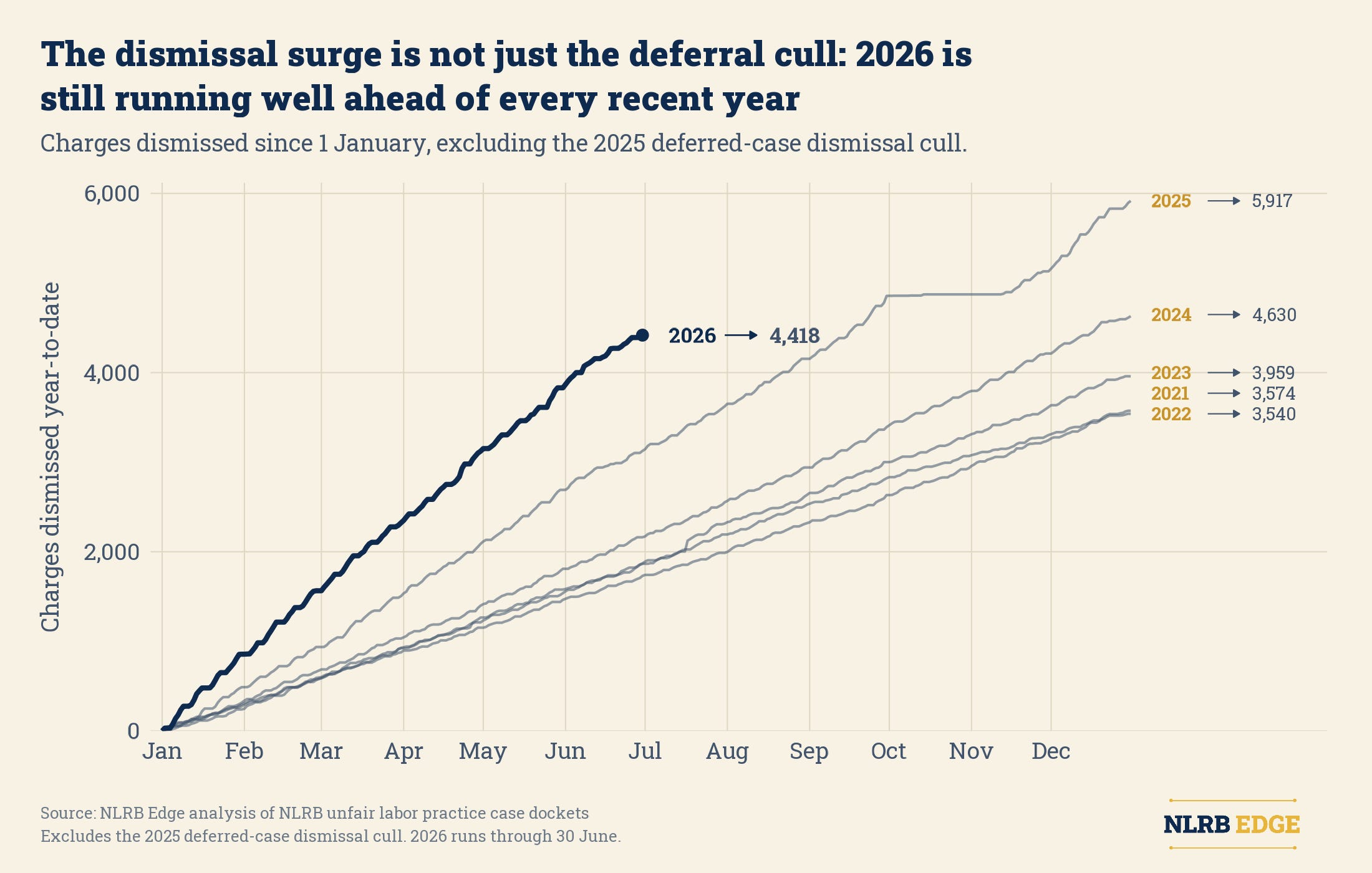
This is not to suggest that these excess case dismissals are generally incorrect as a matter of law. Anecdotally, I have heard from practitioners that they believe more cases are being merit-dismissed or dismissed on non-effectuation grounds than before. But the docket data does not show an increase in the merit-dismissal rate (merit dismissals are up, but not as a percent of all dismissals) and non-effectuation dismissals are not able to be tracked. What makes more sense to me is just that a chunk of Board agent time that previously would have been spent litigating unfair labor practice cases is now being spent looking for meritless charges to get rid of.
Regardless of what precisely is going on behind the scenes, the practical reality is that individuals who are victims of unfair labor practices remain largely unable to vindicate their rights at the agency. The median time between a complaint being issued and a charge being filed stands at 456 days.
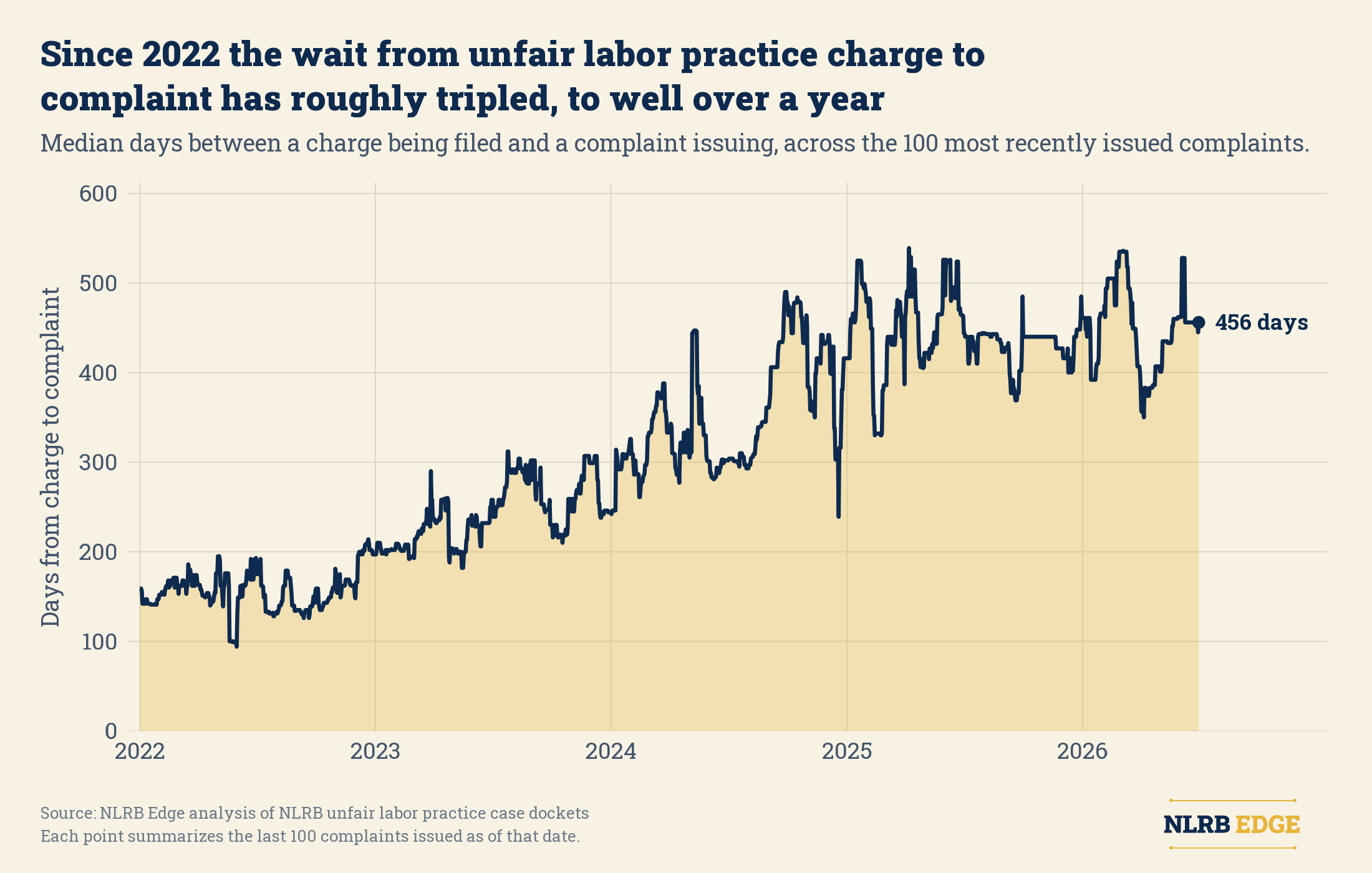
Despite what appears to be an aggressive effort to bring down the backlog, the size of the backlog remains basically unchanged. At best, then, the GC’s efforts are merely keeping it from getting worse. Of course, keeping it from getting worse by scaling back enforcement efforts generates the same sorts of problems for victims.