
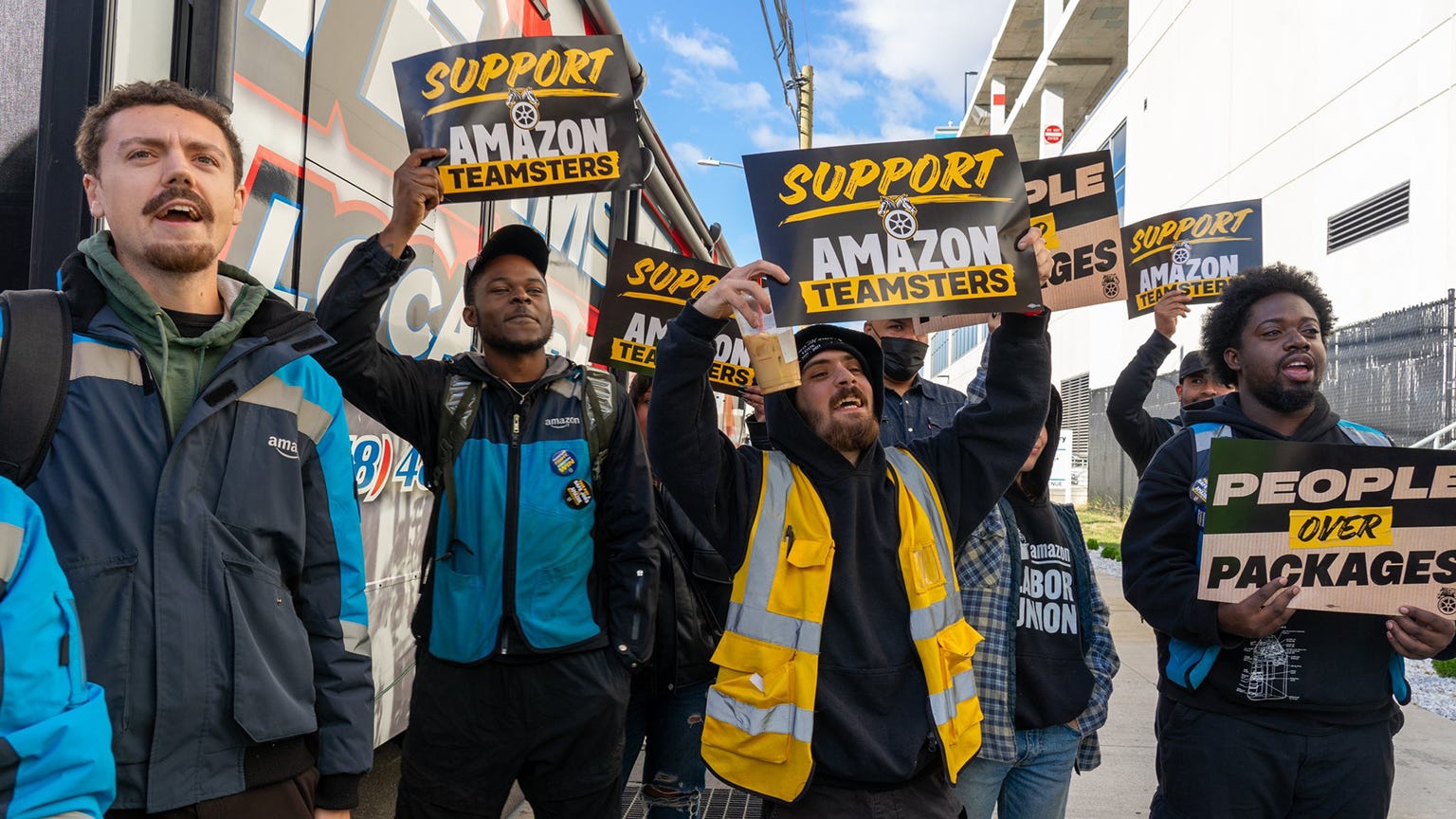
Today we have a decision from the Ninth Circuit in which the court held that it could not issue an injunction pursuant to a constitutional challenge to the NLRB’s structure because the Norris-LaGuardia Act forbids federal courts from issuing injunctions for labor disputes. The Third Circuit reached the same conclusion earlier this month. The Fifth Circuit reached the opposite conclusion in August.
amazon.com Services, LLC v. National Labor Relations Board, 25-886, (9th Circuit)
The U.S. Court of Appeals for the Ninth Circuit has deepened a circuit split by holding that federal courts lack jurisdiction under the Norris-LaGuardia Act to enjoin National Labor Relations Board proceedings, even when the employer raises constitutional challenges to the agency’s structure. The decision aligns the Ninth Circuit with the Third Circuit against the Fifth Circuit regarding whether constitutional attacks on NLRB removal protections fall within the Act’s prohibition on labor dispute injunctions.
Amazon filed suit seeking to halt NLRB proceedings after the Teamsters charged the company with unfair labor practices for refusing to recognize the union as the bargaining representative for drivers employed by Battle Tested Strategies, a terminated delivery contractor. Amazon argued that statutory restrictions on presidential removal of Board members and administrative law judges violated constitutional separation of powers principles.
The Ninth Circuit held that Section 113(a) of the Norris-LaGuardia Act establishes separate requirements for the pending case and the underlying labor dispute. For the case requirement, the court found that both Amazon and the Teamsters—who intervened as a full party—have direct interests in the litigation since Amazon’s constitutional challenges concern the agency’s adjudication of ULP claims the Teamsters initiated. The court emphasized that the Teamsters availed itself of its exclusive statutory mechanism for vindicating NLRA rights by filing charges with the Board.
For the labor dispute requirement, the court concluded the underlying Board proceeding obviously constitutes a labor dispute under Section 113(c) because it concerns employment terms and worker representation, involving controversy between an employer (Amazon) and an employee association (Teamsters as bargaining representative).
The panel rejected Amazon’s argument that the Act applies only to suits directly between employers and employees, noting that Congress deliberately expanded the Clayton Act’s narrower prohibition when it enacted Norris-LaGuardia in 1932. The court distinguished case-related requirements from labor dispute requirements, criticizing the Fifth Circuit’s SpaceX decision for conflating these distinct statutory provisions.
The court also rejected application of the Thunder Basin framework, explaining that Thunder Basin addresses implicit divestment of district court jurisdiction through alternative review schemes, not explicit statutory bars on injunctive power. The Norris-LaGuardia Act’s text controls regardless of whether Thunder Basin factors might otherwise permit review.
Judge Forrest’s opinion emphasized that enjoining the Board proceedings would impede union activities—precisely the outcome Congress intended to prevent by stripping courts of injunctive jurisdiction in labor disputes. The constitutional nature of Amazon’s claims does not exempt the case from the Act’s reach, as the challenges directly concern the Board’s power to adjudicate the employer-union dispute.
Significant Cases Cited
Thunder Basin Coal Co. v. Reich, 510 U.S. 200 (1994): Established factors for determining whether statutory review schemes implicitly divest district courts of jurisdiction over certain agency-related claims.
Axon Enterprise, Inc. v. FTC, 598 U.S. 175 (2023): Applied Thunder Basin factors to conclude that constitutional challenges to ALJ removal protections could proceed in federal district court despite administrative review schemes.
United States v. United Mine Workers of America, 330 U.S. 258 (1947): Interpreted when cases involve or grow out of labor disputes under Norris-LaGuardia Act by examining whether identified persons are involved on both sides or have conflicting interests in the dispute.
Spring Creek Rehabilitation & Nursing Center LLC v. NLRB, 2025 WL 3467537 (3d Cir. Dec. 3, 2025): Held that constitutional challenges to NLRB structure trigger Norris-LaGuardia Act’s jurisdictional bar, creating circuit alignment with the Ninth Circuit against the Fifth Circuit’s SpaceX decision.
Space Exploration Technologies Corp. v. NLRB (SpaceX), 151 F.4th 761 (5th Cir. 2025): Concluded Norris-LaGuardia Act did not apply to constitutional challenges because such suits were not between employers and employees and did not concern employment terms—reasoning the Ninth Circuit rejected.