

There are three cases summaries today, one from the Third Circuit, an Administrative Law Judge decision concerning employer and union retaliation against a dissident union member, and a Regional Election decision concerning confidential employee status.
Spring Creek Rehabilitation and Nursing Center LLC v. NLRB, 24-3043, (Third Circuit)
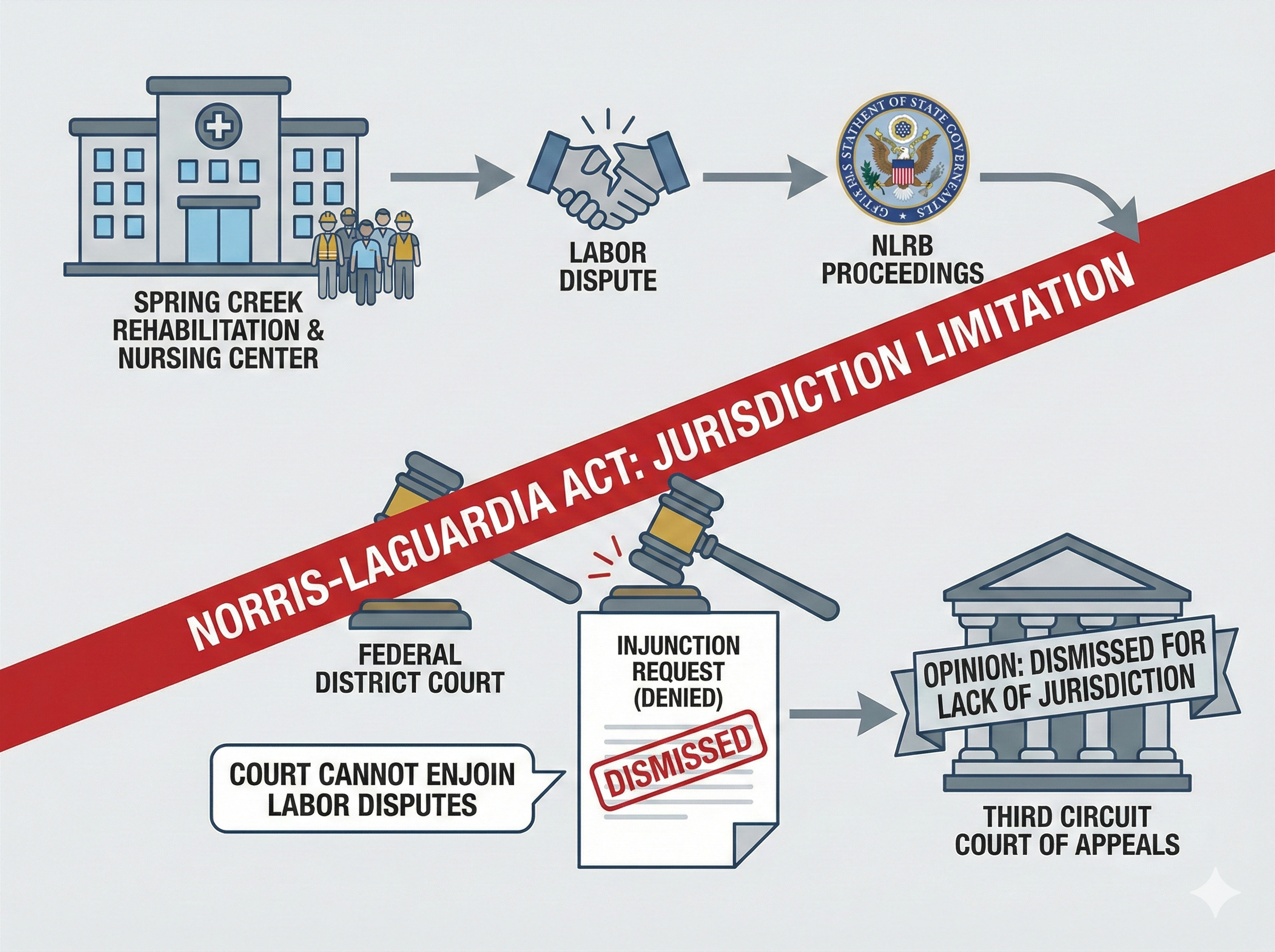
The Third Circuit Court of Appeals dismissed Spring Creek Rehabilitation and Nursing Center’s attempt to block National Labor Relations Board proceedings against it, finding that federal courts lack jurisdiction to issue such injunctions in cases arising from labor disputes.
Spring Creek, a skilled nursing facility operator, purchased its facility from Amboy Nursing and Rehabilitation Center in November 2021. Amboy had maintained a collective bargaining relationship with 1199SEIU United Healthcare Workers East, which represented the facility’s employees. When Spring Creek took over, it informed the union it would not assume the expired collective bargaining agreement and claimed the right to set employment terms unilaterally without bargaining.
The union filed unfair labor practice charges, leading the NLRB to issue a complaint in May 2024 alleging Spring Creek violated Sections 8(a)(1) and 8(a)(5) of the National Labor Relations Act by refusing to bargain collectively and in good faith. When summoned to appear before an administrative law judge, Spring Creek filed suit in federal district court seeking to enjoin the proceedings, arguing that NLRB members and ALJs enjoy unconstitutional protections from presidential removal.
The Third Circuit, in an opinion by Judge Ambro, held that the Norris-LaGuardia Act strips federal courts of jurisdiction to issue injunctions in cases “involving or growing out of a labor dispute” unless strict statutory requirements are met. The court rejected Spring Creek’s argument that its constitutional challenge to the NLRB’s structure was sufficiently removed from the underlying labor dispute to escape the Act’s reach.
The court distinguished its holding from the Fifth Circuit’s decision in Space Exploration Technologies Corp. v. NLRB, which found the Norris-LaGuardia Act inapplicable to similar constitutional challenges. The Third Circuit criticized Space Exploration’s interpretation as too narrow, noting that adopting such a view would render other statutory provisions meaningless. The court emphasized that Spring Creek’s action existed only because of the underlying labor dispute and that enjoining the NLRB proceedings would interfere with the resolution of that dispute—precisely what the Norris-LaGuardia Act seeks to prevent.
Drawing on Supreme Court precedent from Burlington Northern Railroad Co. v. Brotherhood of Maintenance of Way Employees, the court applied a broad interpretation of what constitutes a case “growing out of” a labor dispute. The court found that even though Spring Creek raised constitutional issues collateral to the merits of the unfair labor practices charge, the case still grew out of the labor dispute because Spring Creek could not have brought this action but for the underlying controversy with the union.
Judge Montgomery-Reeves concurred in the result but on different grounds, arguing the case should be dismissed for lack of Article III standing. The concurrence noted that Spring Creek failed to demonstrate any actual injury from the allegedly unconstitutional removal protections, as required under Collins v. Yellen and the circuit’s precedent in NLRB v. Starbucks Corp.
The court vacated the district court’s order denying injunctive relief and remanded for further proceedings consistent with its opinion that the court lacks jurisdiction under the Norris-LaGuardia Act.
Significant Cases Cited
Burlington Northern Railroad Co. v. Brotherhood of Maintenance of Way Employees, 481 U.S. 429 (1987): Established that secondary picketing activities growing out of a primary labor dispute fall within the Norris-LaGuardia Act’s broad anti-injunction provisions.
Jacksonville Bulk Terminals, Inc. v. International Longshoremen’s Association, 457 U.S. 702 (1982): Defined the critical element for determining a labor dispute as whether the employer-employee relationship is “the matrix of the controversy.”
Collins v. Yellen, 594 U.S. 220 (2021): Set requirements for demonstrating Article III injury when challenging unconstitutional removal protections of agency officials.
Space Exploration Technologies Corp. v. NLRB, 151 F.4th 761 (5th Cir. 2025): Fifth Circuit decision holding that constitutional challenges to NLRB structure do not grow out of labor disputes under the Norris-LaGuardia Act.
Lukens Steel Co. v. United Steelworkers of America, 989 F.2d 668 (3d Cir. 1993): Applied the Norris-LaGuardia Act to bar injunctions against arbitration proceedings arising from collective bargaining agreement disputes.
United States Postal Service, JD-88-25, 27-CA-292103 (ALJ Decision)
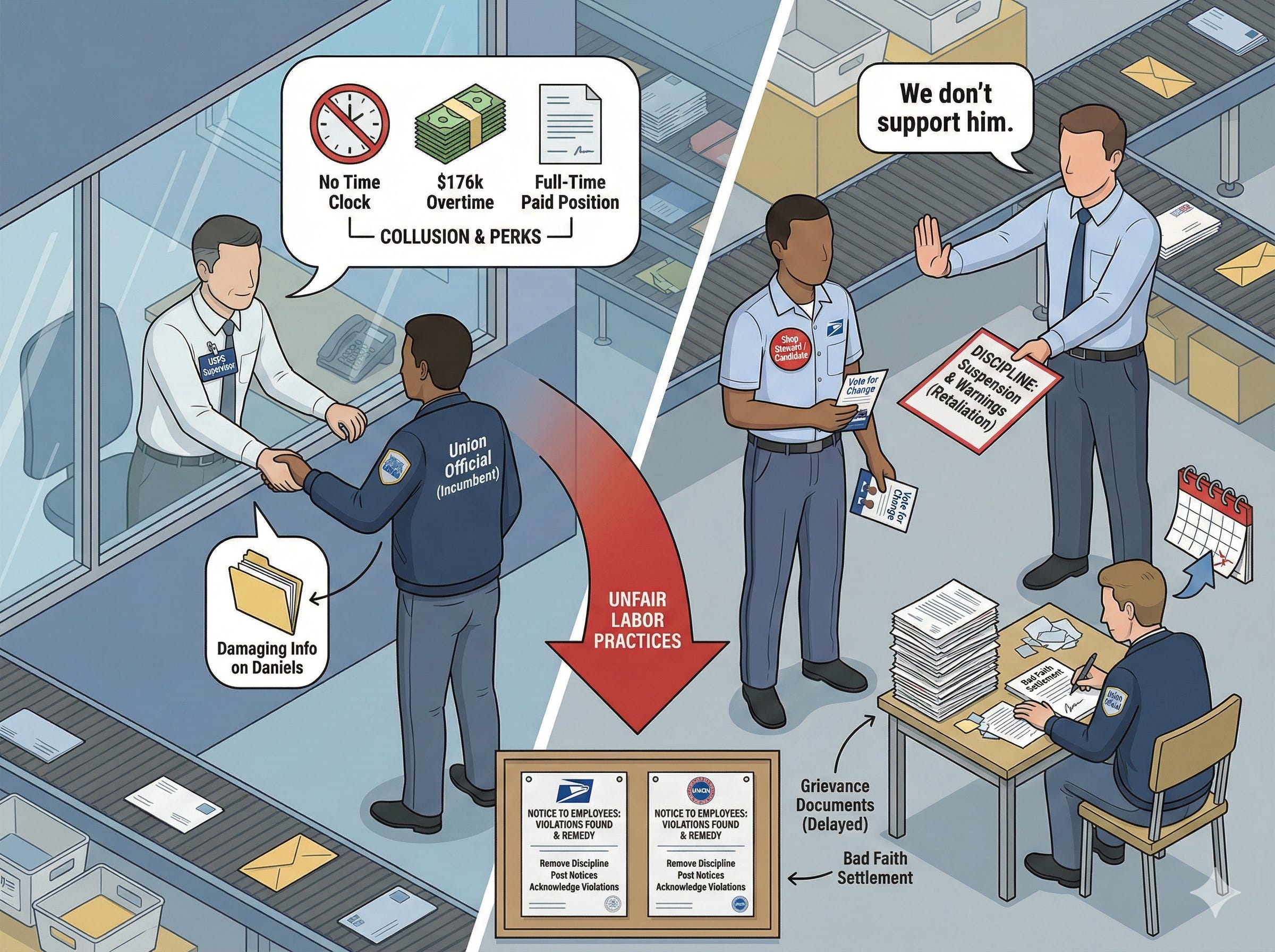
The National Labor Relations Board found that both the USPS and Letter Carriers Union Branch 642 committed unfair labor practices against postal worker Terry Daniels, who served as a shop steward and ran for union president.
Key Facts: Daniels was removed as shop steward in June 2020 after USPS supervisors provided damaging information about him to union officials. In October 2021, he ran for union president against incumbent Dave Negrotti. When Daniels campaigned at other postal facilities on October 30, 2021, arriving late to work, POOM Kenneth Price berated the supervisors who allowed him to campaign, stating “We don’t support him being president.” The USPS disciplined Daniels for tardiness despite not disciplining other regularly tardy employees.
Context: The ALJ found evidence of collusion between USPS management and union president Negrotti, who received favorable treatment including a full-time paid union position, no time clock requirements, and extensive overtime totaling $176,000 annually.
Major Violations Found:
USPS: Issued retaliatory discipline (7-day suspension and two warning letters) for Daniels’ union activities, prohibited him from campaigning, and threatened him with discipline
Union: Delayed providing Daniels his grievance documents for months and processed his suspension grievance in bad faith, with steward Craig Humbarger settling for reduced retention periods without presenting available evidence of disparate treatment
Remedy: The USPS must remove the unlawful disciplines from Daniels’ file and both parties must post notices acknowledging their violations.
Significant Cases Cited
Wright Line, 251 NLRB 1083 (1980): Framework for analyzing discrimination requiring proof of protected activity, employer knowledge, and animus.
Vaca v. Sipes, 386 U.S. 171 (1967): Union breaches duty of fair representation only when conduct is arbitrary, discriminatory, or in bad faith.
Letter Carriers Branch 529, 319 NLRB 879 (1995): Unions violate the Act by arbitrarily refusing to provide employees their grievance documents.
Miranda Fuel Company, 140 NLRB 181 (1962): Established unions’ duty to fairly represent all members in employment matters.
Rossmore House, 269 NLRB 1176 (1984): Set “totality of circumstances” test for evaluating unlawful interrogations.
Prairie State Legal Services, Inc., 25-UC-361402 (Regional Election Decision)
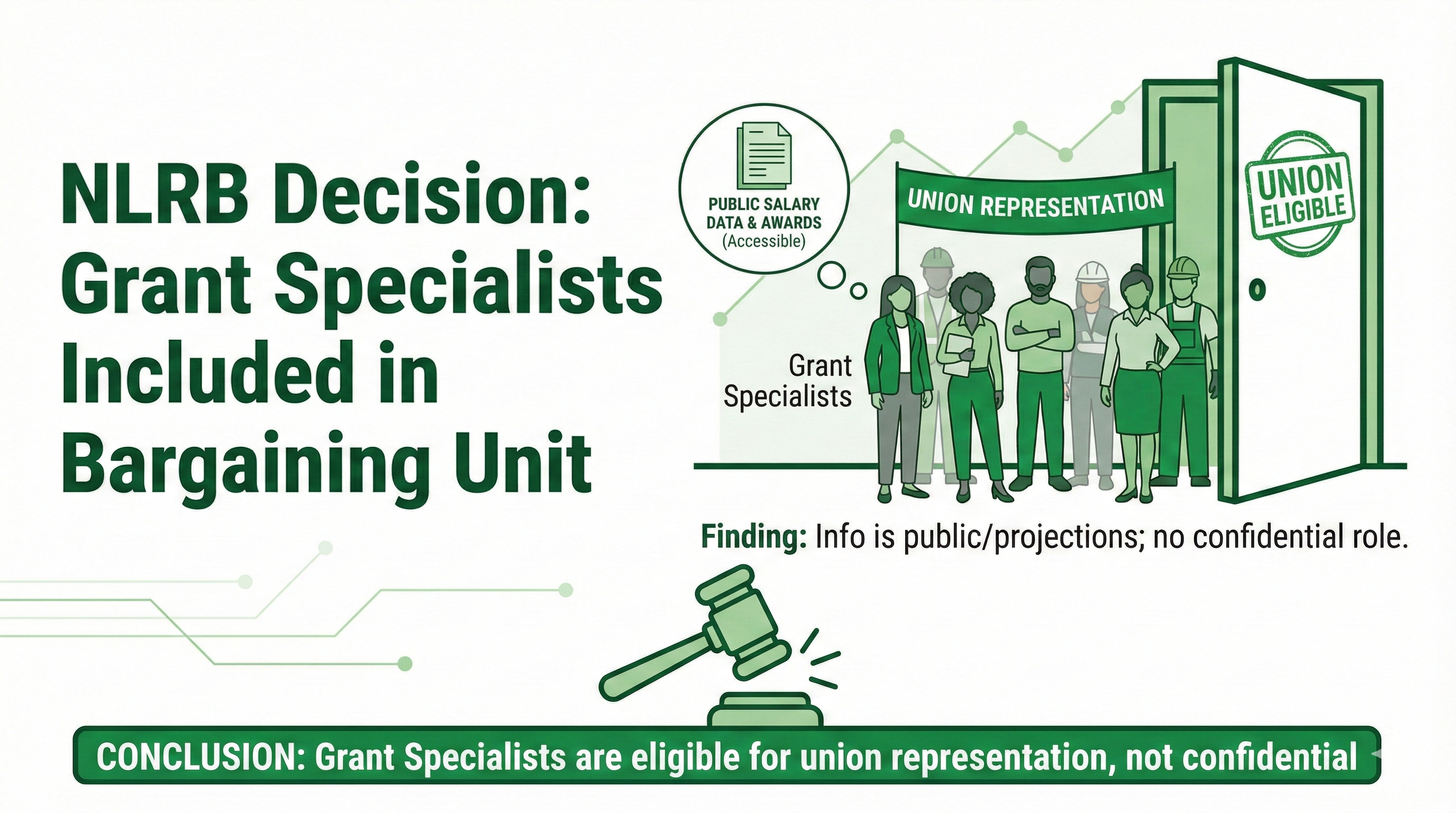
In a decision issued on December 3, 2025, the Regional Director for Region 25 clarified the bargaining unit at Prairie State Legal Services, Inc., ruling that employees in the Grant Specialist and Senior Grant Specialist classifications must be included in the union. The Employer had filed a petition seeking to exclude these workers, arguing they were “confidential employees” because their role in budgeting and applying for grants gave them access to sensitive wage information and labor relations strategies.
The legal analysis focused on the two established standards for determining confidential status: the “labor-nexus” test and the “access” test. Under the labor-nexus test, the Employer argued that Grant Specialists work closely with the Executive Team, which sets labor policy. However, the Regional Director found that while these specialists interact with executives to secure funding, they do not assist in a confidential capacity regarding the formulation or determination of labor relations policies, such as setting specific wage scales. The decision noted that the specialists are only involved after wage policies have effectively been determined by management.
Regarding the access test, the Employer contended that because Grant Specialists draft grant budgets involving staff salaries, they could predict the Employer’s bargaining position. The Regional Director rejected this, applying the standard set in Pullman Standard Division and Washington Post Co.. The decision emphasized that the specialists deal only with “projections and possibilities” regarding funding, rather than the “precise labor rates” the Employer would be willing to accept in a collective-bargaining agreement. Furthermore, the Director observed that the financial information accessed by these specialists—such as grant award amounts and salary scales—was largely public or already accessible to other bargaining unit employees. Consequently, the Grant Specialists were ruled eligible for union representation.
Significant Cases Cited
NLRB v. Hendricks County Rural Electric Corp., 454 U.S. 170 (1981): The Supreme Court decision validating the Board’s two-prong test (labor-nexus and access) for identifying confidential employees who must be excluded from bargaining units.
Pullman Standard Division, 214 NLRB 762 (1974): Established that for an employee to be confidential based on access to information, they must be privy to the precise labor rates an employer is willing to agree to, not just estimates.
Washington Post Co., 254 NLRB 168 (1981): Held that employees who work with budget projections and possibilities are not confidential if they lack access to the precise labor terms the employer intends to accept.
Rhode Island Hospital, 313 NLRB 343 (1993): Ruled that merely compiling budget information or assisting managers who effectuate labor policy does not confer confidential status without involvement in determining labor costs.
B. F. Goodrich Co., 115 NLRB 722 (1956): Defined the “labor-nexus” test, stating that confidential employees are those who assist and act in a confidential capacity to persons who formulate, determine, and effectuate management policies in labor relations.