
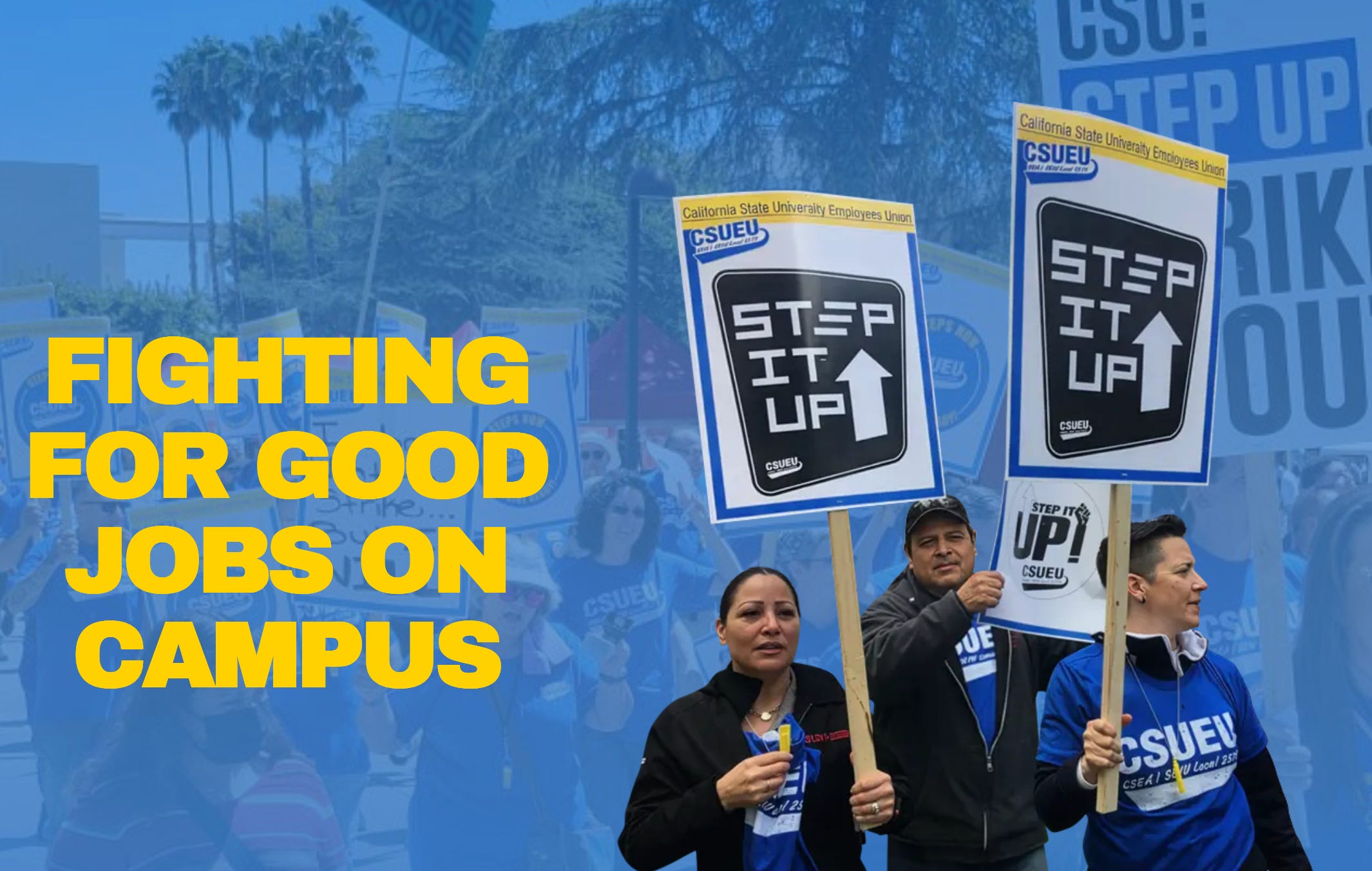
The California State University Employees Union (SEIU Local 2579) represents around 35,000 people employed by the CSU system. The small staff of CSUEU is also unionized and is represented by UAW Local 2350.
As legal counsel for UAW Local 2350, I have watched a bizarre series of events unfold over the last couple of weeks in which a fairly minor dispute about one employee’s probationary period has escalated to the point where the CSUEU staff union (UAW) is being forced to file a federal lawsuit against CSUEU (SEIU). The lawsuit would not resolve the dispute about the probationary period, but would just result in an order compelling CSUEU to arbitrate that dispute, something CSUEU is currently refusing to do.
Having the UAW and SEIU spend potentially tens of thousands of dollars of labor movement money just to get a federal judge to tell CSUEU President Catherine Hutchinson to follow the parties’ collective bargaining agreement and go to arbitration is pretty stupid. Hopefully this post will bring some attention to the issue so that the two unions can avoid that outcome.
Timeline and Background
UAW Local 2350 has a collective bargaining agreement with CSUEU that establishes a one-year probationary period for newly hired exempt employees. During that one-year period, CSUEU is generally free to terminate probationary employees and the staff union is not permitted to grieve the terminations. If CSUEU does not terminate an employee in this period, then the employee exits probation and receives all of the protections of regular employees. Specifically, the contract states that:
Failure to terminate a probationary employee prior to the end of the probationary period shall give the employee permanent status in his/her job classification.
This is fairly standard probationary period language. Indeed, CSUEU’s own collective bargaining agreement with The California State University establishes the same thing for CSU employees. But CSUEU is currently refusing to follow this CBA provision and, more perversely, refusing to even arbitrate a grievance over it.
Here is what is happening:
On January 6, 2025, CSUEU hired a new exempt employee. This hire triggered a one-year probationary period with an end date of January 7, 2026.
On January 6, 2026, CSUEU President Hutchinson sent a letter to this employee stating that “CSUEU is extending your probationary period by 180 days.” The problem with this letter is that the CBA does not permit CSUEU to unilaterally extend the probationary period.
On January 8, 2026, a steward for the staff union filed a step-one grievance with President Hutchinson. The grievance states that “the CBA does not have a procedure for extending the probationary period of UAW employees” and concludes that, because one year has passed without this employee being terminated, this employee “has passed probation and has attained permanent status.”
On April 13, 2026, CSUEU President Hutchinson denied the step-one grievance, stating that this employee’s “probationary period was extended appropriately and in accordance with the Agreement. Her hire date is January 6, 2026, and she was notified of the extension of her probationary period within that timeframe.” The problem, once again, is that the CBA does not permit CSUEU to unilaterally extend the probationary period.
On April 16, 2026, UAW Local 2350 President Nicholas Gleichman filed a step-two grievance with President Hutchinson in which he stated that “The fact that the [probationary] extension was sent within a year is not relevant because there is no provision in the contract that allows management to unilaterally extend probation.”
Also on April 16, 2026, CSUEU President Hutchinson denied the step-two grievance, stating “the grievance is denied as untimely” because it was filed “more than three (3) months” after “the Union knew or reasonably should have known of the matter giving rise to the grievance.”
CSUEU President Hutchinson’s claim that the step-two grievance is “untimely” is clearly incorrect. The relevant part of the CBA states that:
A grievance must be presented in writing within thirty (30) days of when the employee or the Union had learned or may reasonably have been expected to have learned of its cause or within 20 days of receipt of an unfavorable response at Step 1.
In this case, the “unfavorable response at Step 1” occurred on April 13 and the step-two grievance was filed three days later on April 16. In denying the grievance as untimely, CSUEU President Hutchinson appears to simply ignore the bolded part of the provision above.
Thus, on April 16, 2026, UAW Local 2350 President Gleichman sent a response to CSUEU President Hutchinson requesting that she “please go ahead and move this to arbitration.”
On April 21, 2026, I was brought into the fray and reiterated President Gleichman’s request for arbitration and specifically requested “expedited arbitration,” which is an option in the CBA to conduct an arbitration where the arbitrator issues their ruling immediately after the hearing without requiring the parties to file post-hearing briefs.
At this point in the timeline, things were already getting a little bit silly. The CBA clearly does not permit CSUEU to unilaterally extend the probationary period. UAW Local 2350 clearly submitted both its step-one and step-two grievances within the contractual timelines for doing so. CSUEU can resolve all of this in an instant by agreeing to move the employee into permanent status. The only thing UAW Local 2350 could do to resolve it would be to stop pursuing it, but acceding to a situation where an employer can make all new hires probationary for as long as they want would essentially gut the union contract as its protections mostly apply to non-probationary employees.
Refusal to Arbitrate
It would already be a waste of UAW and SEIU money to send this sort of clear-cut dispute to arbitration, but pointless arbitration is not totally unheard of. The reason I am writing this piece is because CSUEU is refusing to even arbitrate the dispute.
On April 22, 2026, outside counsel for CSUEU sent an email stating that:
We received UAW’s arbitration demand. The grievance is not arbitrable. No grievance was presented to CSUEU at the time the employee’s probation was extended. Probationary releases are not grievable. We do not agree to expedited arbitration either.
This bit of text has several problems. A grievance was presented to CSUEU on January 8, two days after the probation was extended on January 6. While it’s true that “probationary releases” are not grievable, CSUEU did not “release” (i.e. fire) the employee. It extended their probationary period. Finally, expedited arbitration is something UAW Local 2350 has a right to. It does not require the agreement of CSUEU.
Beyond these problems though, this email appeared to be saying that CSUEU is refusing to arbitrate the grievance. I was so surprised by this that I asked CSUEU’s counsel to clarify whether this was true and on April 29, 2026, they did so in an email stating that “CSUEU does not agree to arbitrate. UAW abandoned the prior grievance. That matter is closed.”
Of course, this is not how arbitration agreements work. An employer is not permitted to just assert that they believe a union “abandoned the prior grievance” and then get out of arbitration. If that were the case, then arbitration agreements would be meaningless. If CSUEU really believes that UAW Local 2350 did not file their step-two grievance on time, then that is an argument for them to make to an arbitrator.
Of course, CSUEU knows this. As I noted already above, CSUEU’s own contract with The California State University also contains a grievance and arbitration provision and there is no world in which they would permit CSU to simply refuse to arbitrate a grievance by claiming CSUEU abandoned it.
So why is CSUEU acting like this with its own staff union? I don’t know for sure, but the most plausible explanation is that CSUEU President Hutchinson thinks that UAW Local 2350 does not have the resources or willingness to file a Section 301 lawsuit against CSUEU to secure a court order compelling CSUEU into arbitration. This is incorrect as I have been retained to do precisely that.
I guess I should be happy for the work, but I can’t help but think this is actually a tremendous waste of labor movement money. The UAW and SEIU should not send tens of thousands of dollars to outside lawyers (CSUEU has hired a law firm as well) to file papers back and forth in the Eastern District of California until a federal judge orders CSUEU into arbitration. Even arbitrating this dispute is kind of ridiculous. But litigating whether to arbitrate it before arbitrating it is truly insane.
Hopefully, someone will reach out to CSUEU President Hutchinson and talk her down from all this.
It does appear pointless. Food for thought and this may be dual-tracked - Another avenue is to request bargaining over the effects of the decision to changes the terms and conditions of the current CBA (extending the probationary period).