

Section 7 of the NLRA gives workers the right to engage in “concerted activities for the purpose of … mutual aid or protection” while Section 8(a)(1) of the NLRA makes it an unfair labor practice for employers to “interfere with, restrain, or coerce employees in the exercise” of these rights.
In the early 1940s, the NLRB and the Supreme Court established that, by maintaining certain kinds of work rules in company handbooks or employment agreements, employers effectively coerce employees away from engaging in activities that are protected by the NLRA. For example, a work rule banning solicitation makes a worker believe that they are not allowed to solicit people to join a union. A work rule banning disparagement of the company makes a worker believe that they cannot publicly criticize their terms and conditions of employment. And so on.
The precise legal standard for determining whether a work rule is coercive has evolved over the years, but under all such standards, one of the key questions is how a “reasonable worker” would read and react to the rule. If they would read the rule as prohibiting them from doing certain kinds of protected activities and react by refraining from doing so, then the rule is generally considered coercive and maintaining the rule is a violation. If they would not read it this way, then it is generally not considered coercive.
This legal standard raises an obvious question: how do you know whether a particular kind of rule would have this chilling effect on workers who read it?
As with many such questions in law, the answer is that individuals who have spent their entire lives in the legal profession consult their gut feeling about a rule and then declare that a worker would or would not reasonably be coerced by it. In the NLRB process, those consulting their gut in this way include the Board Members, the NLRB General Counsel, and, to a lesser extent, Administrative Law Judges, and Regional Directors.
Of course, to say these legal professionals consult their gut is also a bit naive. For political appointees like the Board members and NLRB General Counsel, they are often just consulting their own policy and ideological views about whether certain work rules should be allowed and then working backwards to assert that “reasonable workers” would or would not be coerced by them.
To see what I am talking about, consider the recent advice memo in the Netflix coercive rules case (Case No. 32-CA-315576). In that memo, the Division of Advice, operating under Acting General Counsel Cowen, directed the Region to dismiss a case brought against confidentiality and media contact rules maintained by Netflix.
Specifically, the memo concludes this about the confidentiality rule:
Applying Stericycle, Inc., 372 NLRB No. 113 (2023), we conclude that the confidentiality provisions are lawful. Although the Protecting Confidential Information section broadly states that “[a]nything you learn . . . and any other information you obtain while working at Netflix” is confidential, a reasonable employee could not interpret the policy, in context, to restrict discussing terms and conditions of employment. Here, employees would reasonably cabin the meaning of confidential information to legitimately confidential business information given the examples provided in that section (“things like marketing and content strategies and materials, product and device technology, financial data, customer data, business plans and strategies and third-party confidential information”) as well as the examples given in the External Communications section (“Revenue,” “Metrics, such as contribution margin, cost per hours,” and “Number of subscribers”). Since employees would reasonably construe confidential information to be limited in this way, we likewise find that the prohibition on “engag[ing] in public discussions, including blogs and other social media, concerning any confidential information obtained while working at Netflix” would not reasonably tend to coerce employees in the exercise of their Section 7 rights.
The memo then concludes this about the media contact rule:
Likewise, we find that the media-contact provisions would not reasonably tend to chill employees from discussing labor disputes or raising concerted concerns about working conditions with the media. Although the External Communications section broadly prohibits employees from “initiat[ing] contact with or answer[ing] questions about Netflix . . . from the press,” employees would reasonably understand from its context that the policy merely bans speaking with the press about business information on behalf of Netflix.
For both rules, there really is not much more to the argument than an assertion that an employee would not “reasonably” conclude that the rules prohibit them from engaging in protected activity. It is not hard to imagine writing a memo that reaches the exact opposite conclusion by simply asserting that an employee would reasonably conclude that the rules prohibit them from engaging in protected activity. Indeed, if General Counsel Abruzzo was in charge when this issue came to the Division of Advice, that is exactly what this memo would have said despite nominally applying the exact same Stericycle standard.
But how do regular people actually read these rules? Is there some way of getting information about that question other than having GC Cowen or GC Abruzzo consult their gut or political ideology about it? To my mind, the answer to the second question is clearly yes. If you want to know how regular people read these rules, you can present them to a representative sample of the population and ask them whether such rules would make them less likely to engage in protected activity.
Last month, I asked Blue Rose Research to do precisely this by conducting a nationally-representative poll about the Netflix rules contained in this case. Contrary to the conclusion of the Division of Advice, for both the confidentiality and media contact rules, the majority of those surveyed said that reading the rules would make them less likely to engage in a specific protected activity.
For the Netflix media contact rule, Blue Rose polled this question:
Imagine that you and a coworker have been organizing a union at your workplace. A local newspaper reporter contacts you and asks you questions about the union organizing drive, how much workers are paid, and how workers are treated by the company. You want to talk to the reporter but, before doing so, you check your employee handbook and see that it has the following rule in it:
“You should not initiate contact with or answer questions about the Company or its business from the press, financial analysts, institutional stockholders, stockbrokers, market researchers, or individual investors. Any inquiries from the media or investors should be referred to the Company Public Relations or Investor Relations teams.”
How would reading this rule change your decision about whether to talk to the reporter?
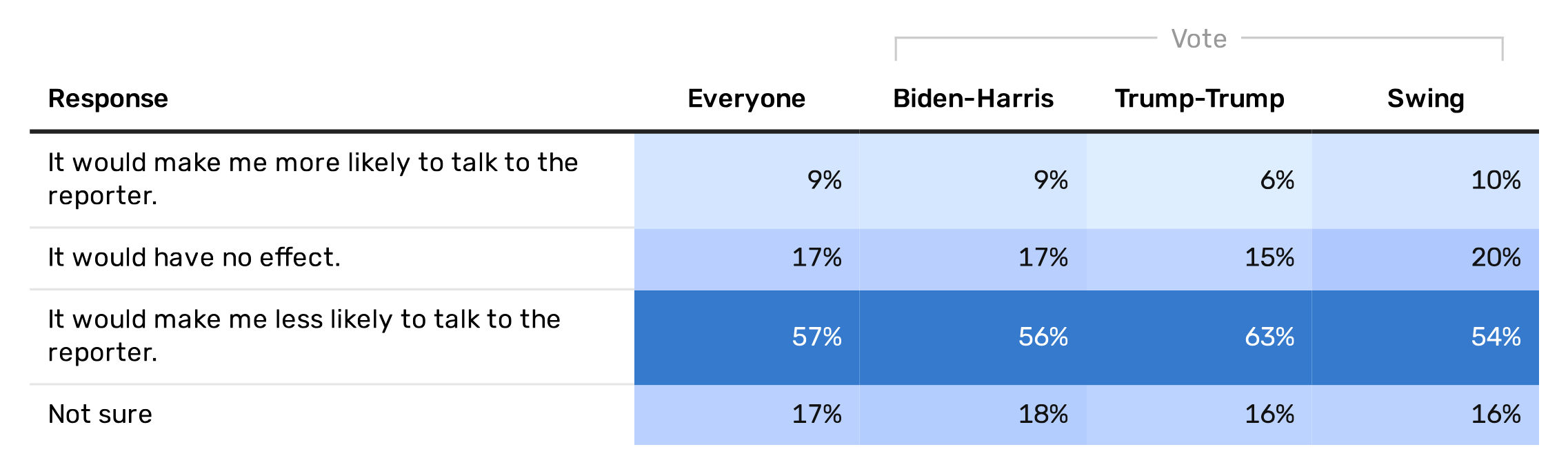
Overall, 57 percent said that it would make them “less likely to talk to the reporter” while just 26 percent said that it would make them “more likely” or that it would have “no effect.” Notably, these percentages hold across the ideological spectrum. In fact, individuals who voted for Trump in both of the last two elections actually were more likely to say that the rule would chill their protected activity.
For the Netflix confidentiality rule, Blue Rose polled this question:
Imagine that you and a coworker are considering posting criticisms of the way your employer treats and pays its employees on your social media accounts. Before doing so, you check your employee handbook and see that it has the following rule in it:
“Employees are entrusted with information that is not publicly known, including things like marketing and content strategies and materials, product and device technology, financial data, customer data, business plans and strategies and third-party confidential information, to name a few. Anything you learn, invent, write, develop or create and any other information you obtain while working at the Company should remain confidential. It is to be used only in doing your job at the Company.”
How would reading this rule change your decision about whether to post the criticisms?
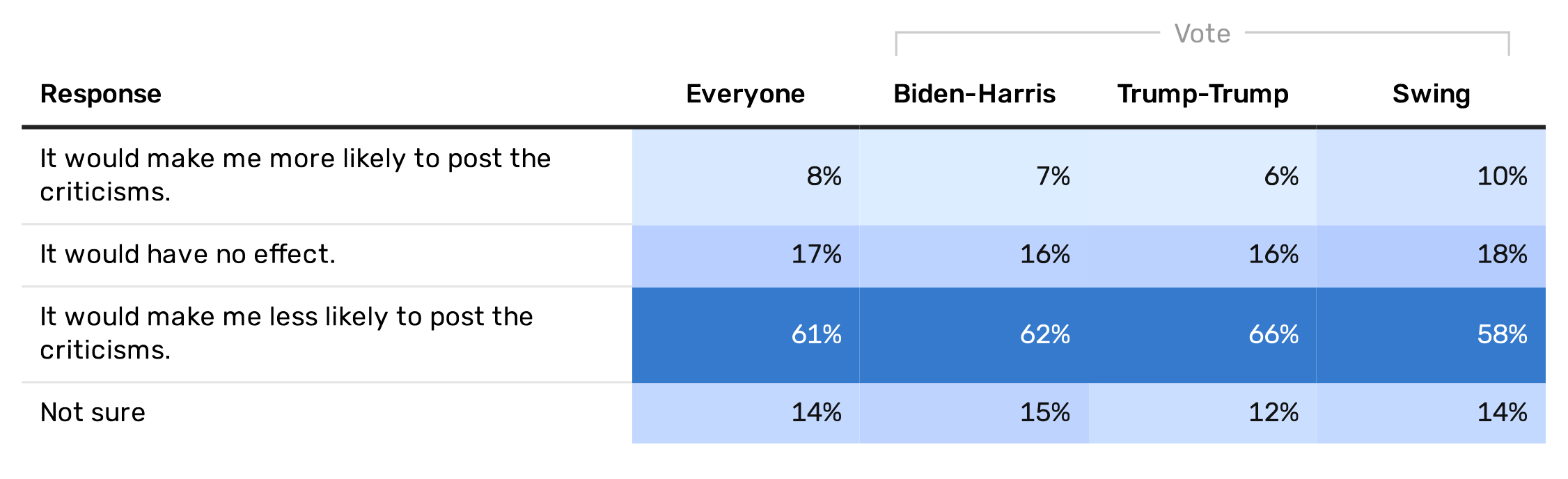
The result was essentially the same as the media contact rule.
To be sure, it would be cumbersome to poll the population for every single coercive rules case. But this does not preclude using surveys like this to generate useful guidance about how the NLRB should approach coercive rules. After all, the vast majority of coercive rules fall into a handful of categories — like non-disparagement, confidentiality, and media contact rules — that the agency could do some baseline polling about. If the goal is to identify which rules truly chill Section 7 activity, empirical survey data is far more reliable than letting the Board’s current political occupants—whether from the AFL-CIO or Jones Day—simply consult their instincts and pepper their conclusions with the word “reasonably.”
The “reasonable person” standard that the law frequently uses makes some small amount of sense when applied by jurors. However, the GC of the NLRB might be person least equipped in the entire world to assess what a reasonable person would understand some workplace rule to mean.
Thank you, this is a simple and brilliant disassembly of this construct.