
In 2023, the NLRB issued the Stericycle decision, which established the current test for determining whether employer rules — such as those contained in handbooks and employment agreements — violate the NLRA.
The two-step Stericycle test works as follows:
I. The General Counsel’s Initial Burden
The General Counsel must first prove that a challenged work rule has a reasonable tendency to chill employees from exercising their Section 7 rights (Section 7 rights refers to the rights of employees to organize and act together to improve their working conditions).
Perspective of the Reasonable Employee: The rule is interpreted from the objective viewpoint of an employee who is subject to the rule and economically dependent on the employer.
Inclination to Interpret Ambiguity: This reasonable employee is inclined to interpret an ambiguous rule to prohibit protected activity she would otherwise engage in.
Layperson Standard: The rule is interpreted as a layperson would, rather than a lawyer.
Presumption of Unlawfulness: If the General Counsel meets this burden, the rule is deemed presumptively unlawful, even if a noncoercive interpretation is also reasonable or if the employer did not intend for the rule to restrict Section 7 rights.
II. The Employer’s Rebuttal Burden
Once a rule is found presumptively unlawful, the employer may rebut that presumption by proving two separate elements:
Legitimate and Substantial Business Interest: The rule advances a specific business need.
Narrowly Tailored Rule: The employer must prove it is unable to advance that legitimate interest with a more narrowly tailored rule that would have a lesser impact on Section 7 rights.
In the 2.5 years since Stericycle was decided, there have been no Board decisions applying the test, but there have been 59 Administrative Law Judge decisions applying the test.
Over the weekend, I used Claude Code and Google Gemini to go through these decisions, pull out the exact text of any rule that was analyzed, determine whether the rule was held to violate the NLRA or not, and then provide a one sentence summary of the reasoning the judge used to reach their conclusion. I also used the LLMs to create rule categories — sixteen in total — and to assign each of the rules to a specific category. I reviewed the results and made a few changes to the LLM output.
I compiled the results of all of this into a PDF file, which I have attached below.
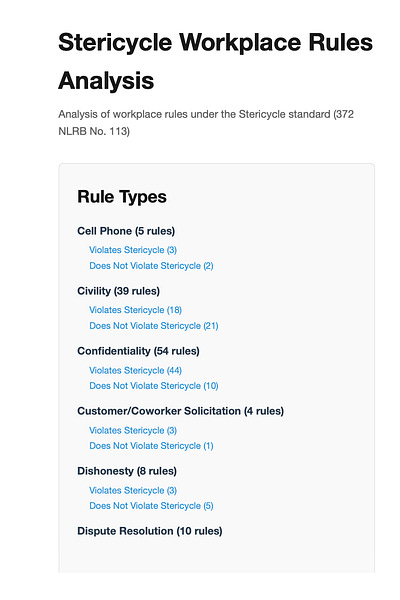
All 204 rules were sorted into one of the sixteen rule types and then further sorted into violating and non-violating rules. The table of contents makes it easy to jump to a specific rule type in the document and see all the rules that have been analyzed of that type. Each rule is neatly displayed in a card format featuring the case citation, rule text, and reasoning. If you click the citation, it will take you to that case in the NLRB Law database. See below for an example.
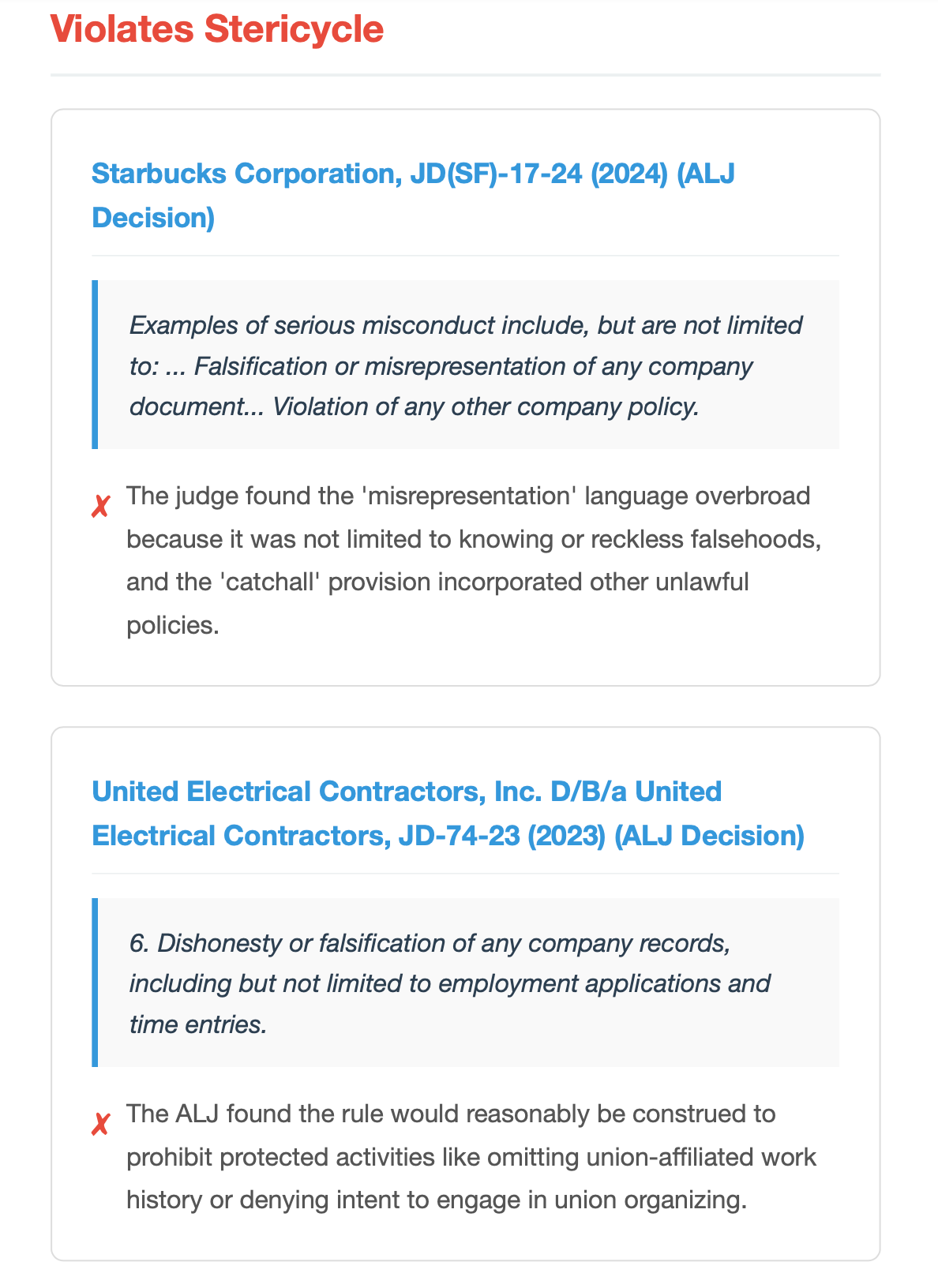
This should be helpful for those who want to determine whether the rules contained in a handbook or employment agreement may violate the NLRA.