
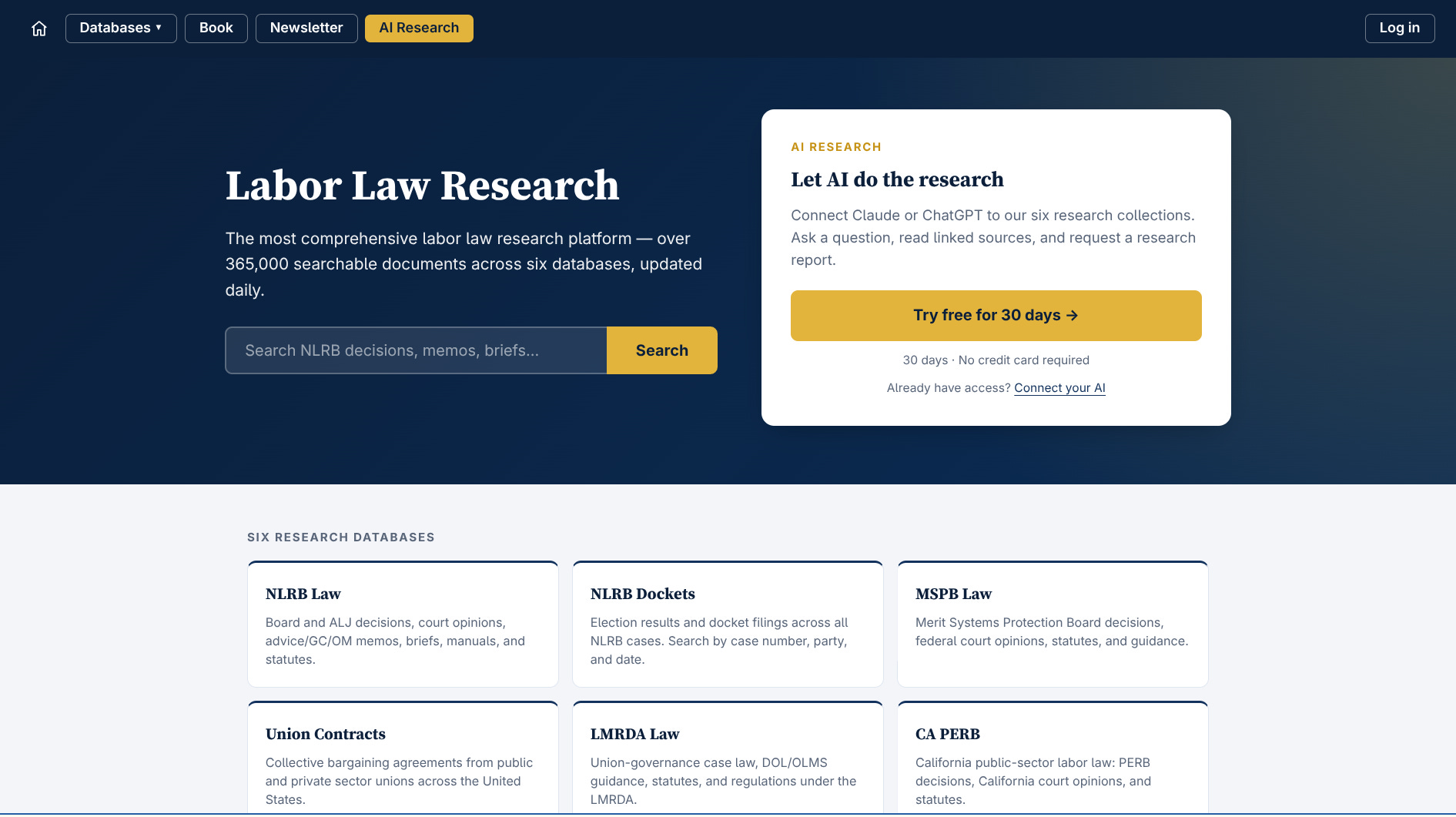
Earlier this year, I began offering free trials and paid subscriptions to a set of tools that allowed AI harnesses and models to answer labor law questions by agentically searching through some of the databases I maintain as part of my NLRB Research project. In the last month, I have majorly overhauled these tools, making them much easier to use while adding to their functionality.
If you are interested in trying these tools, follow these steps:
Sign up for a free trial on the NLRB Research website.
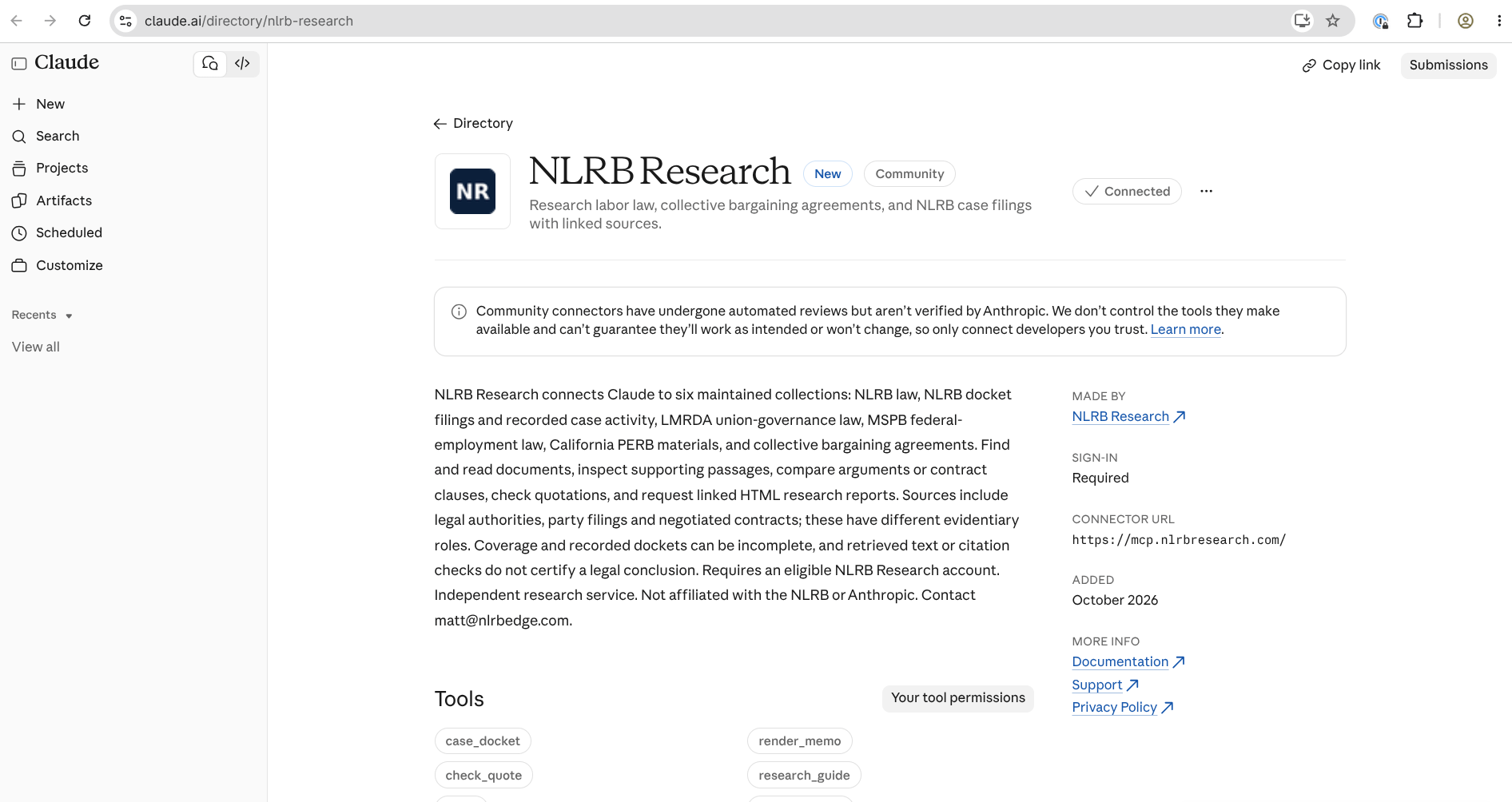
After you receive an email approving you for a trial, follow the instructions for adding the NLRB Research MCP connector to Claude, ChatGPT, or other AI harnesses. If you use Claude, as I recommend, all you have to do is go to the NLRB Research page in the Claude connector directory, click “Connect to Claude” and then input your email and one-time code to authenticate yourself.
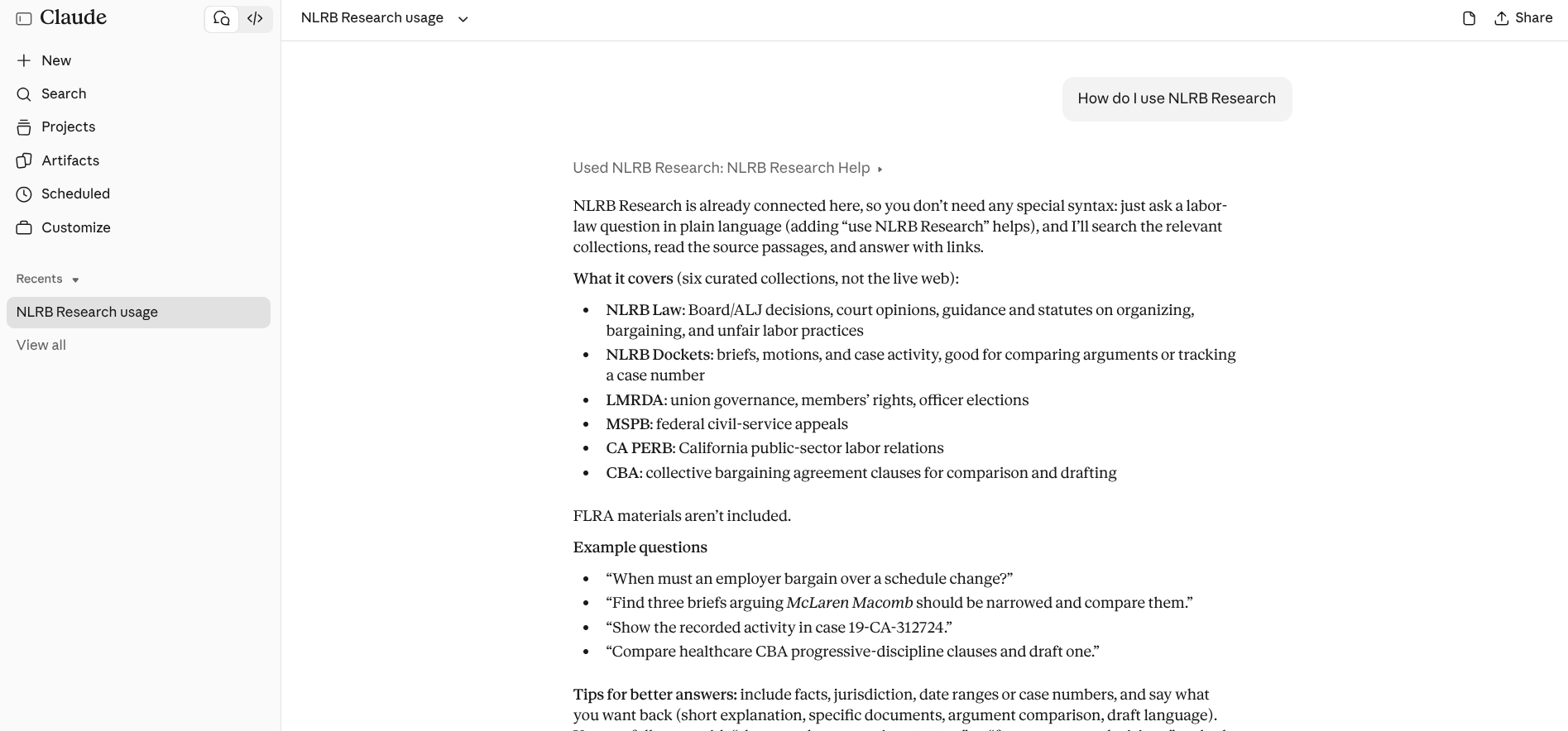
Once the NLRB Research connector is added, you can type “How do I use NLRB Research?” into your AI harnesses for a short description of its functionality.
I made the following YouTube video walking through how to connect it and some examples of how to use it.
Technical Details
The earlier version of these AI tools took the form of five AI Skill files that users had to install into their preferred AI harness. At the time, I was of the mind that AI Skills were the best way to extend the functionality of an AI harness in this way. But more recently, I became convinced that I should instead use a Model Context Protocol (MCP) server approach.
Because of this and other changes, the new AI tool has a number of advantages over the older one:
It is a single unified tool rather than five different Skill files. This makes it easier to install and also allows your AI harness to determine which of the NLRB Research databases is the best one to search rather than making the user decide that upfront by selecting which of the five Skills to invoke. It also allows the AI harnesses to hit multiple databases to answer a question, not just one.
I added access to the NLRB dockets database for the first time. This database contains every docket entry for every NLRB docket from 2010 to present, including over 200,000 files that have been made publicly available on NLRB dockets. This database is a treasure trove for practitioners because it contains examples of basically every kind of document you might ever want to file at the agency. The database is also useful for keeping tabs on what sort of positions the General Counsel is taking, e.g. what sorts of precedents she is seeking to overturn in briefs she files at the Board.
The NLRB Law database now returns page numbers to the AI harness during search. This makes it much more functional as a citation generator and citation checker.
I can update this new tool any time with improvements and those improvements become immediately available to anyone using the tool. Users no longer have to uninstall and reinstall Skill files every time I update them with improvements.
The new tool is not singularly focused on generating research memos like the old Skill files were. The old research memos are still available (you can prompt it with “produce this information as a memo using render_memo” to get one), but the new tool defaults to the more familiar chat-like interface of these AI harnesses. The upside of this is that you can use the tool to get quick answers in the chat interface rather than having to wait several minutes for a full-blown research memo each time. If you ever want more elaboration or more citations on a specific question, you can just send another prompt saying that, and it will do that too.
Related to (5), because the tool is no longer so focused on generating research memos, it is much easier to integrate it into agentic workflows. So people who are using AI, not just in a browser chatbot, but also on their desktop to assist with things like writing and editing documents will find that to be much easier than it was before.
If you have not yet tried out these tools, I really recommend signing up for a free trial. It is now easier and more functional than it has ever been. Legal practitioners, union staffers, and even rank-and-file workers should find it very helpful.