

There are four documents today. The first outlines the new docketing process for unfair labor practice charges. The next three involve cases, an Administrative Law Judge case in which Harvard University illegally failed to provide requested information to the union, a Regional Election Decision in which an employer failed to force an election for a five-facility unit, and an Advice Memo finding that a computer use policy did not violate the NLRA.
New Agency Wide Docketing Protocol, GC 26-01, (GC Memo)
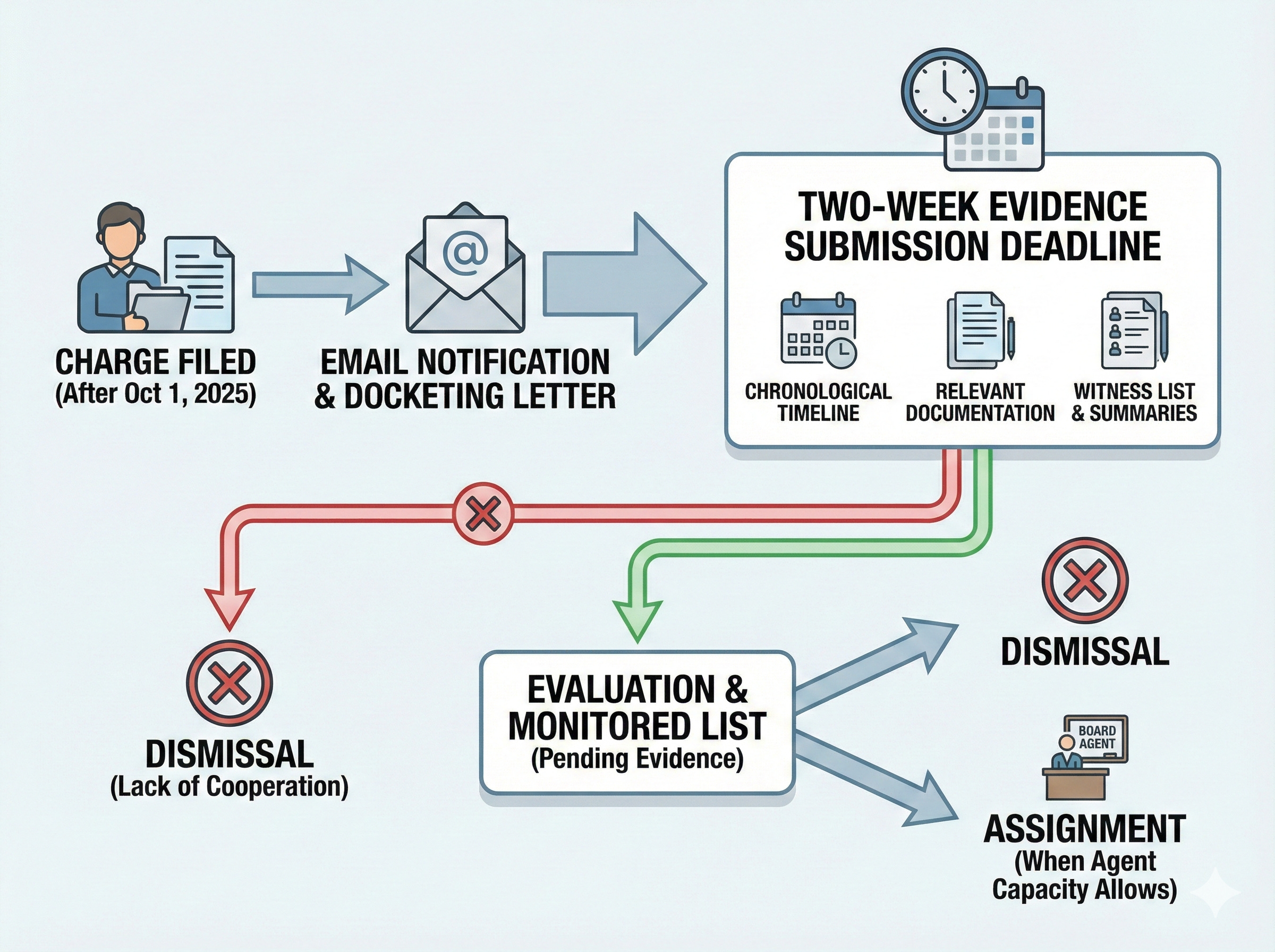
The NLRB’s Acting General Counsel issued new agency-wide procedures for processing unfair labor practice charges filed after October 1, 2025, in response to case backlogs exacerbated by a 43-day government shutdown and declining regional office staffing levels.
Under the new protocol, charging parties must submit substantial evidence within two weeks of filing. This includes a chronological timeline of events with names and titles of involved parties, all relevant documentation including communications, and a witness list with contact information and testimony summaries. Regional offices may substitute questionnaires for the timeline requirement. The docketing letter will be sent via email to ensure charging parties have adequate time to respond, and will include contact information for questions. Failure to provide requested evidence or respond by the deadline may result in charge dismissal for lack of cooperation.
The new procedures significantly alter case assignment practices. Most charges—excluding statutory priority matters and those related to existing cases—will not be immediately assigned to a Board agent upon filing. Instead, charges will remain on a monitored list pending the charging party’s initial evidence submission. After submission and evaluation, the region determines whether assignment or dismissal is appropriate. Even charges deemed suitable for investigation will only be assigned when a Board agent has sufficient capacity for timely investigation; otherwise, they remain unassigned until capacity becomes available.
President and Fellows of Harvard College (Harvard University), JD-95-25, 01-CA-354044 (ALJ Decision)
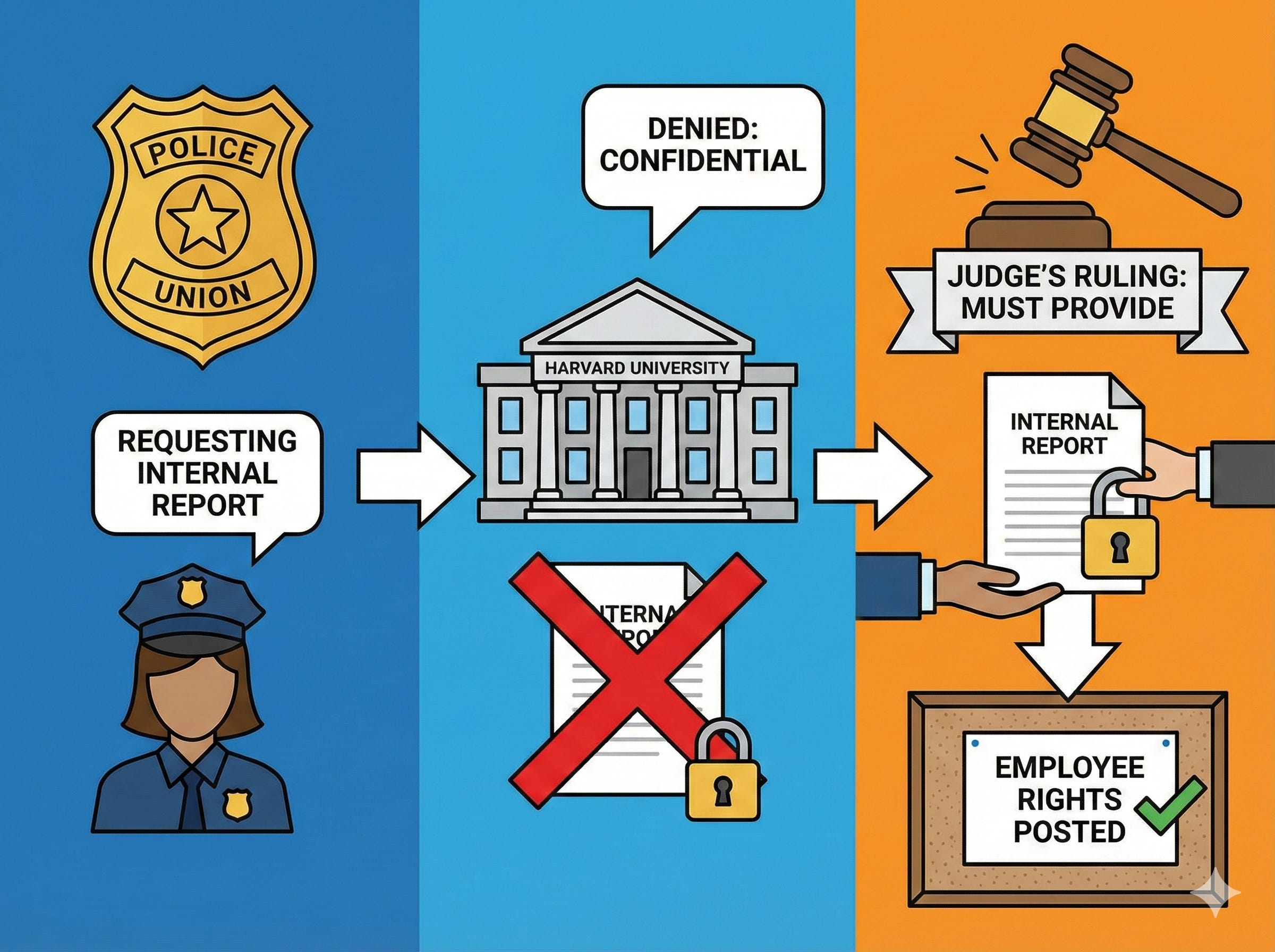
An Administrative Law Judge found Harvard University violated federal labor law by refusing to provide the Harvard University Police Association with an internal investigation report relevant to a sex discrimination complaint filed by a bargaining unit member.
The dispute arose after Harvard hired an outside consultant to investigate Detective Kelsey Whelihan’s handling of a sexual assault case involving students. Whelihan, represented by the police union, filed an internal discrimination complaint alleging her supervisors unduly criticized her work because she is a woman. The union requested a copy of the investigation report three times beginning in January 2024, explaining it needed the document to protect Whelihan’s rights and to evaluate whether to file a grievance under the collective bargaining agreement’s anti-discrimination provisions.
Harvard’s Associate Director of Labor Relations repeatedly denied the requests, claiming the report was confidential and not relevant because the university’s Office of Dispute Resolution did not have access to it. The union offered accommodations, including redacting student identifying information and limiting dissemination, but Harvard never responded to these proposals or offered counterproposals.
The judge determined the report was both presumptively and demonstrably relevant to the union’s representational duties because it concerned a unit employee’s performance evaluation and supervisory oversight. The decision found Harvard failed to prove any legitimate confidentiality interest, noting the official who denied the requests admitted he never actually read the report. Even assuming some confidential student information existed, the union’s proposed accommodations would have adequately protected privacy while allowing access to relevant employment information.
The judge applied established labor law requiring employers to provide unions with information relevant to grievance processing and collective bargaining. Harvard’s claim that the report lacked relevance because internal investigators didn’t possess it was rejected as circular logic—the union specifically wanted the report so it could be presented to those investigators.
Harvard must now immediately provide the complete report to the union and post notices informing employees of their rights.
Significant Cases Cited
NLRB v. Acme Industrial Co., 385 U.S. 432 (1967): Established that an employer’s duty to bargain in good faith includes providing the union with information relevant and necessary for contract administration and grievance investigation.
Northern Indiana Public Service Co., 347 NLRB 210 (2006): Set forth the framework that employers asserting confidentiality must prove a legitimate and substantial interest, and even when proven, must seek accommodations rather than simply refusing disclosure.
Palace Station Hotel & Casino, 368 NLRB No. 148 (2019): Held that parties withholding information on confidentiality grounds forfeit that defense if they fail to offer bargaining over accommodations.
Atlantic Veal and Lamb, LLC, 373 NLRB No. 19 (2024): Clarified that the union’s burden regarding relevance is met when the relevance should have been apparent to the employer under the circumstances.
A-1 Door & Building Solutions, 356 NLRB 499 (2011): Established that parties refusing to supply information on confidentiality grounds have an affirmative duty to seek accommodation, and that such offers must be timely.
Clinica Campesina Family Health Services D/B/a Clinica Family Health & Wellness, 27-RM-369131 (Regional Election Decision)
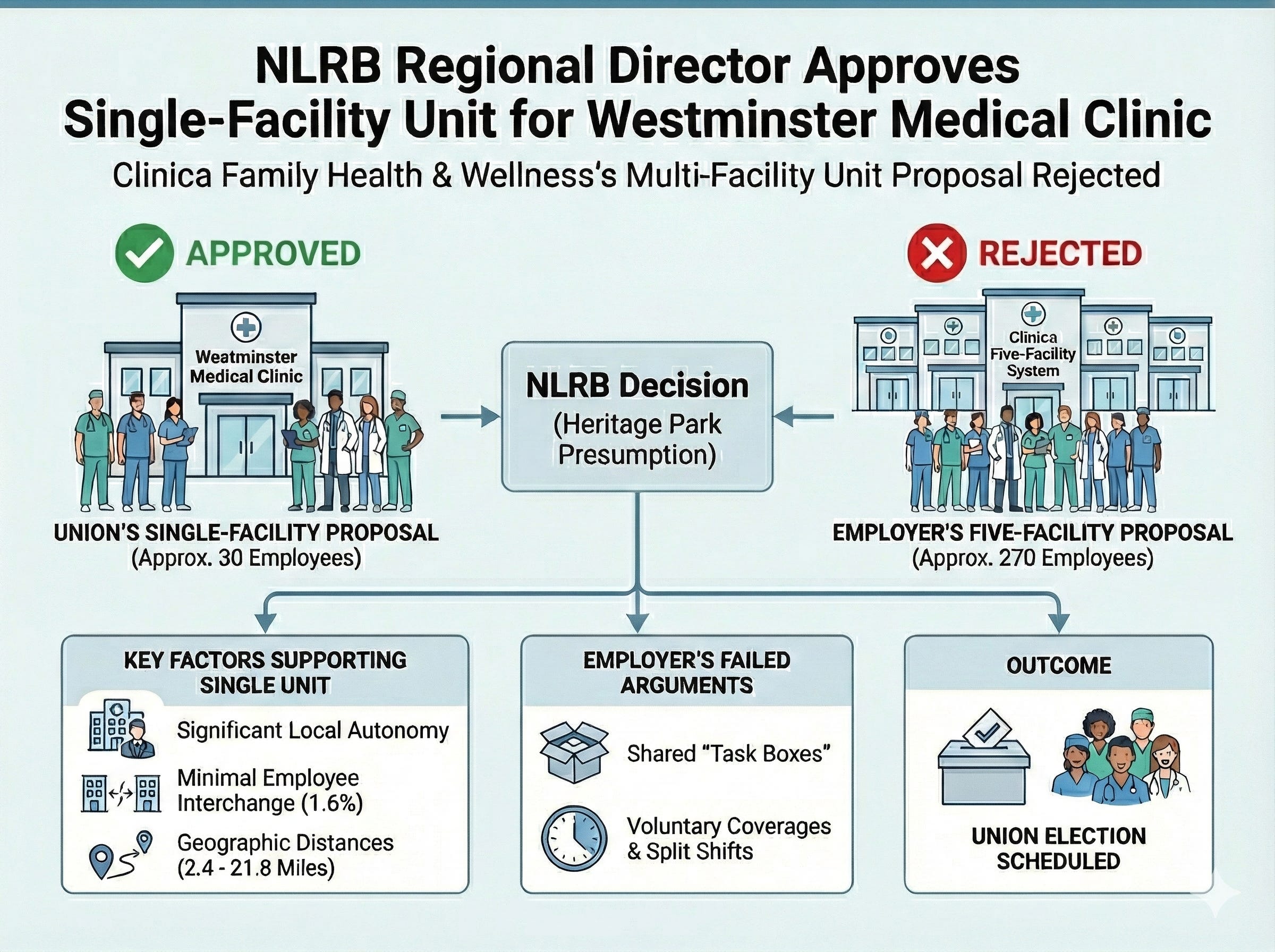
The NLRB Regional Director approved a union election for employees at Clinica Family Health & Wellness’s Westminster Medical Clinic, rejecting the employer’s attempt to require a larger five-facility bargaining unit. The case centered on whether approximately 30 employees at the Westminster location could vote separately, or whether they must be combined with roughly 240 employees from four other clinics.
Applying the Heritage Park presumption that single-facility units are appropriate unless effectively merged or functionally integrated, the Regional Director analyzed six key factors. The decision found that despite some centralized policies, the Westminster Clinic maintains significant local autonomy. Each clinic has its own director responsible for day-to-day operations, local hiring, and discipline, with supervisors reporting directly within their facility.
The employer failed to demonstrate substantial employee interchange. Only 1.6% of work hours involved employees covering shifts at other locations, and all such coverage was voluntary. Permanent transfers were infrequent, voluntary, and sometimes involved non-unit positions. The employer’s evidence of split shifts and shared “task boxes” for patient care proved insufficient, particularly since most task assignments remained within each clinic’s own staff.
The Regional Director found limited functional integration. Patients are assigned to home clinics and generally don’t transfer between facilities. While employees across clinics share similar working conditions, benefits, and training, these commonalities apply to all 14 facilities system-wide, undermining the employer’s argument for grouping only five specific locations. Geographic distances of 2.4 to 21.8 miles between facilities, combined with minimal patient and employee overlap, further supported the single-facility determination.
Significant Cases Cited
Heritage Park Health Care, 324 NLRB 447 (1997): Established that single-facility units are presumptively appropriate unless effectively merged or functionally integrated, with the party opposing bearing a heavy burden of proof.
Mercy Sacramento Hospital, 344 NLRB 790 (2005): Enumerated the six-factor test for determining whether single-facility presumption has been rebutted in healthcare settings.
California Pacific Medical Center, 357 NLRB 197 (2011): Clarified that substantial centralized control over some policies doesn’t negate local autonomy when local supervisors control day-to-day operations and employee grievances.
Passavant Retirement & Health Center, 313 NLRB 1216 (1994): Identified employee interchange and separate supervision as particularly important factors in evaluating single-facility appropriateness.
New Britain Transportation Co., 330 NLRB 397 (1999): Established that voluntary employee interchange receives less weight than mandatory transfers in unit determinations.
Floor and Decor, 05-CA-330890 (Advice Memo)
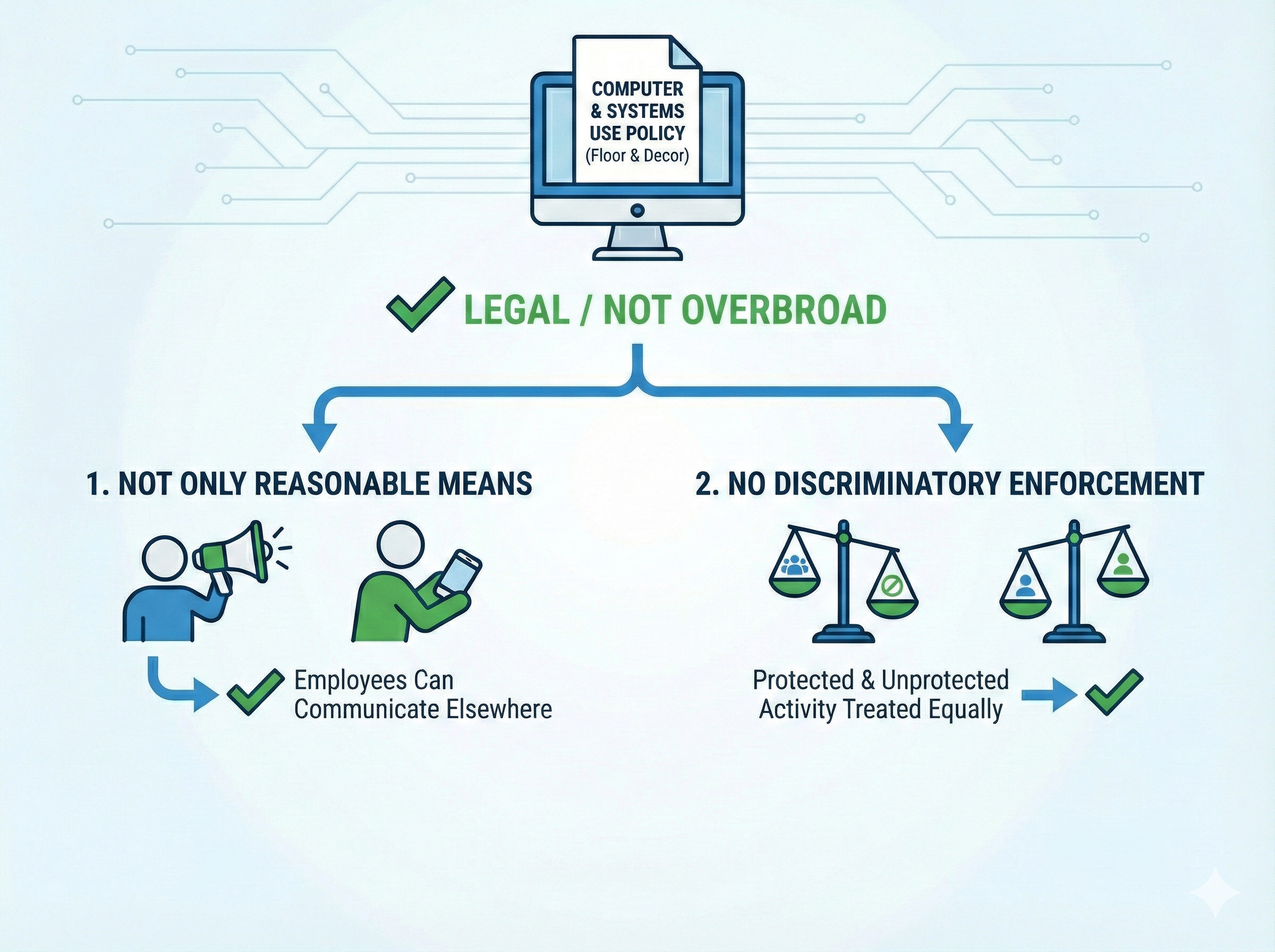
The NLRB’s Division of Advice determined that Floor and Decor’s computer and systems use policy does not violate Section 8(a)(1) of the National Labor Relations Act, concluding the regional office should dismiss the unfair labor practice charge alleging the policy was facially overbroad.
The challenged policy governs employee use of company computer resources, including email, internet access, and software systems. It requires professional and lawful use, prohibits downloading inappropriate or offensive material, restricts unauthorized solicitations, and warns employees that all computer use may be monitored. The policy includes a savings clause stating that nothing should be construed to limit employees’ Section 7 rights to discuss wages, hours, or working conditions.
The legal analysis centered on established precedent governing employer IT systems. Under Rio All-Suites, employees generally have no Section 7 right to use their employer’s IT systems, and employers maintain property rights to control those systems. The Board recognizes only two narrow exceptions: when the employer’s system is the only reasonable means for employee communication, or when discriminatory enforcement is proven.
Since the policy specifically governs computer assets rather than employee conduct generally, the Rio All-Suites framework applied. The Division of Advice found no evidence of discriminatory enforcement and no allegation that the company’s computer system was employees’ only reasonable means of communication. While the policy permits limited personal use, it does not facially distinguish permitted use along Section 7 lines, making it lawful under the Register Guard standard that evaluates whether employers treat similar communications differently based on their Section 7 status.
Significant Cases Cited
Caesars Entertainment d/b/a Rio All-Suites Hotel and Casino, 368 NLRB No. 143 (2019): Established that employees generally have no Section 7 right to use employer IT systems and employers have property rights to control those systems, with limited exceptions.
Register Guard, 351 NLRB 1110 (2007): Set the standard for determining discriminatory treatment of employee communications, requiring employers to treat similar communications disparately based on Section 7 status to establish discrimination.
Pro Residential Services, Inc., 373 NLRB No. 100 (2024): Applied Rio All-Suites framework to find lawful an employer’s rule restricting use of equipment and information technology resources.