

There is one case today, an Administrative Law Judge decision in which an employer illegally interrogated a worker about discussing pay with a coworker and then fired that worker for lying during the interrogation.
Motorola Solutions, Inc., JD-94-25, 27-CA-330814 (ALJ Decision)
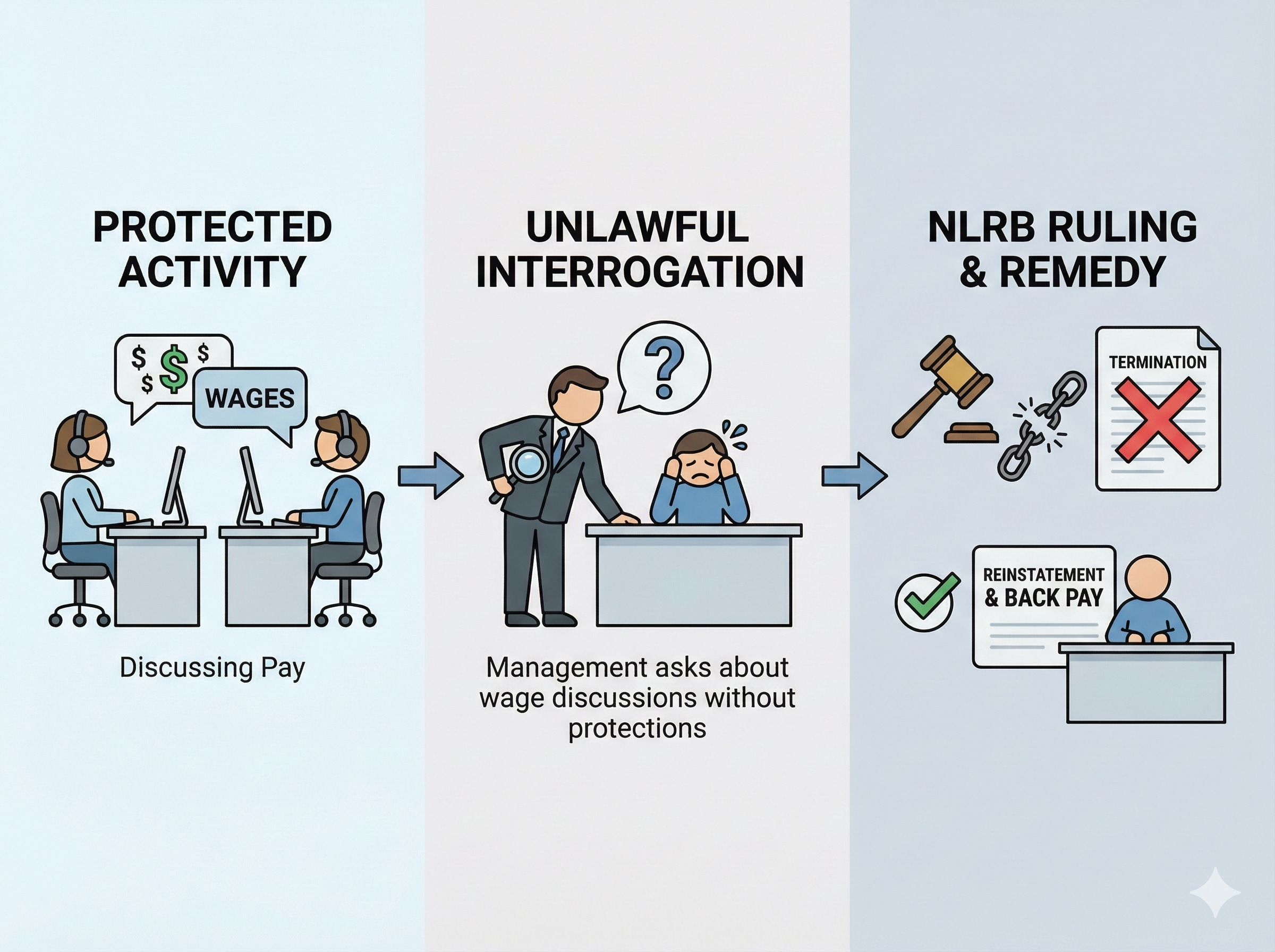
An Administrative Law Judge ruled that Motorola Solutions illegally terminated a remote technical support employee who lied during an investigation into her conversations with coworkers about wages.
In October 2023, Elisa Sheley exchanged messages with colleagues complaining about compensation and discussing that coworker Robert Rivera earned over $70,000 for what she viewed as less demanding work. When Rivera complained about his salary being disclosed, senior manager Tad Johnson investigated, asking employees: “Do you know anything about the sharing of potential pay information of another team member?” Sheley twice denied knowledge, fearing consequences. After colleague Ashley Nicols provided the wage discussion messages to management, Motorola terminated Sheley on November 15, 2023, for “providing untruthful information during a company investigation.”
Judge Charles J. Muhl found multiple violations of Section 8(a)(1) of the National Labor Relations Act. He ruled that Sheley’s wage discussions constituted protected activity under the Act—her conversations with one colleague about their compensation qualified as traditional protected concerted activity, while her comments about Rivera’s salary were “inherently concerted” activity that the Board has long protected because wage discussions are vital to employees and often preliminary to collective action.
The judge found Johnson’s questioning unlawfully coercive under the Bourne factors: he was probing protected activity without providing assurances against reprisal, was a high-level supervisor, and Sheley lied twice out of fear. Critically, applying United Services Automobile Assn. and Spartan Plastics, the judge ruled that because the interrogation was unlawful, Sheley had no obligation to respond truthfully. An employee’s dishonesty about protected conduct cannot serve as lawful grounds for discharge when responding to an unlawful interrogation.
The decision rejected Motorola’s argument that it consistently enforced its lying policy, finding the five prior terminations involved lies about job performance or business operations—not protected concerted activity—making them incomparable. The judge also found HR Manager Brian Sincora violated the Act by instructing Sheley during her termination that employees could not discuss other employees’ wages.
The ruling orders Motorola to reinstate Sheley with full back pay and benefits, compensate her for job search expenses and adverse tax consequences, and expunge references to the discharge from her file.
Significant Cases Cited
United Services Automobile Assn., 340 NLRB 784 (2003): When an employer unlawfully interrogates an employee about protected activity, the employee’s dishonesty in response does not constitute a lawful basis for discharge.
Wright Line, 251 NLRB 1083 (1980): Establishes burden-shifting framework requiring the General Counsel to show protected conduct motivated adverse action, then requiring the employer to prove it would have taken the same action absent the protected conduct.
Spartan Plastics, 269 NLRB 546 (1984): Employees questioned during unlawful interrogations about protected activity are under no obligation to respond, and dishonest responses cannot serve as lawful grounds for discipline.
Meyers Industries (Meyers II), 281 NLRB 882 (1986): Defines concerted activity as including circumstances where individual employees seek to initiate, induce, or prepare for group action or bring group complaints to management.
Rossmore House, 269 NLRB 1176 (1984): Unlawful interrogation is questioning that reasonably tends to restrain, coerce, or interfere with Act rights, analyzed under totality of circumstances using objective standard.