

Today’s roundup consists of just one case. In it, the employee engaged in protected activity, the employer subsequently fired her, but the judge determined that the two were not related to one another and therefore dismissed the retaliation claim.
Reynolds Clinic, JD-91-25, 08-CA-305148 (ALJ Decision)
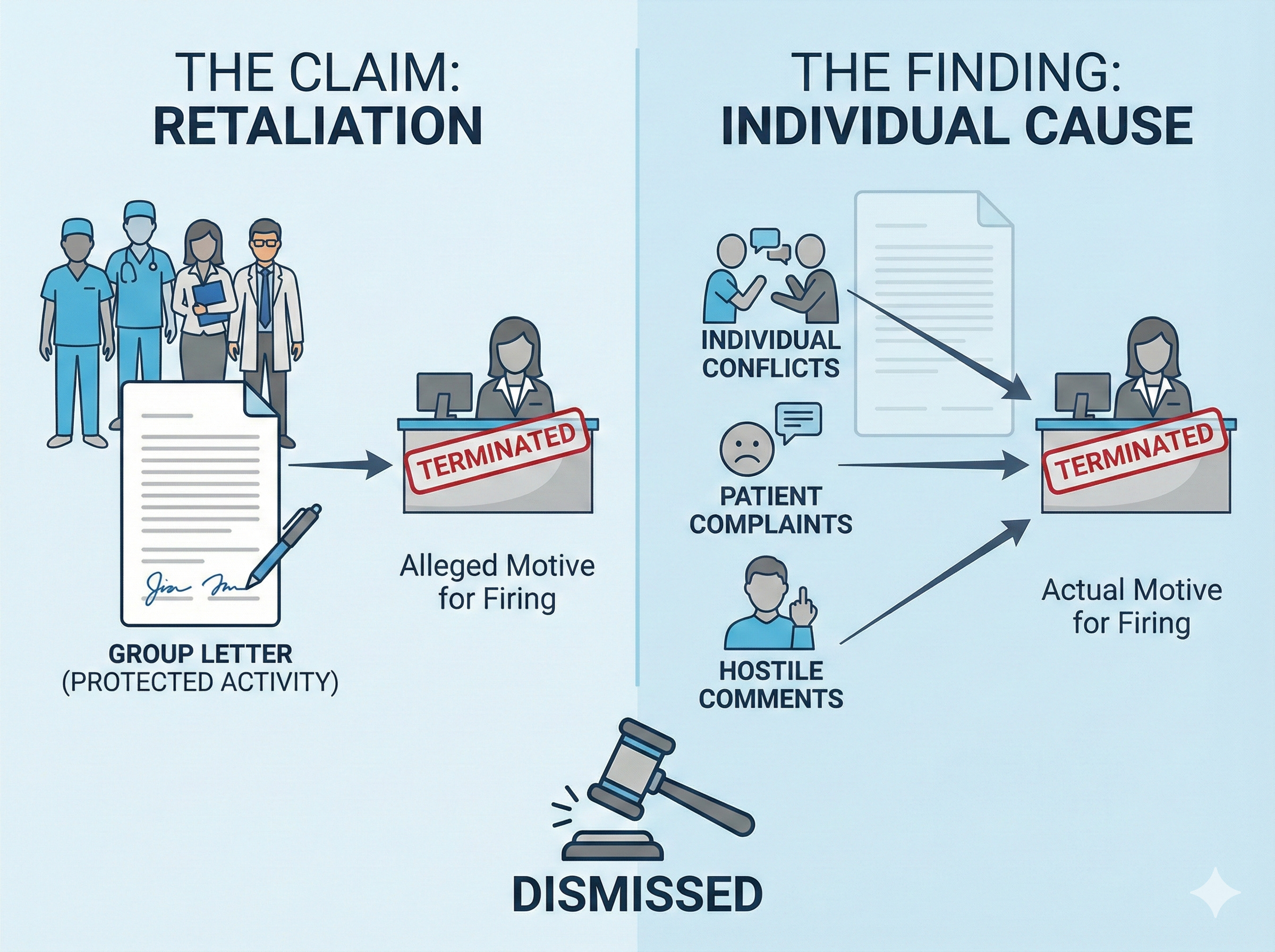
An Administrative Law Judge dismissed an unfair labor practice complaint against Reynolds Clinic, finding insufficient evidence that the employer terminated a medical receptionist in retaliation for protected group activity.
Kaelar Spires worked at the Toledo addiction treatment clinic from January 2021 until her August 2022 termination. The clinic’s owner, Dr. Munir Ahmad, fired Spires following complaints that she had made hostile comments to a recently hired employee, telling the coworker she “didn’t belong” and should find another job. Ahmad characterized this incident as “the straw that broke the camel’s back,” citing a pattern of patient complaints and contentious interactions with another physician at the clinic.
Several months before her discharge, Spires had joined four other employees in signing a collective letter to Ahmad expressing concerns about their treatment by Dr. Mohammed Adas, another physician at the clinic. The employees wrote that they feared losing their jobs and asked Ahmad to address how Adas treated staff. Ahmad had suggested the employees write the letter after they complained to him about Adas.
The ALJ applied the Wright Line framework for discrimination cases, which requires the General Counsel to prove that protected activity motivated the adverse action before the burden shifts to the employer to show it would have taken the same action regardless. While the ALJ acknowledged that signing the group letter constituted protected concerted activity under Section 7 of the National Labor Relations Act, he found the evidence insufficient to establish the required causal connection.
Several factors undermined the retaliation claim. The letter was written at Ahmad’s suggestion and delivered two to three months before the termination. None of the other letter signatories faced adverse employment actions. Additionally, the record showed ongoing friction between Spires and Dr. Adas that extended beyond the letter, including an April 2022 confrontation where Spires threatened to sue Adas. The ALJ found no evidence connecting Spires’ post-letter interactions with Adas to the collective concerns expressed in the group letter, and no evidence that other employees raised additional concerns about Adas after the letter was delivered.
The decision emphasizes that while individual employee actions can qualify as “concerted activity” when they represent a logical outgrowth of group concerns, the General Counsel must still demonstrate the link between the protected activity and the adverse employment action. Here, the ALJ concluded that Spires’ discharge resulted from her individual conflicts with staff and management rather than her participation in the collective letter months earlier.
Significant Cases Cited
Wright Line, 251 NLRB 1083 (1980): Established the burden-shifting framework for discrimination cases where the employer’s motive is disputed, requiring the General Counsel to prove protected activity was a motivating factor before the employer must show it would have acted the same way regardless.
Myers Industries (Myers I), 268 NLRB 493 (1984) and Myers Industries (Myers II), 281 NLRB 882 (1986): Defined “concerted activities” under Section 7 as those engaged in with or on the authority of other employees, not solely by and on behalf of the employee alone.
Mike Yurosek & Son, Inc., 306 NLRB 1037 (1992): Held that individual action qualifies as concerted activity when the concerns expressed are a logical outgrowth of concerns previously expressed by the group.
Hoodview Vending Co., 362 NLRB 690 (2015): Established that the Wright Line test applies to cases involving allegedly discriminatory discipline regardless of whether the employee engaged in union activity or other protected concerted activity.