
There are three cases today, one in which the DC Circuit holds that the removal protections of NLRB Members are unconstitutional, one in which an Administrative Law Judge finds that an employer retaliated against a union supporter, and one in which a Regional Director applies American Steel to reject an employer’s effort to add warehouse workers to a petitioned-for driver unit. The DC Circuit decision has been added to my Timeline of Notable NLRB Events During Trump’s Second Term.
Gwynne A. Wilcox v. Donald J. Trump, 25-5057, (DC Circuit)
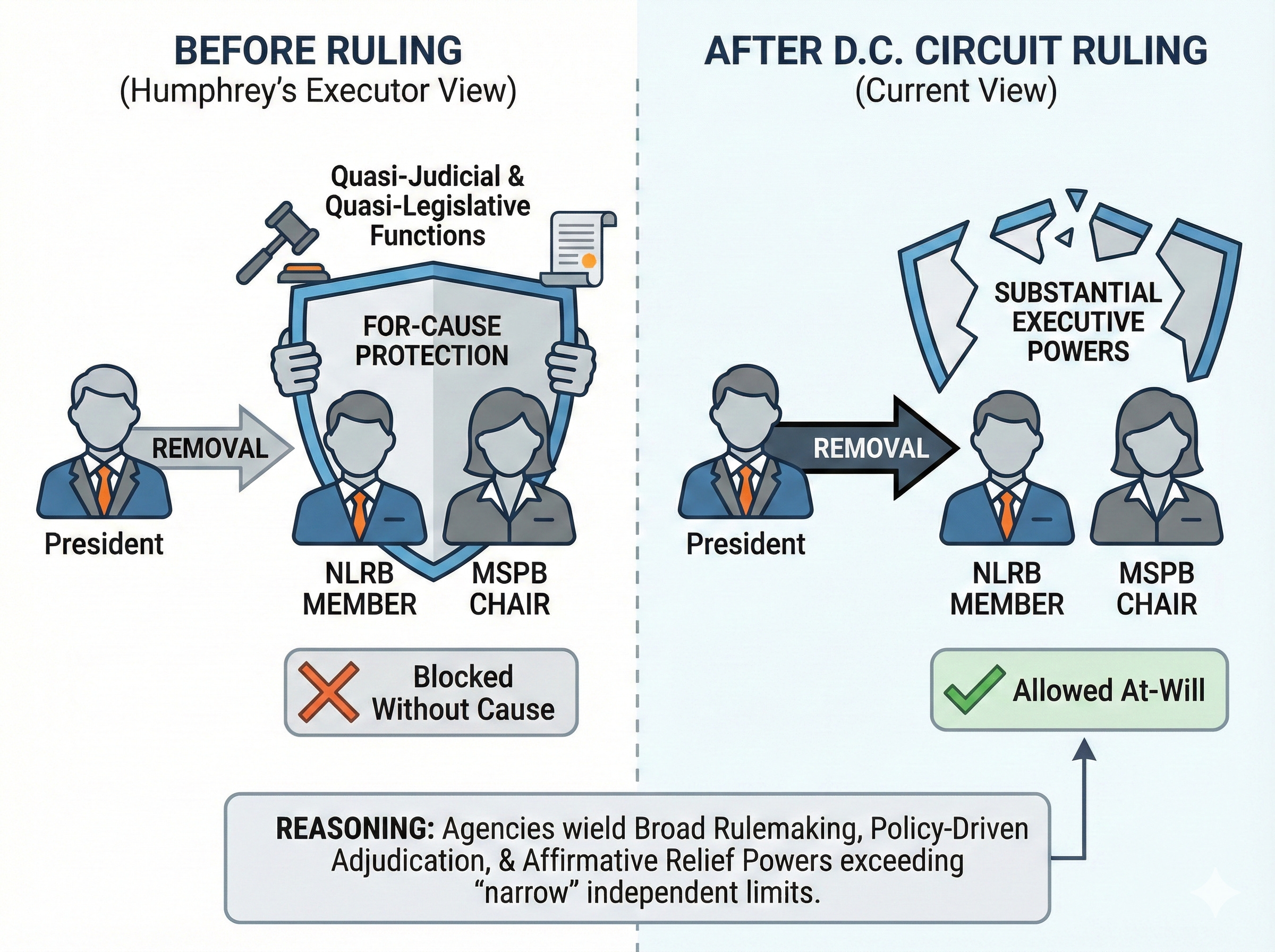
The D.C. Circuit has ruled that statutory for-cause removal protections for members of the National Labor Relations Board and Merit Systems Protection Board are unconstitutional, holding that these agencies wield substantial executive powers exceeding those deemed quasi-legislative or quasi-judicial under Humphrey’s Executor.
The decision reverses district court rulings that had reinstated NLRB Member Gwynne Wilcox and MSPB Chair Cathy Harris after President Trump removed them without cause. Writing for the majority, Judge Katsas explained that Humphrey’s Executor recognized only narrow categories: legislative research functions like investigating and reporting to Congress, and adjudication serving courts or resembling judge-like decision-making without policymaking authority.
The NLRB exceeds these limits through its broad substantive rulemaking authority, its policy-driven adjudications that “develop and apply national labor policy,” its power to award affirmative relief including reinstatement and backpay, and its authority to seek interim relief in district courts. The court noted that the NLRB routinely announces new principles through adjudication based on policy considerations, unlike the impartial, law-bound adjudication contemplated in Humphrey’s Executor.
The majority acknowledged that modern Supreme Court precedents have broadened what counts as executive power, with enforcement, rulemaking, and administrative adjudication all now recognized as executive functions. The court noted that “very little remains of Humphrey’s Executor“ but declined to definitively resolve whether Congress may restrict removal for purely adjudicatory officers or Federal Reserve officials.
Significant Cases Cited
Humphrey’s Executor v. United States, 295 U.S. 602 (1935): Upheld for-cause removal protections for FTC commissioners, establishing that Congress may restrict presidential removal of officers exercising quasi-legislative or quasi-judicial rather than executive powers.
Seila Law LLC v. Consumer Financial Protection Bureau, 591 U.S. 197 (2020): Struck down for-cause removal protection for the CFPB’s single Director, limiting Humphrey’s Executor to multimember expert agencies not wielding substantial executive power.
Myers v. United States, 272 U.S. 52 (1926): Established that the President’s removal power over executive officers derives from the Vesting and Take Care Clauses.
Wiener v. United States, 357 U.S. 349 (1958): Applied Humphrey’s Executor to uphold for-cause removal protection for War Claims Commission members, a purely adjudicatory tribunal.
Free Enterprise Fund v. Public Company Accounting Oversight Board, 561 U.S. 477 (2010): Struck down two layers of for-cause removal protection while declining to revisit Humphrey’s Executor.
Trader Joe’s East, JD-89-25, 09-CA-312856 (ALJ Decision)
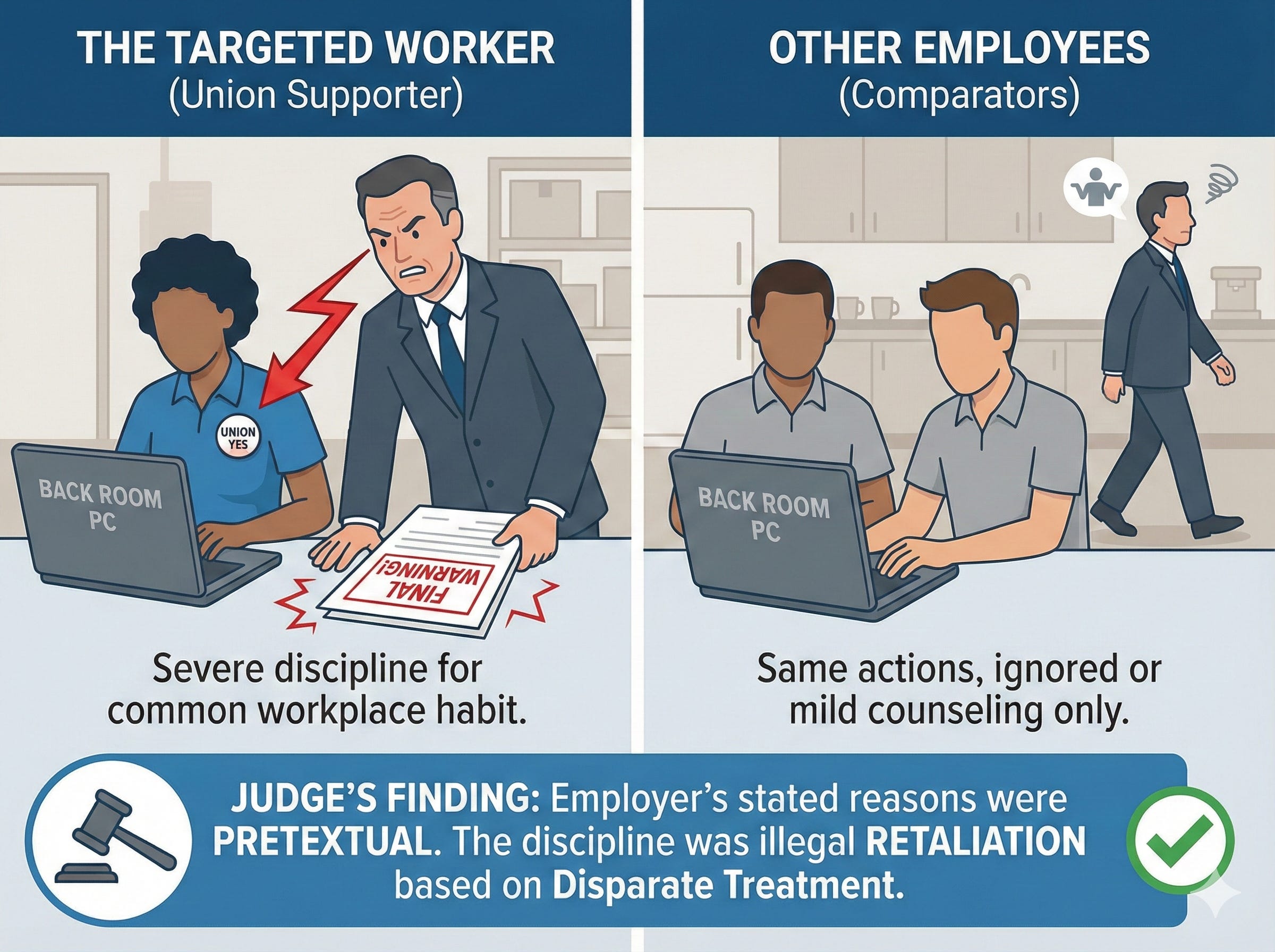
An NLRB Administrative Law Judge ruled that Trader Joe’s East, Inc. violated federal labor law by disciplining employee Zachary Smith in retaliation for his union activities at the Louisville, Kentucky store. The December 5, 2025 decision found the company’s stated reasons for issuing Smith a “final warning” on February 20, 2023 were pretextual.
Smith openly supported Trader Joe’s United, which won a representation election on January 26, 2023. Three weeks later, management issued him a written “final warning” for clocking out using a laptop in the back of the store and for earlier infractions from February 2—clocking in before putting away his jacket and taking an extended break—even though he had already been counseled for those issues.
Judge Sarah Karpinen found the discipline was pretextual based on several factors. There was no established rule prohibiting employees from using time clock applications on back-room computers. Records showed numerous employees, including crew member Patterson who used the back laptop over 60 times, clocked in or out there without consequence. Management only instructed employees to stop using the back laptop after disciplining Smith.
The decision highlighted stark disparate treatment. Patterson was merely counseled when observed using the back laptop, while other employees received multiple counseling sessions for clocking in before putting belongings away without ever receiving written discipline. The use of a “final warning” also deviated from normal practice, with the current store captain testifying he had never used that term.
Applying the Wright Line test, the judge found Smith’s union activity was a motivating factor in the discipline. The timing just weeks after the union election, combined with management’s knowledge of Smith’s union support through his relationship with lead organizer Connor Hovey, supported an inference of anti-union animus. Because the stated reasons were pretextual, Trader Joe’s could not prove it would have taken the same action absent Smith’s protected activities.
Judge Karpinen ordered Trader Joe’s to rescind the incident report, remove all references from Smith’s files, and post notices informing employees of their rights and the Board’s findings.
Significant Cases Cited
Wright Line, 251 NLRB 1083 (1980): Established the burden-shifting framework requiring the General Counsel to show protected activity was a motivating factor, then shifting burden to the employer to prove it would have taken the same action regardless.
Intertape Polymer Corp., 372 NLRB No. 133 (2023): Held that animus may be inferred from circumstantial evidence including timing, disparate treatment, and departures from past practices without requiring direct proof.
Shattuck Denn Mining Corp. v. NLRB, 362 F.2d 466 (9th Cir. 1966): Established that when a stated motive is found false, an unlawful motive may be inferred.
Constellium Rolled Products Ravenswood, LLC, 371 NLRB No. 16 (2021): Disciplining a union supporter while not disciplining others for the same conduct constitutes strong evidence of discriminatory motivation.
Starbucks Corp., 374 NLRB No. 8 (2024): An employer cannot meet its defense burden when evidence shows inconsistent application of disciplinary rules.
FreshPoint Central California, Inc., 32-RC-371171 (Regional Election Decision)
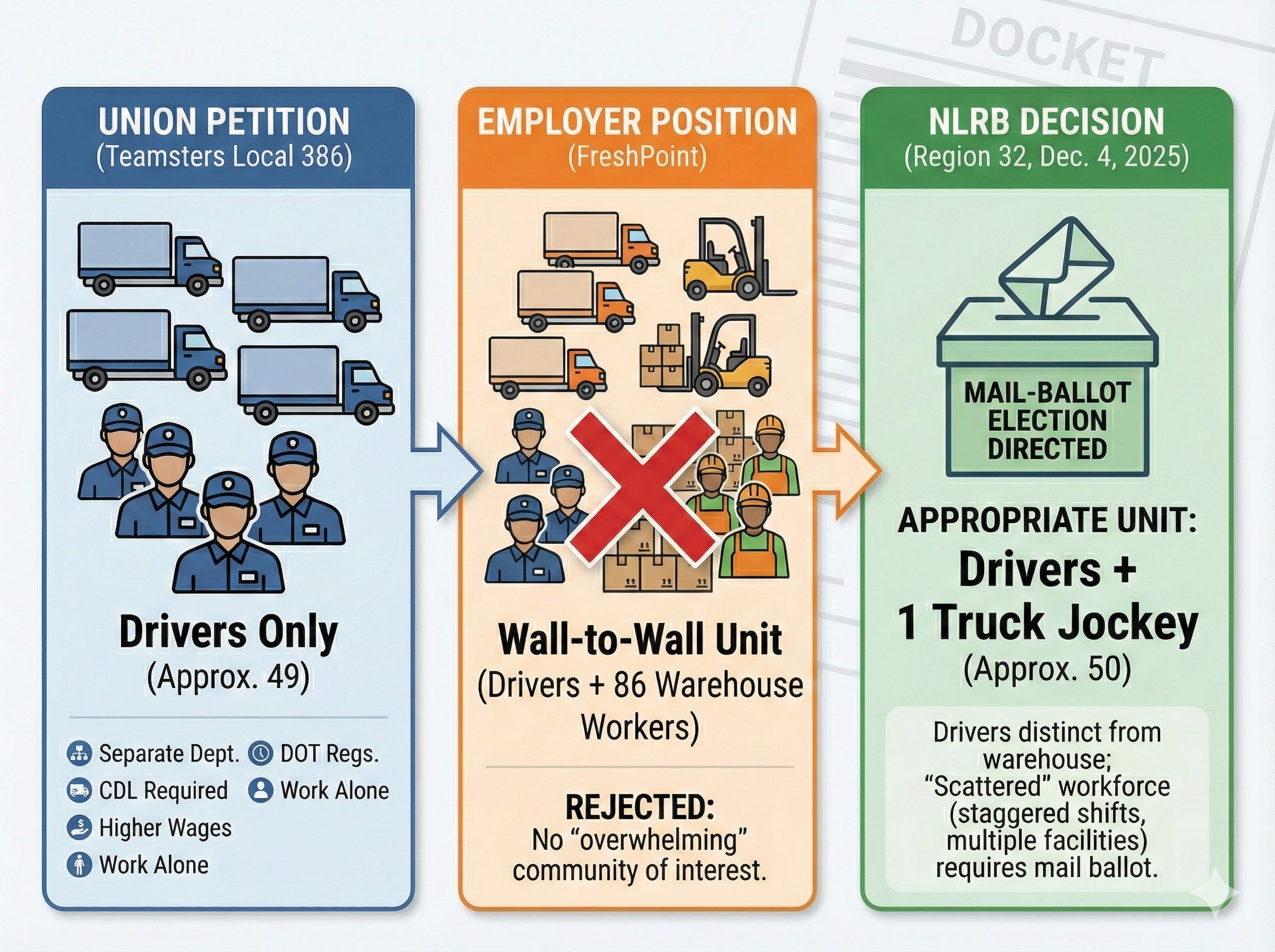
In a December 4, 2025 decision, NLRB Region 32 Director Christy Kwon directed a mail-ballot election for drivers at FreshPoint Central California, largely rejecting the employer’s attempt to expand the bargaining unit to include warehouse workers.
Teamsters Local 386 petitioned to represent approximately 49 drivers in five classifications across FreshPoint’s Turlock, Fresno, and Sacramento facilities. FreshPoint argued the appropriate unit must include 86 additional employees in 23 warehouse and support classifications, creating a nearly “wall-to-wall” unit.
Applying the American Steel framework, the Regional Director found the petitioned-for drivers share sufficient internal community of interest and are sufficiently distinct from warehouse employees to constitute an appropriate unit. Drivers work in a separate Transportation Department under distinct supervision, hold commercial driver’s licenses requiring extensive training, earn higher wages ($23/hour versus $16.50-$18 for warehouse workers), spend most work time driving alone away from facilities, and have work hours regulated by U.S. Department of Transportation rules. They have minimal contact or interchange with warehouse employees and wear distinct uniforms.
While acknowledging functional integration between drivers and warehouse operations, the Regional Director found this insufficient to create an “overwhelming community of interest” requiring warehouse workers’ inclusion. Board precedent including Home Depot and Publix Super Markets supports driver-only units even where some overlapping interests exist.
The decision made one exception: the daytime Truck Jockey must be included because this employee holds a Class A CDL, occasionally fills in as a delivery driver (about every two weeks), works under the same Transportation Department supervision, and is subject to DOT regulations when driving.
The Regional Director ordered a mail-ballot election despite both parties requesting a manual election. Citing San Diego Gas & Electric, the decision found drivers meet the standard for “scattered” employees who lack common presence due to staggered shifts spanning 1:30 a.m. to 5:30 p.m., variable daily hours (10-14 hours), and work across three facilities over 80 miles apart.
The final unit includes approximately 50 eligible voters: all full-time and regular part-time Driver A, Driver B, Driver-Domiciled, Driver-Shuttle, Lead Driver, and Truck Jockey (Day) employees. Ballots will be mailed December 12, 2025, with counting scheduled for January 6, 2026.
Significant Cases Cited
American Steel Construction, Inc., 372 NLRB No. 23 (2022): Established the three-part test for appropriate units and the “overwhelming community of interest” standard for determining whether additional employees must be included.
Home Depot USA, Inc., 331 NLRB 1289 (2000): Found driver-only unit appropriate based on heavily regulated driving work, required credentials, and distinct uniforms despite some overlapping duties with non-drivers.
Publix Super Markets, 343 NLRB 1023 (2004): Held that a union may seek an election in any appropriate driver-only unit.
San Diego Gas & Electric, 325 NLRB 1143 (1998): Established Regional Director discretion to order mail-ballot elections where voters are “scattered” geographically or temporally.
Pacemaker Mobile Homes, 194 NLRB 742 (1972): Recognized that drivers often have “dual community of interest” and that the issue is simply whether the petitioned-for unit is appropriate.