

We have three documents today, one a Fourth Circuit opinion upholding an NLRB decision and the other two ALJ decisions finding unfair labor practices.
Constellis, LLC v. NLRB, 23-1925, (Fourth Circuit)
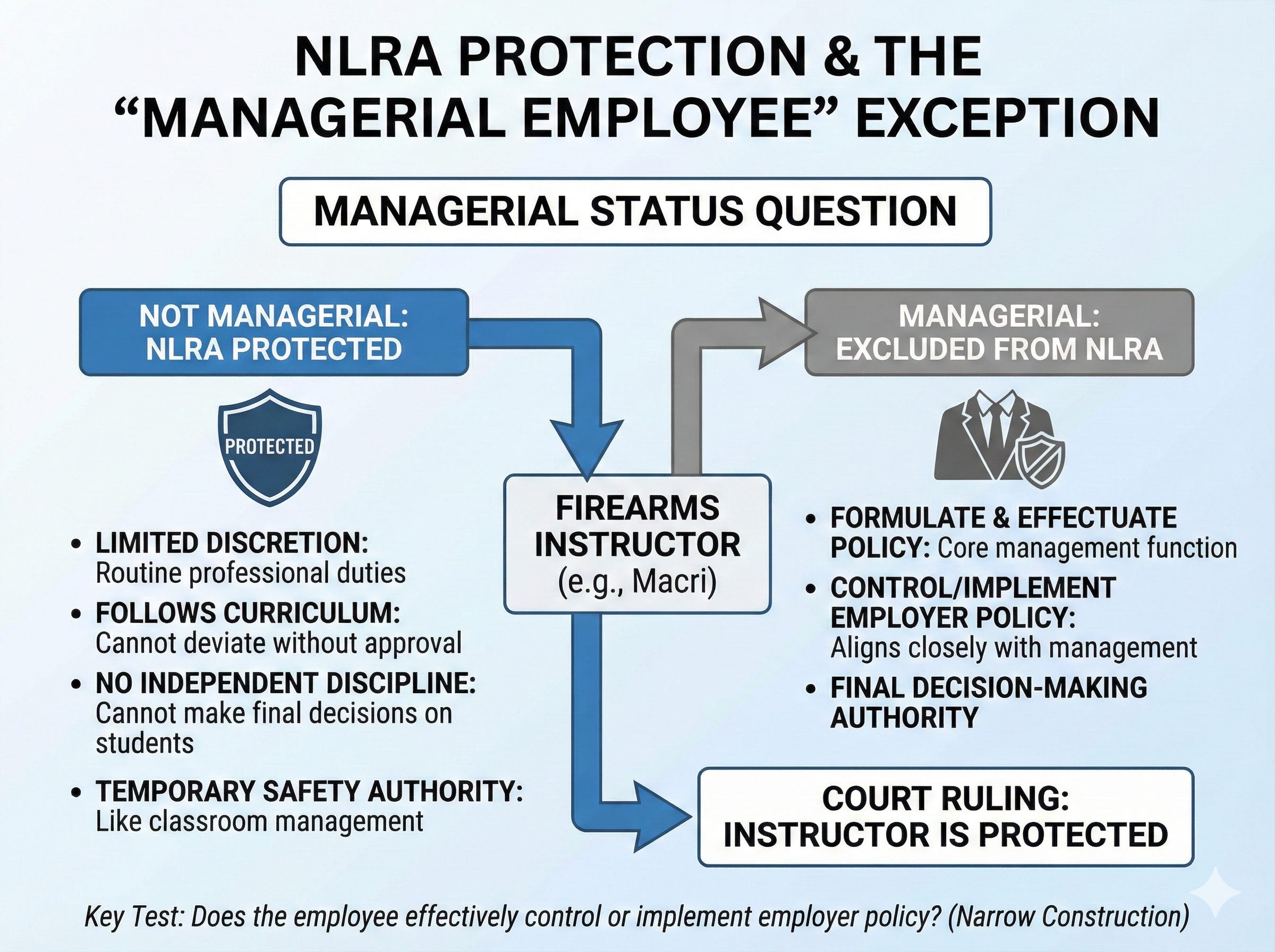
The Fourth Circuit Court of Appeals upheld the National Labor Relations Board’s determination that a firearms instructor who complained about dangerous workplace safety conditions was protected from retaliation.
The case arose when Michael Macri, a firearms and tactics instructor at Constellis, raised concerns about inadequate COVID-19 workplace precautions and, more critically, a severe safety hazard at the company’s firing ranges where bullets were ricocheting back toward shooters. Multiple people had already been struck by bullet fragments when Macri and his colleagues sent management a letter warning that the problem posed “a serious but correctable life hazard” that could lead to “injury or death.” After Macri confronted supervisors about the company’s failure to fix the ricochet problem, raising his voice during the meeting, Constellis suspended and then terminated him, claiming insubordination.
The central legal question was whether Macri qualified as a “managerial employee” who would be excluded from the NLRA’s protections. The Supreme Court established in Bell Aerospace that managerial employees who “formulate and effectuate management policies” fall outside the Act’s coverage, reasoning that Congress viewed such employees as so clearly beyond the statute’s scope that no explicit exclusion was necessary.
The Fourth Circuit, examining this exception for the first time, emphasized it must be construed narrowly to preserve the NLRA’s broad protective sweep. The court explained that employees whose decision-making is limited to routine professional duties don’t qualify as managerial under the standard articulated in Yeshiva University. The key test is whether an employee’s responsibilities align so closely with management that they effectively control or implement employer policy.
Applying this framework, the court found substantial evidence supported the Board’s conclusion that Macri was not managerial. Despite having some discretion - such as temporarily removing students from live firing for safety violations or filing “spot reports” about student misconduct - instructors couldn’t deviate from prescribed curricula without supervisory approval, had no role in student selection, couldn’t independently discipline students, and lacked authority to make final decisions about program enrollment. The court noted that the temporary authority to remove students for safety reasons was particularly crucial in weapons training contexts and resembled the limited classroom management powers of non-managerial teachers rather than true managerial discretion.
Significant Cases Cited
NLRB v. Bell Aerospace Co. Division of Textron, 416 U.S. 267 (1974): Established the managerial employee exception to NLRA coverage for those who formulate and effectuate management policies.
NLRB v. Yeshiva University, 444 U.S. 672 (1980): Clarified that employees whose decision-making is limited to routine professional duties are not managerial employees.
Holly Farms Corp. v. NLRB, 517 U.S. 392 (1996): Held that exemptions from NLRA coverage must not be interpreted so broadly as to deny protection to workers the Act was designed to reach.
Wright Line, 251 NLRB 1083 (1980): Established that to prove retaliation, the NLRB must show protected activity was a substantial or motivating factor in the employer’s adverse action.
Amazon.com Services LLC, JD-86-25, 19-CA-295640 (ALJ Decision)
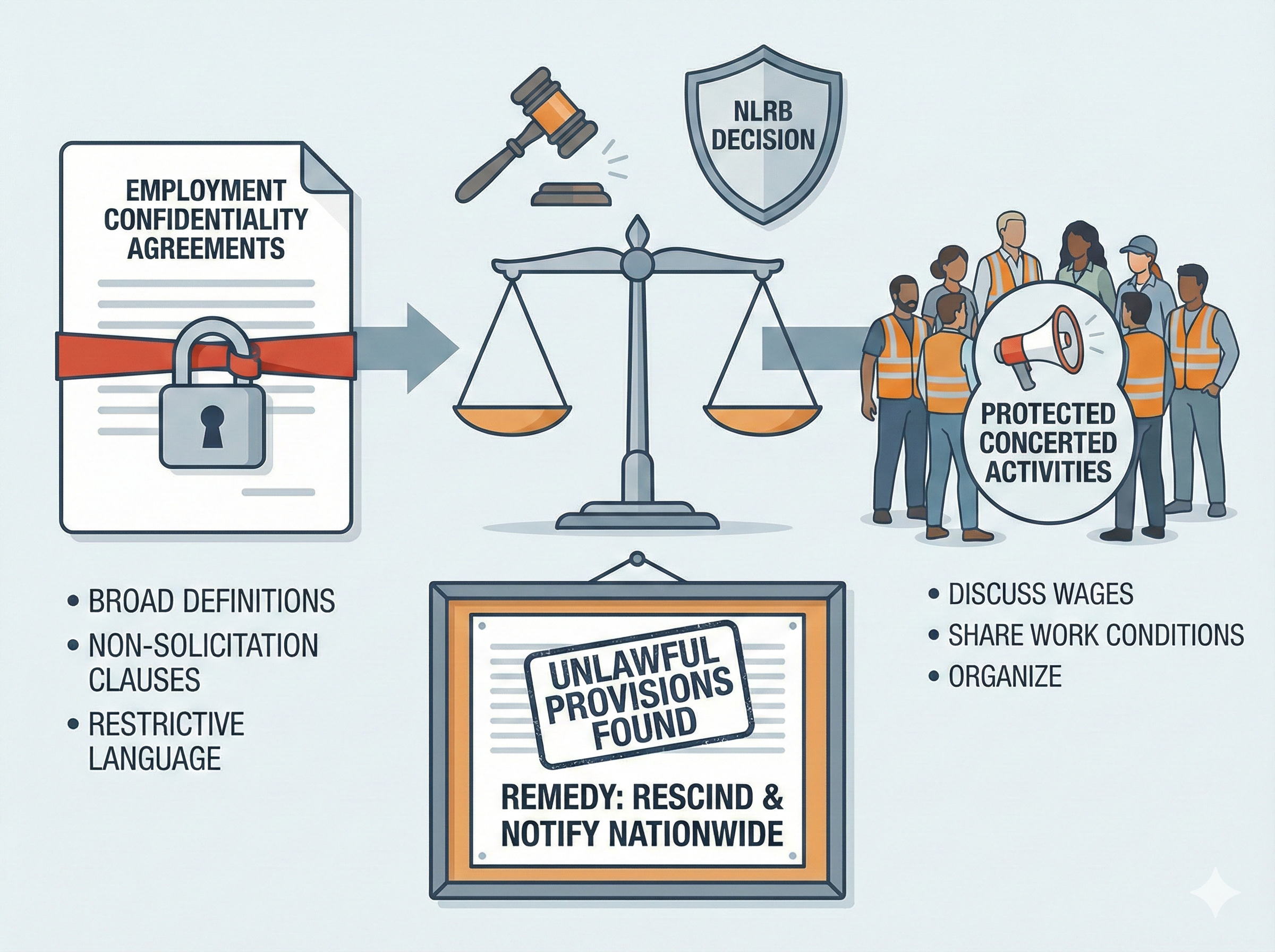
This ALJ decision examines whether Amazon’s employment confidentiality agreements violate Section 8(a)(1) of the Act by potentially restricting employees’ rights to engage in protected concerted activities.
Case Background
Amazon requires all employees to sign confidentiality agreements as a condition of employment. Two unfair labor practice charges were filed - one by an individual employee in 2022 and another by the Committee of Correspondence of Amazon Workers in 2024. The consolidated complaint challenges specific provisions in these agreements for both exempt and non-exempt employees.
Legal Framework
The Administrative Law Judge (ALJ) applied the Stericycle standard, which evaluates work rules from the perspective of a reasonable employee who is economically dependent on the employer and contemplating engaging in protected activity. Under this framework, if an employee could reasonably interpret a rule as restricting Section 7 rights, it’s presumptively unlawful unless the employer proves the rule advances a legitimate business interest that cannot be achieved through more narrowly tailored means.
Key Violations Found
1. Exempt Employee Savings Clause (2020-2024 Version) The original savings clause only excluded “the terms and conditions of Employee’s own employment” from confidentiality restrictions. The ALJ found this problematic because employees could reasonably interpret this to prohibit discussing coworkers’ wages and working conditions, making concerted activity impossible. Amazon’s 2024 revision adding “or Employee’s coworkers’” came nearly two years after the initial charge, and Amazon failed to prove it properly notified existing employees of the change, falling short of Passavant requirements for effective repudiation.
2. Overly Broad Confidentiality Definitions The prohibition on disclosing information “relating or pertaining to Amazon’s business, projects, products, customers, suppliers” was found unlawfully broad. Following AGA Gas Co., employees have Section 7 rights to share information acquired through regular job duties, even if not generally known to the public. The undefined term “legal affairs” could reasonably include NLRB proceedings or discussions about legal action against the employer.
3. Non-Solicitation Provisions The 18-month prohibition on “encouraging any Customer or Business Partner to cease doing business with Amazon” was found to potentially restrict protected activities like boycotts, picketing, or making truthful negative statements about employment practices. The savings clause in a different section of the agreement was insufficient to cure this specific prohibition.
4. Non-Interference Language Despite containing a specific NLRA savings clause, the broad prohibition on encouraging others to terminate relationships with Amazon was still found unlawful under Tower Industry, which holds that general savings clauses cannot negate specifically drafted restraints on Section 7 activity.
Business Justification Analysis
Amazon’s Senior Corporate Counsel testified about general business needs for confidentiality but provided no specific justifications unique to Amazon’s operations that would outweigh employees’ Section 7 rights. The ALJ found these generalized business interests insufficient under Stericycle’s requirement for legitimate and substantial business interests that cannot be achieved through narrower means.
Remedy
The Board ordered Amazon to rescind the unlawful provisions, notify all employees nationwide of the rescission, and either provide lawful replacement language or remove the problematic sections entirely. Physical and electronic notice posting is required for 60 days at all U.S. facilities.
Significant Cases Cited
Stericycle, Inc., 372 NLRB No. 113 (2023): Established current framework for evaluating facially neutral work rules from reasonable employee’s perspective
McLaren Macomb, 372 NLRB No. 58 (2023): Policies requiring relinquishment of future Section 7 rights are unlawful
AGA Gas Co., 307 NLRB 1327 (1992): Employees may share information acquired through regular job duties as protected activity
Tower Industry, Inc., 349 NLRB 1077 (2007): General savings clauses insufficient when specific language precludes protected behavior
Passavant Memorial Area Hospital, 237 NLRB 138 (1978): Requirements for effective repudiation of unlawful policies include timely, unambiguous disavowal and adequate publication
New Vitae, Inc. D/B/a New Vitae Wellness and Recovery, JD-87-25, 04-CA-324629 (ALJ Decision)
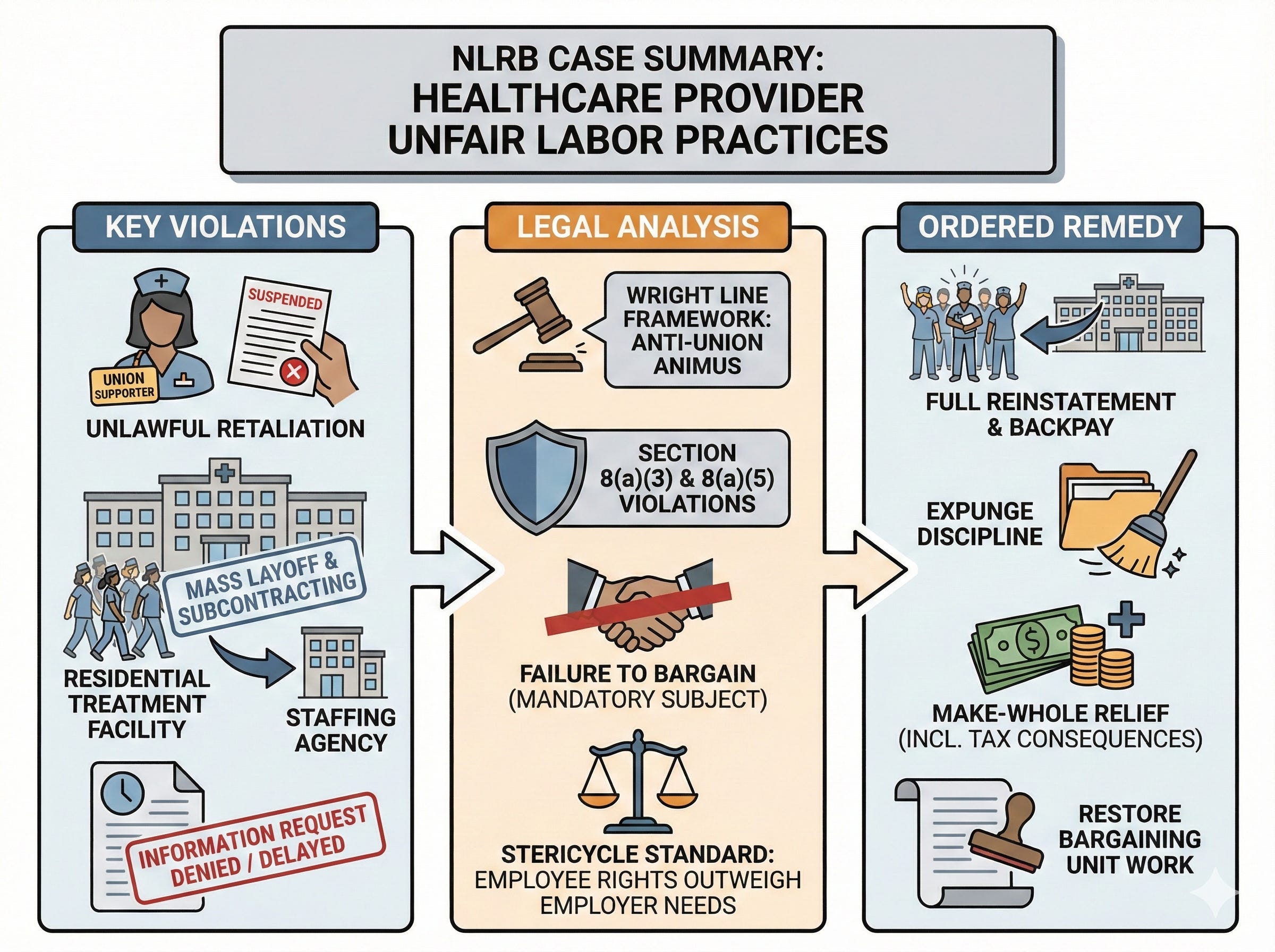
This case involves New Vitae, Inc., a healthcare provider operating residential treatment facilities for adults (RTFAs) in Philadelphia. The employer faced multiple unfair labor practice charges after its registered nurses voted for union representation by District 1199C in March 2023.
The Administrative Law Judge examined several significant violations:
Unlawful Retaliation Against Union Supporter
The decision found that New Vitae unlawfully retaliated against nurse Danita Alexander, who helped organize the union campaign. After Alexander raised workplace concerns during a voluntary “stay interview,” the employer suspended her for declining what was initially framed as an optional follow-up meeting. The ALJ applied the Wright Line framework and found the employer’s actions were motivated by anti-union animus, evidenced by internal documents identifying Alexander as a union supporter and directing her exclusion from employer meetings about the union.
Mass Layoff and Subcontracting Violation
In a particularly egregious violation, New Vitae laid off its entire bargaining unit of nurses on November 1, 2024 - less than a month after contract negotiations began - and immediately subcontracted all their work to staffing agencies. The ALJ found this violated both Section 8(a)(3) as discriminatory retaliation and Section 8(a)(5) as an unlawful unilateral change. The employer’s cost-savings justification was deemed pretextual, as the analysis showed savings came primarily from using less-qualified LPNs rather than from using agency nurses.
Bargaining Obligations
The decision addressed the principle from Fibreboard Paper Products Corp. v. NLRB that subcontracting bargaining unit work is a mandatory subject of bargaining. The employer failed to provide notice or opportunity to bargain before implementing the mass layoff and subcontracting. The ALJ rejected the employer’s defense that it had previously used some agency nurses, noting this didn’t justify completely eliminating all unit positions without bargaining.
Information Request Violations
New Vitae violated its duty to provide relevant information by refusing certain requests and unreasonably delaying others for over five months. The ALJ applied established precedent that delays of even 2-3 months violate the Act absent showing the information was particularly voluminous or difficult to gather.
Confidentiality Directive
The employer unlawfully prohibited Alexander from discussing workplace complaints with coworkers, threatening discipline for violations. Under Stericycle, such restrictions on discussing employer investigations violate Section 7 unless justified by legitimate business needs that outweigh employees’ rights.
Remedy
The ALJ ordered comprehensive relief including:
Full reinstatement of all laid-off nurses with backpay
Restoration of all bargaining unit work to pre-November 1, 2024 status
Expungement of disciplinary records
Make-whole relief including compensation for adverse tax consequences
Notably, the ALJ rejected allowing the employer to argue “undue burden” at the compliance stage, finding the violations too egregious to permit such consideration.
Significant Cases Cited
Wright Line, 251 NLRB 1083 (1980): Framework for analyzing discrimination based on union activity requiring showing of protected activity, employer knowledge, and animus
Fibreboard Paper Products Corp. v. NLRB, 379 U.S. 203 (1979): Established that decisions to replace unit employees with subcontractors are mandatory subjects of bargaining
Stericycle, Inc., 372 NLRB No. 113 (2023): Set standard that workplace rules restricting Section 7 rights are presumptively unlawful unless employer shows legitimate justification
NLRB v. Katz, 369 U.S. 736 (1962): Foundational case requiring bargaining before unilateral changes to terms and conditions of employment
NLRB v. Acme Industrial Co., 385 U.S. 432 (1967): Established employer’s duty to provide union with information relevant to bargaining responsibilities