
Starbucks Corporation, JD-66-26, 12-CA-358230 (ALJ Decision)
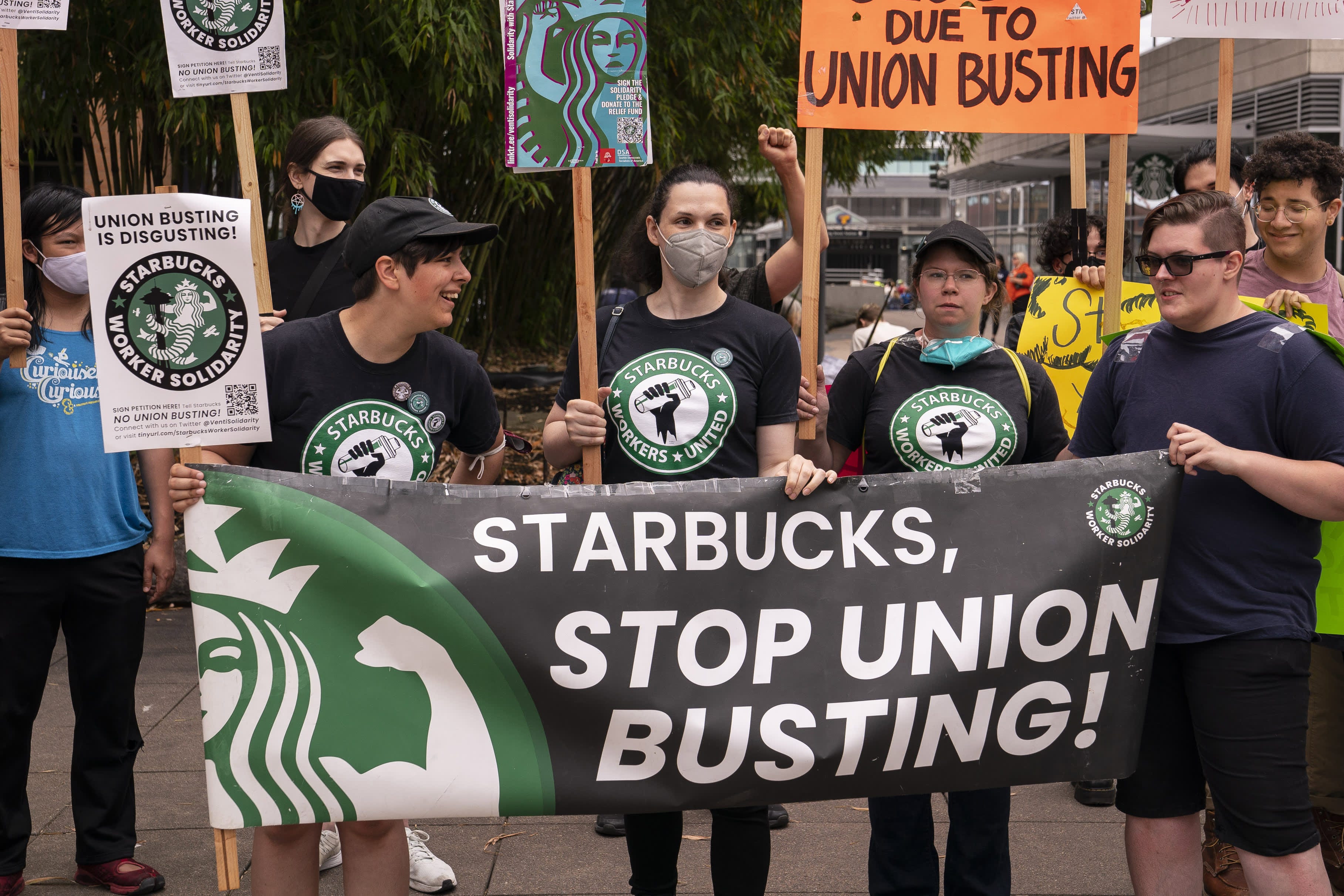
An administrative law judge has ruled that Starbucks violated the NLRA by cracking down on facial piercings at a unionized Tallahassee, Florida store without first bargaining with the union over the change.
The case centered on Store 8804, where baristas and shift supervisors have been represented by Workers United since 2022, though the parties had not yet reached a first contract. Starbucks’ companywide employee handbook has long limited workers to one facial piercing no larger than a dime, but the judge found that this rule simply was not enforced at Store 8804 for years. A barista named Emma Sainsbury testified, largely without contradiction, that she and several coworkers wore multiple piercings openly from 2021 through mid-2024, and submitted photos backing up her account. None of the store’s several managers over that period had ever told her to remove a piercing.
That changed in July 2024, when Jennifer Benoit took over as temporary store manager and began enforcing the one-piercing rule, coaching employees and posting reminders about the dress code. When a shift supervisor warned a worker that she could be sent home without pay for noncompliance, employees fell in line and removed their extra piercings. The company never notified or bargained with the union before making this change.
The judge concluded that this shift amounted to an unlawful unilateral change to a mandatory subject of bargaining under the Act, following the reasoning of a recent Board decision involving a Starbucks store in Jantzen Beach, Oregon, where stricter dress code enforcement after unionization was similarly found unlawful. The judge rejected Starbucks’ argument that the case was different because no employee was formally disciplined, noting that employees only avoided discipline because they complied under threat of being sent home. The judge also rejected the company’s claim that the piercing rule was not a significant enough change to trigger bargaining obligations, pointing to the Board’s implicit endorsement of that kind of enforcement change as material in the Starbucks Corp. Jantzen Beach case.
As a remedy, the judge ordered Starbucks to rescind the enforcement change, bargain with the union before altering terms and conditions of employment at the store, and post a notice to employees describing their rights.
Significant Cases Cited
NLRB v. Katz, 369 U.S. 736 (1962): Established that an employer violates its bargaining duty by making unilateral changes to mandatory subjects of bargaining without first notifying and bargaining with the union.
Starbucks Corp., 374 NLRB No. 130 (2026): Held that Starbucks unlawfully changed a mandatory subject of bargaining by more strictly enforcing its dress code at a newly unionized store without bargaining, even though the change stemmed from stricter enforcement of an existing written policy rather than a new rule.
800 River Road Operating Co., LLC d/b/a Care One at New Milford, 369 NLRB No. 109 (2020): Addresses discretionary discipline issued under an existing policy or practice, which the Board found did not apply where the real issue was a change in enforcement practice itself.
Print Fulfillment Services, LLC, 361 NLRB 1243 (2014): Held that an employer need not actually enforce a new or stricter policy for a bargaining violation to be found; unilaterally imposing the changed policy is enough.
ABC Automotive Products Corp., 307 NLRB 250 (1992): Held that merely announcing a unilateral change, even without implementing it, violates the Act because it damages the bargaining relationship by signaling the employer will set terms unilaterally.
B.N.F. Painting, LLC, 357 NLRB No. 60, 09-CA-318278 (Published Board Decision)
The Board affirmed an administrative law judge's finding that a Cincinnati painting contractor unlawfully fired an employee for discussing wages and unlawfully maintained overbroad confidentiality and conduct rules in its employee manual.
The case arose after Christopher Hauser, a painter for B.N.F. Painting, discussed his wages with coworkers on two occasions in the fall of 2022. Shortly after the second conversation, company managers texted Hauser that he was being let go because "we heard that you had talked about how much money we are paying you and we can't have that here," though the company later told him it was a layoff due to lack of work. The judge found this explanation pretextual, pointing to management's repeated statements that wage discussions caused disgruntlement among employees, the timing of the discharge immediately after the wage discussion, and the absence of solid evidence that a genuine work shortage drove the decision. The judge also found the company unlawfully threatened employees over wage discussions and maintained handbook rules defining "confidential information" to include compensation data and employee conversations, as well as conduct rules barring "boisterous" behavior and "insubordination," all of which employees could reasonably read as restricting their right to discuss working conditions.
On review, B.N.F. Painting argued that the judge improperly allowed the General Counsel to amend the complaint at the start of the hearing to add the work-rule allegations, and that the judge should have granted its motion to dismiss those allegations because the General Counsel failed to introduce the handbook rules into evidence during her main case. The Board acknowledged that the General Counsel gave the company only minimal notice of the amendment and failed to meet her evidentiary burden at the close of her case-in-chief, as required under Yale University. Still, the Board found no abuse of discretion in allowing the amendment, noting the company did not seek a continuance, and held that the judge was permitted under Federal Rule of Civil Procedure 52(c) to defer ruling on the dismissal motion until issuing her final decision, at which point the full record supported the violations. Member Prouty concurred separately, taking narrower grounds and emphasizing that the General Counsel was not obligated to justify the timing of her amendment request.
The Board ordered reinstatement and backpay for Hauser, rescission of the unlawful handbook provisions, and the posting of a notice to employees.
Significant Cases Cited
Yale University, 330 NLRB 246 (1999): To defeat a motion to dismiss at the close of the General Counsel's case-in-chief, the General Counsel must present evidence sufficient to establish a prima facie unfair labor practice.
Wright Line, a Division of Wright Line, Inc., 251 NLRB 1083 (1980): Sets out the burden-shifting framework for determining whether an adverse employment action was motivated by protected activity.
Stericycle, Inc., 372 NLRB No. 113 (2023): Reestablished that work rules are evaluated from the perspective of a reasonable employee economically dependent on the employer who contemplates engaging in protected activity.
Lutheran Heritage Village-Livonia, 343 NLRB 646 (2004): Set out factors for determining when a facially neutral work rule unlawfully restricts Section 7 rights.
Lafayette Park Hotel, 326 NLRB 824 (1998): Held that work rules are evaluated based on whether they would reasonably tend to chill employees in exercising their Section 7 rights.
Anodyne Coffee, LLC, 18-UC-373464 (Regional Election Decision)
The Regional Director issued an order clarifying the bargaining unit at Anodyne Coffee, LLC's Milwaukee-area locations to resolve a question left open when the union was first certified.
The underlying certification, issued in September 2025, recognized the Milwaukee Area Service and Hospitality Workers Union as the bargaining representative for baristas, barista leads, shift supervisors, event staff, factory production employees, shipping and delivery employees, and warehouse leads across the company's four locations. At the time, the parties disagreed about whether market education leads and assistant general managers (also called café assistant managers or assistant manager/MITs) belonged in the unit. Because those employees' votes were not decisive in the election, the dispute over their classification did not need to be resolved before certification, so they were allowed to vote subject to challenge while the question remained open.
After the Board denied the employer's request for review of the certification in June 2026, the union filed a petition seeking to formally include the market education lead and assistant general manager classifications in the unit. The parties then reached a joint stipulation agreeing that both classifications should be included, and they asked the Regional Director to clarify the unit on that basis without a hearing, waiving their rights to a hearing and to seek review of the clarification decision.
Based on that stipulation, the Regional Director ordered the certified unit amended to include market education leads and assistant general managers alongside the previously recognized classifications, while continuing to exclude office clerical employees, sales employees, managerial employees, guards, and statutory supervisors.
MultiCare Tacoma General Hospital, 19-UC-392166 (Regional Election Decision)
A regional director dismissed a petition to clarify a nurses' bargaining unit after finding that the parties' own stipulated election agreement already resolved the dispute.
The case grew out of a representation election for Registered Nurse Case Managers at MultiCare Tacoma General Hospital. When the union sought to represent that classification, the parties signed a stipulated election agreement describing the unit as case managers "employed by the Employer under the MultiCare Tacoma General Hospital license." A dispute later arose over whether that language also covered case managers working at Allenmore Hospital, a separate facility that operates under the same state license as Tacoma General. The union argued the parties had agreed to include the Allenmore employees, pointing to an email exchange where its attorney proposed the "license" language specifically to capture them. The employer disputed that it had been told the purpose of the change and maintained the agreement's reference to employees "employed by the Employer" meant only those employed by Tacoma General itself. Case managers at Allenmore ultimately voted subject to challenge, but their ballots were not outcome determinative, and the union was certified for the Tacoma General unit.
The union then filed a unit clarification petition asking that the Allenmore case managers be formally added to the unit. Applying the Board's framework for interpreting stipulated election agreements, the regional director first asked whether the agreement's language was unambiguous. He found that it was: the employer named in the agreement was MultiCare Tacoma General Hospital, described as operating "an" acute care hospital, and the unit was limited to employees "employed by the Employer." Nothing in the agreement referenced Allenmore Hospital, and the fact that both facilities shared a single state license did not change who the "Employer" was under the contract's own terms. Because the agreement was unambiguous, there was no need to look at extrinsic evidence of the parties' intent or to apply the Board's community-of-interest test.
The decision relied heavily on a similar federal appeals court case involving a stipulated agreement that defined "employer" as a specific corporate entity, excluding employees of a related but separate subsidiary. Just as that agreement's defined term controlled regardless of the parties' later disputes about intent, the regional director concluded that the stipulated agreement here controlled, and it did not include RN Case Managers working for or operating out of Allenmore Hospital. The petition was dismissed.
Significant Cases Cited
Caesars Tahoe, 337 NLRB 1096 (2002): Sets out the three-part test for resolving disputes over stipulated election agreements, first looking to whether the agreement is unambiguous, then to extrinsic evidence of intent, and finally to the community-of-interest test.
National Labor Relations Board v. Arrmaz Products Inc., 123 F.4th 1295 (11th Cir. 2024): Enforced a Board order finding a stipulated election agreement unambiguously excluded employees of a related subsidiary because the agreement's defined term "employer" named only the parent company.