
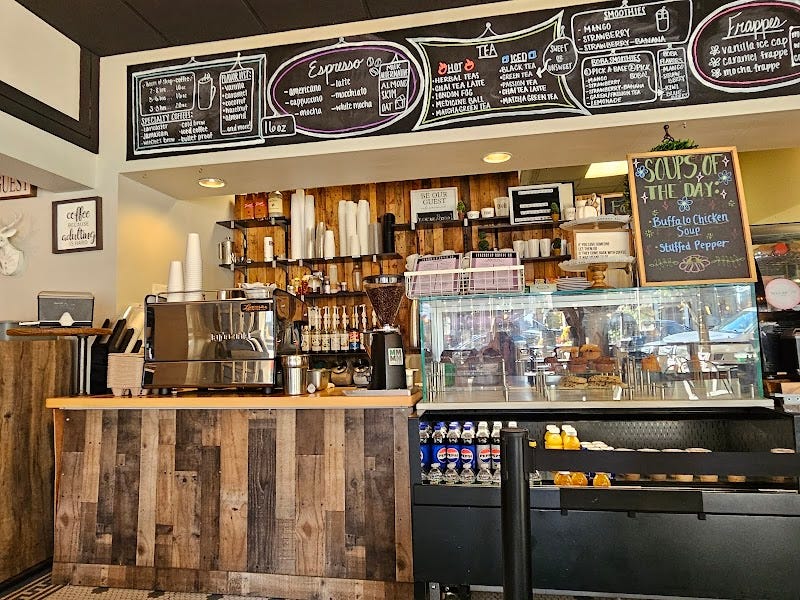
Lancaster Coffee Company, 357 NLRB No. 58, 03-CA-306479 (Published Board Decision)
The Board reversed an administrative law judge’s finding that one employee, among a group of four coworkers at a small Lancaster, New York coffee shop, had voluntarily quit his job rather than being unlawfully discharged.
The case grew out of a dispute between employees and the café’s owner over working conditions, including a faulty door lock, gas leaks, pest problems, and inconsistent pay. After raising these issues without success, a group of employees, including Samantha Godus, Quinn Schuster, Alyssa Battenfield, and Reese Fiato, staged a work stoppage and asked to meet with the owner, Tracy Diegelman, to discuss their concerns. Diegelman declined to attend the meeting and instead sent her boyfriend, Frank Amodio, to confront the group, demand their keys, and escort on-duty employees to their cars. Amodio physically restrained one employee and grabbed another by the throat. Diegelman later removed the group from the work schedule, changed the locks, and threatened them with arrest for trespassing if they returned.
The judge found that the Respondent unlawfully discharged Godus, Battenfield, and Fiato in retaliation for their protected concerted activity, along with related violations including physical restraint, creating an impression of surveillance through a “SMILE you’re on CAMERA” sign, and threats of arrest. But the judge excluded Schuster from these findings, concluding that statements Schuster made during the standoff, that he was “done” and would leave his key on the counter, showed he had resigned.
The Board disagreed. It explained that an employer claiming an employee abandoned their job bears the burden of producing unequivocal evidence of intent to permanently sever the employment relationship, citing Atlantic Scaffolding Co. The Board found that Amodio’s demand for the employees’ keys, made as part of a retaliatory scheme approved by Diegelman, meant Schuster’s decision to leave his key could not be treated as clear evidence of a voluntary resignation. The Board also found the judge mischaracterized Schuster’s hearing testimony, which explained in retrospect why he never returned to work (he felt unsafe, assumed he’d been fired, and had been threatened with arrest), as if it were a statement made at the time he left his key. Finally, the Board noted that Diegelman never solicited Schuster to return to work and instead sent him a letter threatening arrest, which undercut any claim of abandonment.
As a result, the Board found that the café unlawfully discharged Schuster, removed him from the schedule, and locked him out, just as it had with the other three employees, and ordered the same remedies, including reinstatement and backpay, for all four.
Significant Cases Cited
Atlantic Scaffolding Co., 356 NLRB 835 (2011): An employer asserting job abandonment by employees engaged in a work stoppage must present unequivocal evidence of the employee’s intent to permanently sever the employment relationship.
L.B.&B. Associates, Inc., 346 NLRB 1025 (2006): Defined the “unequivocal evidence” standard employers must meet to establish that an employee resigned rather than was discharged.
NLRB v. Augusta Bakery Corp., 957 F.2d 1467 (7th Cir. 1992): Confirmed that an employer bears the burden of presenting unequivocal evidence of a striker’s intent to permanently sever employment in order to establish job abandonment.
NLRB v. Washington Aluminum Co., 370 U.S. 9 (1962): Established that a concerted work stoppage by employees protesting working conditions is protected activity under the NLRA.
Thryv, Inc., 372 NLRB No. 22 (2022): Held that make-whole remedies for unlawful discharges must include compensation for all direct or foreseeable pecuniary harms, not just backpay.
Bluefield Hospital Company, LLC D/B/a Bluefield Regional Medical Center and Its Single and/or Joint, 357 NLRB No. 59, 10-CA-153544 (Published Board Decision)
The Board resolved a dispute over backpay owed to eight nurses who were discriminated against, ruling on which parts of the employer's defense could go forward to a hearing and which were resolved in the General Counsel's favor without further proceedings.
The case traces back to a settlement in which the employer, Bluefield Regional Medical Center, agreed it had violated the NLRA by unlawfully discharging the nurses. A federal appeals court enforced that order in 2020. The parties could not agree on how much backpay was owed, so the matter returned to the Board through a compliance proceeding.
The General Counsel asked the Board to grant summary judgment on many of the specification's allegations, arguing the employer's answers were too vague or amounted to improper general denials under the Board's rules, which require respondents to specifically explain any disagreement with backpay figures and provide supporting detail.
The Board granted summary judgment on several points the employer had effectively admitted or that improperly attempted to relitigate remedies already set by the enforced court order, including allegations about adverse tax consequences from lump-sum backpay payments.
But the Board denied summary judgment on the central disputes. It found the employer raised a genuine factual issue over whether backpay calculations should include wage increases, since the employer pointed to employment agreements it says did not guarantee such increases. The Board also found the employer's general denials about interim earnings and interim retirement benefits were adequate because that information was not within the employer's own knowledge, consistent with Board precedent that a respondent is not required to detail facts only the discriminatee or a third party would know. Various other allegations tied to these disputed figures were also sent back for hearing because they depend on resolving the wage-increase and interim-earnings questions first.
The Board further denied the employer's request to strike part of the General Counsel's reply brief, treating it as an improper surreply. The case was remanded to the Regional Director in Region 10 to schedule a hearing before an administrative law judge limited to the specific allegations where summary judgment was denied.
Significant Cases Cited
M&M Affordable Plumbing, Inc., 365 NLRB 546 (2017): A general denial is sufficient to warrant a hearing on backpay issues that are not within the respondent's own knowledge, such as interim earnings.
Alaris Health at Harborview, 371 NLRB No. 68 (2022): Specification allegations that are "dependent" on other adequately denied allegations should also be sent to hearing rather than resolved by summary judgment.
Tel Data Corp., 315 NLRB 364 (1994): If an employer proves a discriminatee engaged in unprotected misconduct for which any employee would have been discharged, backpay is cut off as of the date the employer learned of the misconduct.
1621 Route 22 West Operating Co., LLC d/b/a Somerset Valley Rehabilitation, 371 NLRB No. 86 (2022): Summary judgment was properly denied where the employer disputed whether a specific pay increase should be included in gross backpay.
Fugazy Continental Corp., 260 NLRB 1225 (1982): General denials on interim earnings are sufficient to require a hearing because net backpay calculations are directly dependent on interim earnings data.
Commercial Steel Treating Corporation, JD-64-26, 07-CA-328161 (ALJ Decision)
An administrative law judge found that a Madison Heights, Michigan metal heat-treating company violated the NLRA in a series of disputes with the union representing its production and maintenance workers before the company closed its facility in 2024.
The judge ruled that the company's associate handbook contained several unlawfully broad rules, including restrictions on employee access to the premises during non-work hours, bans on solicitation, distribution, and "campaigning" without management permission, limits on cell phone and camera use that were not confined to work time or work areas, a vague prohibition on "distracting" demonstrations, and a rule barring removal of company records or job-related information from the premises. The judge also found that an acknowledgment form employees were required to sign unlawfully shortened the time employees had to pursue monetary remedies after filing labor board charges. Separately, the judge declined to find two other handbook provisions, covering posting on bulletin boards and disclosure of confidential business information, to be unlawful.
The judge also found that the company unlawfully told the union chairman, Christopher Combs, not to discuss his demotion and pay rate with the union or coworkers after demoting him from a maintenance position, and that it later threatened employees with discharge if they refused to sign the handbook acknowledgment form. The company was found to have unlawfully bypassed the union by asking employees directly to sign the acknowledgment form and by unilaterally imposing that requirement without bargaining.
On the plant closing, the judge found the company unlawfully dealt directly with employees by announcing the closure and a severance offer without first notifying the union, and that it failed to bargain in good faith over the effects of the closing. The company had initially promised four weeks of severance pay to employees who stayed until closure, then withdrew that offer during bargaining and proposed only to pay out already-contractually-owed vacation time. The judge characterized this as a regressive, retaliatory bargaining tactic that, combined with the company's hostile reaction to the union's grievances, showed bad faith. The company's bargaining representatives also lacked authority to modify the proposal, which further undermined any claim of genuine negotiation.
As a remedy, the judge ordered the company to bargain with the union over the effects of the closure and to pay backpay to former unit employees under the formula used in Transmarine Navigation Corp., along with rescinding the unlawful acknowledgment form and posting a notice to employees.
Significant Cases Cited
Tri-County Medical Center, 222 NLRB 1089 (1976): Set the standard for evaluating rules restricting off-duty employees' access to employer property.
Stericycle, Inc., 372 NLRB No. 113 (2023): Established the current two-part test for determining whether facially neutral work rules are unlawfully overbroad.
Lutheran Heritage Village-Livonia, 343 NLRB 646 (2004): Held that work rules are unlawful on their face if they explicitly restrict Section 7 activity.
Permanente Medical Group, 332 NLRB 1143 (2000): Set out the three-factor test for finding unlawful direct dealing between an employer and union-represented employees.
Transmarine Navigation Corp., 170 NLRB 389 (1968): Established the backpay remedy formula used when an employer fails to bargain over the effects of a plant closure.
United Parcel Service, JD-65-26, 10-CA-338971 (ALJ Decision)
An administrative law judge found that United Parcel Service unlawfully maintained two policies that barred employees from wearing union insignia on company-issued safety vests, ruling that the restrictions went further than needed to protect any legitimate business interest.
The case arose from a dispute involving Evette Avery, a longtime UPS package car driver and union steward at the company's Atlanta hub. Avery began wearing a dark-colored safety vest bearing her Teamsters local's logo in place of the company-issued yellow-green vest, and later switched to a union-provided steward vest in the same yellow-green color as UPS's approved vest but marked with the word "STEWARD" and the local's logo. After a new division manager took over the facility and tightened enforcement of uniform rules, UPS told Avery she could not wear either vest and eventually disciplined her, including a brief discharge that was reduced to a warning through the grievance process, for continuing to wear the steward vest.
UPS argued the case was barred by a prior Sixth Circuit ruling, United Parcel Service v. NLRB, which upheld the company's right to restrict union pins under its customer-facing uniform policy. The judge rejected that argument, finding the earlier case addressed a materially different situation, drivers' required customer-facing uniforms, rather than the optional safety vests worn in the yard and hub that are not required on delivery routes.
The judge also declined to defer most of the case to the parties' grievance settlements, reasoning that while Avery's individual discipline had been resolved through arbitration, no grievance settlement had addressed the broader legality of the policies themselves. However, the judge did defer the claim that the policies were enforced disparately against Avery, since that issue was adequately resolved through the grievance process under the standards set in Spielberg Mfg. Co. and Olin Corp.
On the merits, the judge applied the Board's balancing test from Republic Aviation Corp. v. NLRB, which presumes restrictions on union insignia are unlawful unless an employer shows special circumstances justifying them. UPS argued its "8 Rules of Yard Control" policy, requiring unaltered, UPS-issued safety vests in the yard, was necessary to preserve the vests' visibility for safety purposes. The judge agreed that darker, non-UPS vests reduced visibility and could lawfully be banned, but found no evidence that the modest union lettering and logo on the yellow-green steward vest meaningfully diminished its visibility or caused any distraction.
As for UPS's broader Uniform Standards policy, which also covers drivers' customer-facing routes, the judge acknowledged UPS's legitimate interest in presenting a neat, recognizable image to customers but found the company failed to show that any actual disruption or customer complaints resulted from employees wearing union-marked vests. Because UPS already allows a small union-issued pin and a steward button, and presented no evidence of harm from Avery's vest, the judge concluded the broader ban was not narrowly tailored and therefore unlawful.
The judge ordered UPS to rescind both policies, post a remedial notice, and provide employees with revised materials reflecting the changes, while dismissing the disparate-enforcement allegation under the deferral doctrine.
Significant Cases Cited
Republic Aviation Corp. v. NLRB, 324 U.S. 793 (1945): Established the foundational balancing test weighing employees' right to wear union insignia against an employer's right to maintain discipline and production.
United Parcel Service v. NLRB, 41 F.3d 1068 (6th Cir. 1994): Upheld UPS's right to restrict union pins under its customer-facing uniform policy based on the company's interest in presenting a neat, recognizable public image.
Tesla, Inc., 371 NLRB No. 131 (2022): Held that restrictions on union insignia must be justified by legitimate business interests that outweigh employees' Section 7 rights and must be narrowly tailored.
Spielberg Mfg. Co., 112 NLRB 1080 (1955): Set forth the standard for Board deferral to grievance arbitration settlements where proceedings were fair, parties agreed to be bound, and the result was not repugnant to the Act.
In-N-Out Burger, Inc., 365 NLRB No. 471 (2017): Found a rule prohibiting uniformed, customer-facing employees from wearing union pins to be unlawful absent special circumstances.
Colorado Coalition for the Homeless, 27-RC-391415 (Regional Election Decision)
A regional director for the NLRB has ruled that housing assistance employees at a Denver homeless services nonprofit cannot be added to an existing bargaining unit of supportive services employees through a self-determination election, because the two groups do not share a sufficient community of interest.
The case arose after a union sought to expand a previously certified unit of Housing Supportive Service Department employees, such as case managers and behavioral health clinicians, to include Housing Navigators, Housing Specialists, and Administrative Assistants from the separate Housing Assistance Department. The two departments perform different functions for the same clients: the Housing Assistance Department helps clients find housing and administers government vouchers, while the Housing Supportive Service Department provides ongoing social services like healthcare access and food assistance, sometimes starting before a client even moves in.
Applying the multi-factor community of interest test from United Operations, Inc., the regional director weighed organization, supervision, interchange, contact, skills and functions, functional integration, and terms and conditions of employment. The decision found that the two departments are organized separately, do not share supervisors at the first or second levels, and have no temporary or permanent interchange of employees. It also found that the departments require different skills and job functions, with Housing Assistance Department roles requiring no formal education while some Housing Supportive Service Department roles, like behavioral health clinicians, require a master's degree and licensure. Functional integration was found to be limited to a few narrow contexts, such as a small housing assistance team working on a research grant program and periodic tenant conferences involving both departments.
Although the regional director found that terms and conditions of employment, such as shared benefits, similar hours, and a common work site, along with frequent work-related contact between the groups, favored finding a shared community of interest, these factors were outweighed by the lack of common organization, supervision, interchange, and similar skills. Citing Casino Aztar for the principle that the degree of interchange, contact, and functional integration matters more than shared supervision alone, the regional director concluded the petitioner failed to establish a sufficient community of interest. As a result, the Housing Assistance Department employees will instead vote in a standalone unit on whether to be represented by Service Employees International Union, Local 105.
Significant Cases Cited
Warner-Lambert Co., 298 NLRB 993 (1990): Establishes that a self-determination election is the proper method for a union to add unrepresented employees to an existing bargaining unit.
United Operations, Inc., 338 NLRB 123 (2002): Sets out the multi-factor test for community of interest, including organization, skills, functional integration, contact, interchange, terms of employment, and supervision.
Casino Aztar, 349 NLRB 603 (2007): Holds that the degree of interchange, contact, and functional integration matters more than whether employee groups share common supervision.
Hilton Hotel Corp., 287 NLRB 359 (1987): Holds that frequent interchange between employee groups may suggest blurred departmental lines and a fluid workforce with comparable skills.
Seaboard Marine, 327 NLRB 556 (1999): Holds that the Board will not approve fractured units that are too narrow in scope or lack a rational basis.
Nitro Construction Services, 09-CA-313196 (Unpublished Board Decision)
The Board declined to reconsider its earlier decision or reopen the record in this case. The charging party had asked the Board to revisit its prior ruling and take additional evidence, but the Board found no material error or extraordinary circumstances that would justify reconsideration under its procedural rules, and no valid basis for reopening the record either.
The Board noted that some of the charging party's arguments improperly tried to expand on the General Counsel's theory of the case, which a charging party is not permitted to do. It also found that arguments not raised earlier before the judge or the Board had been waived and could not now support a request for reconsideration or reopening the record. Finally, the Board explained that the request to reopen the record and for a rehearing rested on points it had already considered and rejected in its original decision, so there was nothing new to warrant revisiting the matter.
Significant Cases Cited
Hobby Lobby Stores, Inc., 363 NLRB 1965 (2016): A charging party cannot enlarge upon or change the General Counsel's theory of a case.
H&M Int'l Transportation, 363 NLRB 1861 (2016): Issues not previously urged before the judge or the Board are deemed waived.
Raven Government Services, 336 NLRB 991 (2001): A motion for reconsideration will be denied to the extent it attempts to relitigate issues already decided.