
IUOE Local 139 (The Boldt Company), 375 NLRB No. 38, 18-CD-352973 (Published Board Decision)
The Board quashed a notice of hearing in a dispute between two unions over truck driving and hauling work at a construction contractor's Wisconsin facility, finding the case was not actually a jurisdictional dispute suitable for resolution under Section 10(k) of the NLRA.
The Boldt Company had long assigned the work of driving trucks and hauling materials to and from its Appleton yard to employees represented by both International Union of Operating Engineers, Local 139 and Teamsters General Union Local 662. When the last Teamsters-represented employee retired in 2024, the company told the union it could not hire a replacement because of a hiring freeze. After the Teamsters filed grievances, the company warned the Engineers that resolving those grievances might require laying off an Operating Engineer, and the Engineers' district manager responded that the union would picket to preserve the work for its members. The company then filed a charge alleging the Engineers had threatened unlawful conduct in violation of Section 8(b)(4)(D) to force a favorable work assignment.
The Board found that although both unions technically claimed the same work, each was really only trying to hold onto work its own members had historically performed, making this a work preservation dispute rather than a true jurisdictional one. Citing precedent, the Board explained that a dispute does not become jurisdictional merely because two unions both assert work-preservation claims to the same tasks. The Board also found that the company itself had helped create the conflict by letting the Teamsters' unit shrink to zero through attrition, invoking a hiring freeze that conveniently matched its preference for Engineers who could operate equipment as well as drive, rather than by any neutral, even-handed dilemma imposed on it. Because the Board will not let an employer use a Section 10(k) proceeding to resolve a dispute of its own making, and because the real dispute was contractual and grievance-based rather than jurisdictional, the Board granted the Teamsters' motion to quash the notice of hearing and declined to award the disputed work to either union.
Significant Cases Cited
Operating Engineers Local 150 (R&D Thiel), 345 NLRB 1137 (2005): Sets out the threshold requirements for finding reasonable cause to proceed with a Section 10(k) determination, including competing claims, proscribed means, and lack of an agreed voluntary resolution method.
Teamsters Local 578 (USCP-Wesco), 280 NLRB 818 (1986): Establishes that the Board looks to the "real nature and origin of the dispute" in deciding whether a true jurisdictional dispute exists.
Seafarers (Recon Refractory & Construction), 339 NLRB 825 (2003): Holds that a work preservation dispute is a complete defense to Section 8(b)(4)(D) allegations and falls outside the intended scope of Section 10(k).
Machinists District 190 Local 1414 (SSA Terminal, LLC), 344 NLRB 1018 (2005): Holds that a dispute remains one of work preservation even when more than one union asserts a claim to the same work, and that the Board will not let an employer use Section 10(k) to resolve a dispute it created itself.
Carpenters (Prate Installations, Inc.), 341 NLRB 543 (2004): Distinguishes disputes where a union seeks to expand into work it never performed from disputes where a union merely seeks to retain work it has historically performed.
Leo Marine Services, Inc.; Olympic Tug and Barge; Centerline Logistics, 375 NLRB No. 35, 19-CA-273208 (Published Board Decision)
The Board found that a group of related marine transportation companies unlawfully stripped union-represented barge workers of their jobs and funneled the work to a nonunion sister company, while also unlawfully propping up a rival, minority union at a newly created affiliate.
The case centered on Westoil Marine Services, a company that had serviced a longtime customer, Glencore, in the Los Angeles/Long Beach port for more than two decades. Its parent, Centerline Logistics Corporation, ran an internal bidding process among its subsidiaries for this and other West Coast work in late 2020, ultimately awarding the Glencore contract first to Olympic Tug & Barge and then to a newly formed subsidiary, Leo Marine Services, neither of which employed the Inlandboatmen's Union of the Pacific-represented workforce that had performed the work for years. The Board agreed with the administrative law judge that Centerline, Olympic Tug & Barge, Leo Marine, Westoil, and Harley Marine Financing operate as a single employer, given their shared ownership, management, and interlocking operations.
Applying the "clear and unmistakable waiver" standard reinstated in Endurance Environmental Solutions, the Board held that the union never waived its right to bargain over the loss of the Glencore work. The record showed that the employer's negotiators strung the union along, soliciting proposals to make Westoil's bid more competitive while quietly submitting an unchanged, doomed bid behind the scenes and ultimately handing the contract to affiliated nonunion entities. Because the parties never validly reached impasse and the union never yielded on the specific issue of transferring the work elsewhere, the unilateral transfer and the resulting layoffs of ten Westoil employees violated the NLRA. The Board did, however, reverse the judge on one narrower point, finding that simply telling union representatives on the day of the decision that Westoil had lost the work was not itself a separate violation, since it was inseparable from the unlawful transfer already found unlawful.
The Board also upheld findings that Leo Marine violated the Act by recognizing the Seafarers International Union before it had hired a substantial, representative workforce, and by signing a contract with that union containing a union-security clause and dues checkoff despite the SIU lacking majority support. Because the recognition was premature, requiring new hires to join the SIU and sign dues-deduction forms was independently unlawful.
As a remedy, the Board ordered reinstatement and backpay for the affected employees, extended to any casual employees who lost work as a result of the unlawful transfer, reimbursement of dues and fees collected under the improper SIU contract, and compensation for other financial harms employees suffered, including tax consequences of lump-sum payments, consistent with the Board's remedial framework in Thryv.
Significant Cases Cited
Endurance Environmental Solutions, LLC, 373 NLRB No. 141 (2024): Restored the "clear and unmistakable waiver" standard for determining whether a union waived its right to bargain over a unilateral change, replacing the "contract coverage" test.
MV Transportation, Inc., 368 NLRB No. 66 (2019): Established a two-step "contract coverage" standard for evaluating unilateral employer action, later abandoned by Endurance Environmental Solutions.
First National Maintenance Corp. v. NLRB, 452 U.S. 66 (1981): Held that management decisions involving a change in the scope and direction of the enterprise are not mandatory subjects of bargaining, distinguishing them from decisions motivated primarily by labor costs.
Emsing's Supermarket, Inc., 284 NLRB 302 (1987): Set out the four-factor test for single-employer status: common ownership, common management, interrelated operations, and centralized control of labor relations.
Thryv, Inc., 372 NLRB No. 22 (2022): Established that backpay remedies must include compensation for all direct or foreseeable pecuniary harms resulting from an unfair labor practice, not just lost wages.
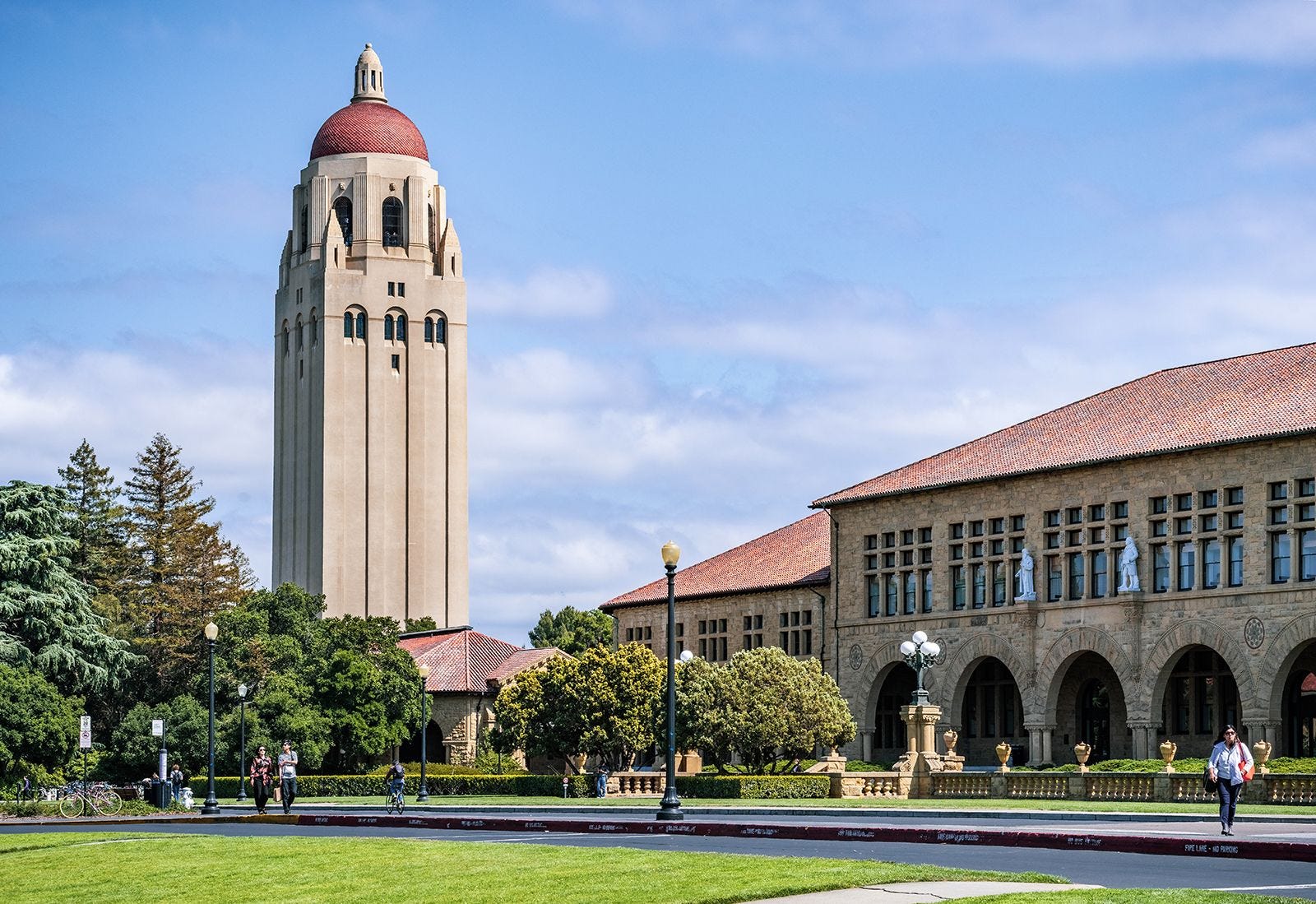
Stanford University, 32-RC-386778 (Regional Election Decision)
A regional director has directed an election among Resident Student Leaders (RSLs) at Stanford University, rejecting the university's arguments that these student residential staff fall outside the National Labor Relations Board's jurisdiction.
The petition, filed by Residential Assistants United Rising (RAUR), sought to represent RAs, RA-Os, and ETAs who live in and manage Stanford's undergraduate campus housing. These students receive quarterly stipends totaling $12,400 for the academic year and perform duties including community building, conflict resolution, emergency response, event programming, and financial stewardship of house funds. They are supervised by Resident Fellows, Resident Directors, Community Coordinators, and Associate Directors, and can be disciplined or terminated for failing to meet expectations.
Stanford opposed the petition on three grounds: that RSLs are not statutory employees under Section 2(3) of the NLRA, that the Board should decline jurisdiction to avoid conflicts with constitutional and other federal rights, and that RAUR does not qualify as a labor organization.
The regional director applied the common-law employment test from Columbia University, which asks whether a worker performs services for another, under that party's control, in exchange for payment. Applying that framework, the decision found RSLs perform valuable services central to Stanford's residential life program, operate under substantial University control through binding terms of appointment and disciplinary authority, and receive compensation in the form of stipends that RSLs may use however they wish. The decision rejected Stanford's argument that the stipends function as financial aid rather than pay, noting they are unconditional and not tied to educational costs.
The director also rejected Stanford's request to apply a stricter "primarily educational" test from Brown University, finding RSLs' year-long, often renewable appointments comparable to the tenures already covered under Columbia University. Because overturning Columbia University precedent is not within a regional director's authority, that argument was left for the Board itself to address if raised on review.
Finally, the decision found RAUR satisfies the statutory definition of a labor organization because RSLs participate in it and it exists to address their working conditions with Stanford.
The director directed a secret-ballot election for October 6 and 7, 2026, among RSLs employed for the 2026-2027 academic year, while excluding resident directors, resident fellows, community coordinators, and other supervisory or confidential staff from the unit.
Significant Cases Cited
Columbia University, 364 NLRB 1080 (2016): Held that student assistants with a common-law employment relationship with their university are statutory employees under the NLRA, overruling Brown University.
Brown University, 342 NLRB 483 (2004): Previously held that graduate student assistants were not statutory employees because their relationship with their university was primarily educational, not economic.
NLRB v. Kentucky River Community Care, Inc., 532 U.S. 706 (2001): Held that the party seeking to exclude workers from Act coverage as supervisors bears the burden of proof.
Sure-Tan, Inc. v. NLRB, 467 U.S. 883 (1984): Established that the NLRA's definition of "employee" broadly covers any person who works for another in exchange for compensation.
NLRB v. Bell Aerospace Co., 416 U.S. 267 (1974): Addressed the Board's authority to resolve novel employee-status questions through adjudication.