
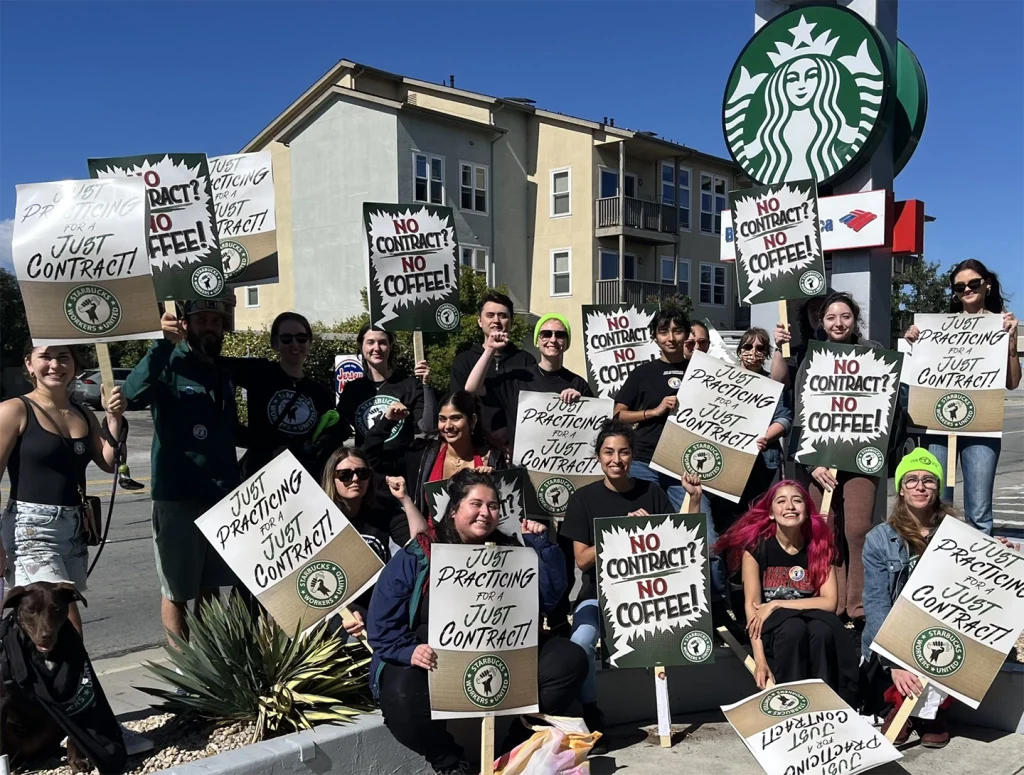
Starbucks v. NLRB, 24-60653 (5th Circuit)
A Fifth Circuit panel partly upheld and partly rejected an NLRB finding that Starbucks violated the NLRA through statements made by managers at a Wichita, Kansas store during a 2022 union organizing campaign.
The case centered on a store where a union lost its representation election, after which the union filed unfair labor practice charges. An administrative law judge found that the store manager and assistant manager violated Section 8(a)(1) of the NLRA in several ways: by suggesting employee benefits could be lost if the store unionized, by tying a reduction in store hours to union pressure, by linking a hiring portal closure to the union campaign, and by creating an impression that employees' organizing was under surveillance. The Board adopted these findings, with one member dissenting in part, and imposed a narrow cease-and-desist order along with a remedial notice requirement.
The court agreed with only one part of the Board's decision. It found substantial evidence supported the conclusion that the manager's statement to one employee, made during a benefits meeting, that her maternity-related benefits "could not be guaranteed" if she supported organizing, amounted to an unlawful threat of reprisal because it lacked any reference to the give-and-take nature of collective bargaining. The court enforced the Board's order on that point.
On the remaining claims, the court sided with Starbucks. It found the manager's comment linking shortened store hours to relieving "pressure" from the union did not, in context, amount to a threat, especially given testimony that reduced hours stemmed from documented staffing shortages unrelated to the union. Similarly, the court held that a statement about the hiring portal being paused due to restrictions on discussing unions with applicants was too disconnected from current employees' terms of employment to qualify as coercive. Finally, the court rejected the surveillance-impression finding, concluding the record did not support that all organizing conversations occurred outside the workplace and that the manager's general acknowledgment of awareness of union talk, without more, did not tend to interfere with or coerce employees' protected activity.
Significant Cases Cited
NLRB v. Gissel Packing Co., 395 U.S. 575 (1969): Employers may lawfully predict the effects of unionization if the predictions are carefully grounded in objective fact and do not threaten reprisal.
Brown & Root, Inc. v. NLRB, 333 F.3d 628 (5th Cir. 2003): Employers retain a protected right to express opinions about unionization so long as statements do not threaten reprisal or force.
UNF West, Inc. v. NLRB, 844 F.3d 451 (5th Cir. 2016): A statement about reduced wages or benefits is not an unlawful threat if it is framed in the context of the give-and-take of collective bargaining.
NLRB v. Mueller Brass Co., 509 F.2d 704 (5th Cir. 1975): An employer's mere acknowledgment of awareness of an employee's union activity does not create an unlawful impression of surveillance absent evidence it interfered with or coerced protected activity.
AllService Plumbing & Maintenance, Inc. v. NLRB, 138 F.4th 889 (5th Cir. 2025): Courts must reject Board findings that fail to grapple with countervailing evidence in the record.
NLRB v. VNS Fed. Servs., LLC, 25-1233 (6th Circuit)
The Sixth Circuit enforced a Board order finding that VNS Federal Services, LLC violated the NLRA when it fired heavy equipment operator Israel Bo Sword after he complained that the company had improperly guaranteed a coworker 40 hours of work per week, a deal Sword believed violated the union's collective bargaining agreement.
Sword worked for VNS at the Portsmouth Gaseous Diffusion Plant in Ohio, where operators were represented by the International Union of Operating Engineers, Local 18, under an agreement called the General Presidents' Project Maintenance Agreement. In February 2020, Sword objected during a team meeting to a supervisor's side deal giving another operator, Greg Dillow, a guaranteed 40-hour week, telling his supervisor that "the contract" did not allow such arrangements. Two days later, after Sword's union representative raised the issue with VNS management, the company permanently laid Sword off, citing "lack of work."
The court applied the Interboro doctrine, under which an employee's honest and reasonable invocation of a right under a collective bargaining agreement counts as protected concerted activity even if the employee turns out to be mistaken about the underlying right. The court explained that this rule, adopted by the Supreme Court in NLRB v. City Disposal Systems, Inc., protects employees from being punished for informally raising contract disputes, since requiring pinpoint accuracy would turn labor agreements into "a trap for the unwary."
Applying that standard, the court found substantial evidence supported the Board's conclusion that Sword's complaint invoked the agreement in good faith, even though the agreement did not actually bar the side deal. The court also upheld the Board's findings that VNS knew of Sword's protected activity, that the timing and statements surrounding his firing showed animus, and that VNS's stated justification of insufficient work was pretextual, given that the company continued assigning overtime and hired a new operator shortly after Sword's termination.
On remedies, VNS argued that reinstatement and backpay were improper given evidence that Sword turned down later job referrals. The court declined to address that argument, following its usual practice of deferring backpay and reinstatement disputes to the Board's separate compliance proceedings rather than resolving them during the enforcement appeal. The court granted the Board's petition to enforce its order in full.
Significant Cases Cited
NLRB v. City Disposal Systems, Inc., 465 U.S. 822 (1984): Held that an employee's honest and reasonable invocation of a right under a collective bargaining agreement is protected concerted activity, regardless of whether the employee was correct that the right was violated.
NLRB v. Transportation Management Corp., 462 U.S. 393 (1983): Established the burden-shifting framework for evaluating claims that an employer discharged an employee for protected activity.
Sure-Tan, Inc. v. NLRB, 467 U.S. 883 (1984): Confirmed the Board's broad discretion to order reinstatement and backpay while deferring precise calculations to compliance proceedings.
NLRB v. Mexia Textile Mills, 339 U.S. 563 (1950): Held that an employer's partial or claimed compliance with a Board order does not make the order unenforceable.
Airgas USA, LLC v. NLRB, 916 F.3d 555 (6th Cir. 2019): Applied the Wright Line framework requiring the General Counsel to show protected activity, employer knowledge, and animus before the burden shifts to the employer.
John Henry Foster Minnesota, Inc., 375 NLRB No. 36, 18-RC-306175 (Published Board Decision)
The Board granted an employer's request for review of a regional director's decision on challenged ballots in a representation case, remanding the matter for further proceedings over a dispute about which employees were eligible to vote in a rerun union election.
At issue was whether two employees, Andrew Medrano and Michael Foux, were properly counted as eligible voters. The employer argued they were economic strikers who had actually quit or abandoned their struck jobs before the rerun election, making their challenged ballots invalid. To support that claim, the employer subpoenaed communications between the union and each employee about their work-related activities, but a hearing officer revoked the subpoenas after the union objected that the requests intruded on protected organizing activity, and the regional director upheld that ruling.
The Board majority found the hearing officer should not have revoked the subpoenas outright without first reviewing the documents privately, known as an in-camera inspection, to determine whether they contained information bearing on whether the two employees intended to return to their jobs after the election. The majority pointed to the employer's specific factual basis for its request: Foux had told the employer he planned to seek other work with better insurance and later took a new union-obtained job paying more, while Medrano was a paid union organizer whose duties included filing activity reports with the union and who had briefly ended and then resumed the strike. The majority concluded these facts were enough to justify a limited in-camera review, and remanded the case for that narrower inspection while otherwise denying the request for review.
Member Prouty dissented, arguing the employer's subpoenas were an overly broad fishing expedition into protected union communications and that the hearing officer had reasonably found no basis to believe further documents existed after crediting both employees' hearing testimony that they intended to return to work. Prouty also objected that the majority improperly rewrote the employer's subpoena on its own initiative rather than requiring the employer to justify a properly narrowed request, warning that the ruling would encourage employers to file broad subpoenas hoping for in-camera review on demand.
Significant Cases Cited
Laguna College of Art and Design, 362 NLRB 965 (2015): Employer interests in compelling disclosure of union organizing strategy are outweighed by employees' interests in keeping their Section 7 activity confidential.
Ozark Automotive Distributors, Inc. d/b/a O'Reilly Auto Parts v. NLRB, 779 F.3d 576 (D.C. Cir. 2015): A subpoena was improperly quashed on Section 7 grounds where neither the hearing officer nor the Board attempted to balance employee interests against the company's need for the documents.
Veritas Health Services d/b/a Chino Valley Medical Center, 362 NLRB 283 (2015): An employer violated Section 8(a)(1) by subpoenaing employees for communications with the union and union card materials because it would chill protected activity.
Burns Security Services, 278 NLRB 565 (1986): A subpoena broadly seeking union records without evidentiary support was quashed as a fishing expedition not entitled to enforcement.
U.S. v. Zolin, 491 U.S. 554 (1989): A party seeking in-camera review must present evidence sufficient to support a reasonable belief that such review may yield relevant, non-privileged evidence.
International Union, United Automobile Workers, Aerospace & Agricultural Implement Workers of Americ, JD-61-26, 12-CB-360927 (ALJ Decision)
An administrative law judge dismissed a union unfair labor practice complaint accusing a UAW local of unlawfully refusing to sign a written agreement on warehouse production standards at Mack Trucks' Jacksonville distribution facility.
Under the union's collective bargaining agreement with Mack Trucks, the company and Local 2420 were required to meet and try to agree on productivity metrics for warehouse tasks like unloading, picking, and packing. After an outside consultant's proposed numbers proved too aggressive, the two sides negotiated directly and reached agreement in September 2024 on specific line-per-hour targets for six job functions, along with a shared understanding that existing "Mack work rules" would keep applying at the facility. When the company later handed the union a written memorandum reflecting that deal, it also included new language stating that the targets would be subject to an "ongoing process of adjustment" tied to changing operations and efficiency gains, with the parties meeting "as necessary" to revisit them. The union balked and refused to sign, and the company filed unfair labor practice charges under Section 8(b)(3) of the NLRA, claiming the union had already agreed to that language at the bargaining table.
The judge found that the numeric targets themselves, and the continued application of Mack work rules, were solidly established by the testimony and bargaining notes of both sides, meaning the union was bound to sign as to those terms. But the adjustment language was different: the judge found no true "meeting of the minds" on it, since the company's negotiators spoke only vaguely about revisiting targets if efficiencies improved, never showed the union any draft language during bargaining, and the specific wording later appeared unilaterally in the written memorandum two weeks afterward. Because that language would have materially altered the contract's production-standards process, and because the union's local president reasonably believed it could let the company adjust targets unilaterally, the General Counsel failed to prove agreement on that material term. The judge distinguished the company's cited precedents, Chauffeurs, Teamsters, and Helpers Local Union No. 771 (Pennsy Supply) and Windward Teachers Association, noting that in both of those cases the union had actually reviewed and signed off on specific written language before refusing to execute the final document, which did not happen here. Since a valid 8(b)(3) violation requires agreement on all material terms, the judge recommended dismissal of the complaint in its entirety.
Significant Cases Cited
Chauffeurs, Teamsters, and Helpers Local Union No. 771 (Pennsy Supply, Inc.), 357 NLRB 2203 (2011): A union that reviewed and orally approved specific written contract language, then shook hands to confirm the deal, was bound to sign it despite later second thoughts.
Windward Teachers Association, NYSUT, AFT, AFL-CIO, 346 NLRB 1148 (2006): A union that reviewed multiple drafts of bonus language without objecting, and presented that same language to its membership for ratification, could not later refuse to sign based on a claimed misunderstanding.
Sunrise Nursing Home, 325 NLRB 380 (1998): An employer or union's duty to execute a negotiated contract only arises once there is a "meeting of the minds" on all substantive issues and material terms.
Hempstead Park Nursing Home, 341 NLRB 321 (2004): Whether a "meeting of the minds" exists is judged by the objective terms of the agreement, not the parties' private subjective understandings.
Kelly's Private Car Service, 289 NLRB 30 (1988): The General Counsel must prove both that the parties reached a meeting of the minds and that the document the respondent refused to sign accurately reflects that agreement.
McAlvain Companies, Inc., 27-RC-389626 (Regional Election Decision)
A regional director for the National Labor Relations Board has ordered an election for a proposed bargaining unit of cement finishers at a Boise, Idaho construction company, rejecting the employer's bid to split the unit between its directly hired workers and those referred through a union hiring hall.
The petitioner, a local affiliate of the Operative Plasterers and Cement Masons International Association, sought to represent all cement finisher foremen, general foremen, journeypersons, and apprentices working for McAlvain Companies, Inc. The company agreed the job classifications belonged together but argued that workers it hired directly should be kept separate from workers referred by the union, because the two groups do not share a sufficient community of interest.
The dispute centered on the company's work for a large semiconductor manufacturing project near Boise, where the employer operates under a project labor agreement requiring it to use union-referred cement finishers on a one-to-one ratio with its own hires. That agreement created real differences between the two groups, including separate pay scales, benefits, grievance procedures, and hiring processes. On the company's other projects, which do not fall under the labor agreement, workers are cross-trained across multiple trades and no union-referred employees are used at all.
The regional director found that once on the job site, the distinctions largely faded. Both groups of cement finishers are hired through similar screening and orientation processes, work side by side performing identical tasks, use the same tools, report to the same supervisors, and are subject to the same site rules, hours, and safety requirements. Applying the Board's community-of-interest test, which weighs shared supervision, job functions, skills, contact between workers, and terms of employment, the director concluded that the main difference between the two groups was simply how their employment began, not how they actually work. Citing prior Board decisions involving temporary and jointly employed workers, the director noted that differences in wages and benefits alone do not defeat a finding of shared community of interest when employees otherwise work alongside each other under common supervision.
Based on this analysis, the director certified the union's proposed unit as appropriate and directed a secret-ballot election, to be held in mid-September, allowing the roughly 29 employees in the unit to vote on whether they wish to be represented by the union.
Significant Cases Cited
American Steel Construction, Inc., 372 NLRB No. 23 (2022): A petitioned-for unit need not be the most appropriate unit, only an appropriate one, and must share a community of interest, be readily identifiable, and be sufficiently distinct.
NLRB v. Action Automotive, 469 U.S. 490 (1985): The Board's unit determinations focus on whether employees share a community of interest.
Walt Disney Parks & Resorts, U.S., Inc., 373 NLRB No. 99 (2024): Sets out the community-of-interest factors, including department structure, skills, job functions, integration, contact, interchange, terms of employment, and supervision.
Re MJM Studios of New York, Inc., 336 NLRB 1255 (2001): Temporary employees working side by side with regular employees under the same supervision share a sufficient community of interest for inclusion in the same unit, despite differing wages and benefits.
Interstate Warehousing of Ohio, LLC, 333 NLRB 682 (2001): Temporary employees who work side by side and are largely interchangeable with permanent employees, sharing job classifications, functions, hours, and supervision, belong in the same bargaining unit.
Seattle Roots Community Health, 19-RD-391788 (Regional Election Decision)
A regional director has directed elections at Seattle Roots Community Health, a Seattle nonprofit that operates medical, behavioral health, and dental clinics, after an employee filed a petition to decertify SEIU Healthcare 1199NW as the bargaining representative for a mixed unit of professional and nonprofessional staff.
The decision resolved two disputes between the employer and the petitioner, since the union was barred from participating after missing its deadline to file a statement of position. The first concerned whether the roughly 135-person bargaining unit, which combines professional employees like nurses and behavioral health counselors with nonprofessional employees like medical assistants and billing specialists, required a special self-determination vote for the professionals. The employer argued this so-called Sonotone election was unnecessary because the professional employees had already voted once before, in an earlier organizing campaign, to be grouped with nonprofessional staff. The regional director rejected that argument, explaining that the NLRA requires a fresh vote of professional employees on inclusion each time a mixed unit faces an election, regardless of how they voted previously, and that the parties cannot bargain that right away by stipulation.
The second dispute involved which per diem employees should be allowed to vote. The employer wanted all per diem workers included without restriction, but the regional director applied the standard Davison-Paxon formula, which limits eligibility to per diem employees who averaged at least four hours of work per week over the prior quarter, finding no special circumstances that would justify departing from that standard.
The regional director also set the mechanics of the vote: a mixed mail and in-person election, with remote employees voting by mail and everyone else voting in person at the two clinic locations. Professional employees will answer two questions on their ballots, first whether they wish to remain grouped with nonprofessional employees, and second whether they want SEIU Healthcare 1199NW to represent them. Depending on how the professionals vote on the first question, the final bargaining unit will either remain a single combined unit or split into two separate units, professional and nonprofessional, each voting independently on representation.
Significant Cases Cited
Sonotone Corp., 90 NLRB 1236 (1950): Established the self-determination election procedure required before professional employees can be grouped with nonprofessional employees in a single bargaining unit.
American Medical Response, Inc., 344 NLRB 1406 (2005): Held that a new Sonotone election is required each time professionals and nonprofessionals may be combined in a unit, even if professionals previously voted for inclusion, and that parties cannot stipulate away that right.
Pontiac Osteopathic Hospital, 327 NLRB 1172 (1999): Confirmed that stipulations between parties cannot override the statutory requirement that professional employees separately decide on inclusion with nonprofessionals.
Davison-Paxon Company, 185 NLRB 21 (1970): Established the formula used to determine voting eligibility for irregularly scheduled employees based on averaging at least four hours of work per week over the preceding quarter.
Trump Taj Mahal Casino, 306 NLRB 294 (1992): Articulated the Board's goal of maximizing employee enfranchisement in election eligibility formulas while excluding those without a genuine continuing interest in employment terms.