
Pacific Maritime Association v. National Labor Relations Board, 23-658 (9th Circuit)
The Ninth Circuit, sitting en banc, denied petitions for review filed by the International Longshore and Warehouse Union (ILWU) and the Pacific Maritime Association (PMA), and granted the National Labor Relations Board's cross-petition to enforce its order awarding maintenance and repair work at a Seattle container terminal to the International Association of Machinists and Aerospace Workers (IAM).
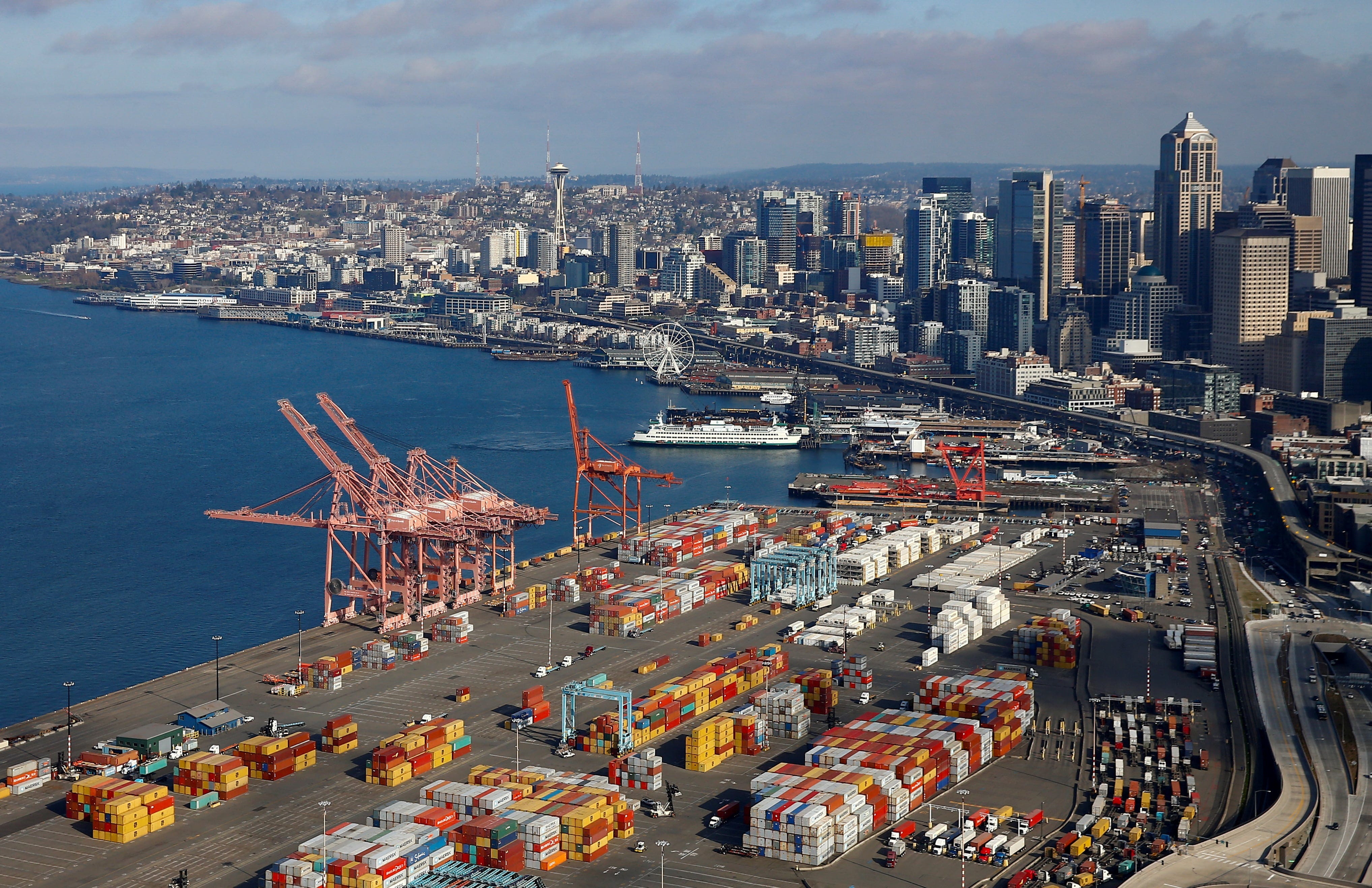
The dispute arose after SSA Terminals reopened and modernized Terminal 5 in the Port of Seattle, triggering competing claims to the same equipment maintenance and repair work from ILWU and IAM, each acting under separate collective bargaining agreements with SSA Terminals. Because SSA Terminals could not assign the work to one union without breaching its contract with the other, the dispute qualified as a "jurisdictional dispute" under the NLRA. SSA Terminals invoked Section 8(b)(4)(D) of the NLRA and asked the Board to resolve the conflict under Section 10(k). Following a hearing, the Board awarded the work to IAM, citing the employer's preference, IAM's skills and experience, and considerations of economy and efficiency.
ILWU did not accept the outcome. It filed a grievance against SSA Terminals, arguing the company failed to defend ILWU's contractual right to the work during the Board proceeding, and an arbitrator ruled in ILWU's favor, ordering SSA Terminals to pay ILWU for lost work opportunities. IAM and SSA Terminals then brought an unfair labor practice charge against ILWU, arguing that pursuing the grievance violated Section 8(b)(4)(D) by attempting to coerce SSA Terminals into defying the Board's work assignment. The Board agreed and rejected ILWU's argument that its conduct was protected "work preservation" activity under the standard set out by the Supreme Court in National Labor Relations Board v. International Longshoremen's Association.
The central question for the en banc court was whether that work-preservation defense, which can excuse conduct otherwise barred as unlawful "secondary" pressure under Section 8(b)(4)(B), also applies to charges brought under Section 8(b)(4)(D) for defying a Board jurisdictional-dispute ruling. The court held it does not. It explained that Section 8(b)(4)(B) is aimed at distinguishing legitimate primary pressure on an employer from unlawful secondary pressure on neutral third parties, so the work-preservation defense makes sense there. Section 8(b)(4)(D), by contrast, already presupposes primary activity, since every union in a jurisdictional dispute is seeking work from its own contracting employer. Allowing a union to invoke work preservation to excuse defiance of a Board's Section 10(k) award would let any losing union escape liability simply by describing its noncompliance as an effort to preserve its own contractual work, undermining Congress's purpose in creating the Section 10(k) process: providing a conclusive, binding resolution to jurisdictional disputes.
In reaching this conclusion, the court expressly overruled language from its earlier decision in Kinder Morgan suggesting that the work-preservation defense could defeat a Section 8(b)(4)(D) charge. The court found the reasoning of the D.C. Circuit's decision in Sea-Land more persuasive, agreeing that permitting such a defense would let unions circumvent the Board's authority to finally resolve jurisdictional disputes. The court also rejected ILWU and PMA's argument for a narrower exception when a union is enforcing a bargained-for "work modernization" clause, noting that such clauses are common and that allowing an exception for them would still undermine the Board's ability to issue binding resolutions. The court clarified that the Board must still consider the terms of the parties' collective bargaining agreements, including modernization clauses, when deciding how to assign disputed work in the first instance, but once the Board issues its determination, the losing union cannot use the work-preservation defense to defy it.
Significant Cases Cited
National Labor Relations Board v. International Longshoremen's Association, 447 U.S. 490 (1980): Established the two-part work-preservation defense test for determining whether conduct is protected primary activity rather than unlawful secondary activity under Section 8(b)(4)(B).
International Longshore & Warehouse Union v. National Labor Relations Board (Kinder Morgan), 978 F.3d 625 (9th Cir. 2020): Previously suggested, in language the en banc court overruled here, that the work-preservation defense could defeat a Section 8(b)(4)(D) unfair labor practice charge.
National Woodwork Manufacturers Association v. National Labor Relations Board, 386 U.S. 612 (1967): First articulated the work-preservation defense distinguishing primary from secondary union activity.
NLRB v. Plasterers' Local Union No. 79 (Texas Tile), 404 U.S. 116 (1971): Explained that Section 8(b)(4)(D) must be read together with Section 10(k) as an interlocked scheme for resolving jurisdictional disputes.
International Longshoremen's & Warehousemen's Union v. NLRB (Sea-Land), 884 F.2d 1407 (D.C. Cir. 1989): Held that a union charged with violating Section 8(b)(4)(D) for defying a Section 10(k) award cannot invoke the work-preservation defense.
AOD Movie, LLC, 02-RM-389897 (Regional Election Decision)
The Regional Director for Region 2 dismissed a petition filed by AOD Movie, LLC seeking an election among its production assistants after the Union sought voluntary recognition of that group.
The employer's position was that it was a single purpose entity formed only to produce a movie, that the production had wrapped, that every production assistant's employment had already ended, and that none of them had any expectation of being rehired. The Union, for its part, took issue with the scope of the proposed unit, arguing it improperly left out the production secretary, but did not dispute the employer's account of the workforce's status.
After receiving the parties' statements of position, the Regional Director issued an order to show cause and indefinitely postponed the hearing, asking the parties to explain why the petition should not simply be dismissed. Neither party responded by the deadline.
Given that silence, and the uncontested facts that no employees currently work in the proposed unit and that former employees have no expectation of future employment there, the Regional Director found there was no employee complement for which an election could be held and dismissed the petition. The order advised the parties of their right to seek Board review of the dismissal under Section 102.67 of the Board's Rules and Regulations.
Phoenix Energy Management Inc. And PEM Inc., 29-RM-350311 (Unpublished Board Decision)
The Board denied the employer's request for review of a Regional Director's decision dismissing an RM petition and a decertification petition after unresolved unfair labor practice charges were pending against the employer.
The Regional Director had applied what the Board calls a "merit-determination dismissal," under which the petitions were dismissed, subject to reinstatement, based on a determination regarding the merit of certain unfair labor practice allegations. Under that framework, complaint allegations are accepted as true, and the question becomes whether those allegations, if proven, would require setting aside an election. The employer did not challenge how the Regional Director applied that test to the facts. Instead, it argued the framework should not have been applied at all, primarily because the Regional Director allegedly failed to first resolve whether Ironworkers Local 852 had properly assumed representation of the unit employees from another local, Ironworkers Local 580. The Board rejected this argument, finding that the Regional Director had implicitly treated the complaint's allegation that Local 852 assumed representation from Local 580 as true, consistent with the merit-determination dismissal methodology, even though her order did not say so explicitly.
Chairman Murphy and Member Mayer noted they did not participate in the Rieth-Riley Construction Co. decision establishing the merit-determination dismissal framework and take no position on whether it was correctly decided, applying it here only for institutional consistency. Member Mayer separately reiterated views expressed in a prior Starbucks Corp. matter that the framework deserves reconsideration because it can leave employees unable to exercise their representation choice for extended periods. He also flagged that seventeen months passed between the close of the pre-election hearing and the dismissal order, despite no litigable issues being raised at that hearing, calling the delay regrettable given the prompt-election protections under the 2020 Election Protection Rule that governed these petitions.
Significant Cases Cited
Rieth-Riley Construction Co., 371 NLRB No. 109 (2022): Established the merit-determination dismissal framework, under which unfair labor practice complaint allegations are accepted as true to assess whether they would require setting aside an election.
Marathon Petroleum Logistics Services LLC, 27-RD-387246 (Unpublished Board Decision)
The Board denied a request for review of a Regional Director's decision to hold a decertification petition in abeyance under the blocking-charge policy set out in Section 103.20 of the Board's Rules and Regulations. The Board found the request raised no substantial issues warranting review, so the petition remains on hold while related unfair labor practice charges are processed.
In a footnote, two Board members wrote separately to note that they were applying existing law without expressing any view on whether the blocking-charge policy itself was correctly decided. They pointed out that under current procedures, regional directors are expected to keep reassessing whether a charge should continue to block a petition throughout the processing of both the charge and the petition, and that a regional director retains authority to resume processing a petition if special circumstances arise or if employee free choice becomes possible despite the pending unfair labor practice allegations.
Significant Cases Cited
Starbucks Corporation, 374 NLRB No. 141 (2026): Addressed the Board's blocking-charge procedures and regional directors' ongoing duty to assess whether a charge blocks a pending petition.