
Starbucks Corporation, 375 NLRB No. 28, 19-CA-295850 (Published Board Decision)
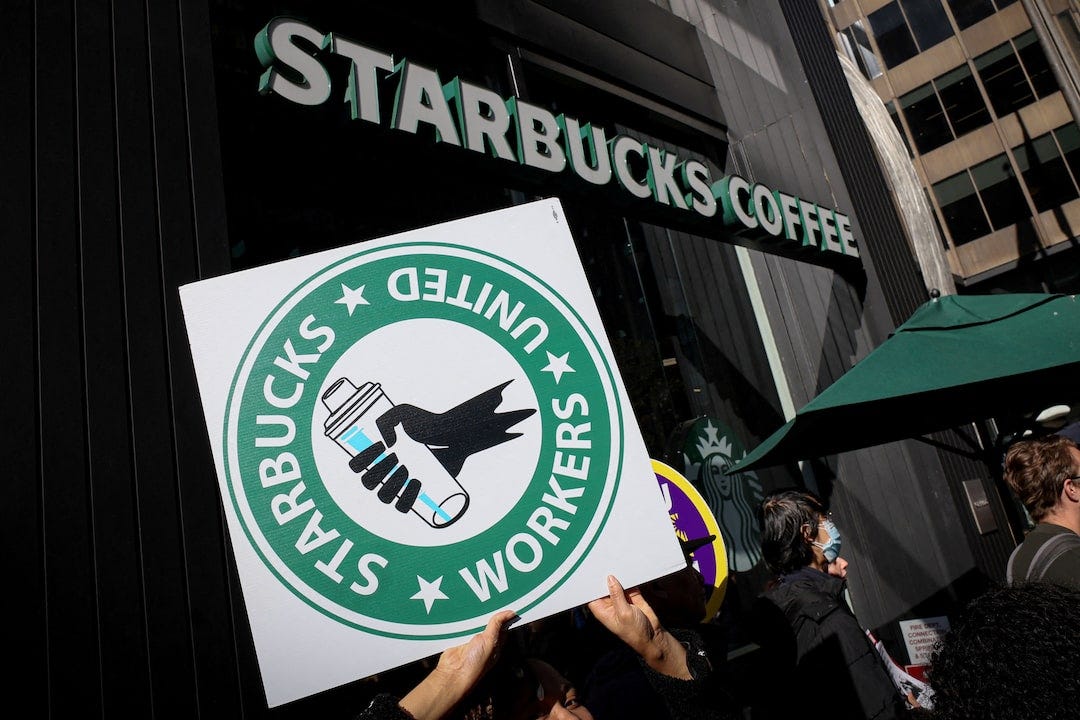
The Board majority reversed an administrative law judge and dismissed a complaint alleging that Starbucks unlawfully threatened employees over their ability to pick up shifts at other stores based on union status.
Starbucks employees are typically scheduled for fewer than 40 hours a week at their assigned “home store” and routinely “borrow” shifts at other locations to make up hours. In January 2022 the company rolled out an online tool called Shift Marketplace to facilitate this borrowing, and none of the training materials or guides limited borrowing based on whether an employee’s home store was unionized.
Barista Alejandra Toscano’s home store, the Holman Road location in Seattle, was unionized in May 2022. She continued borrowing shifts at the nonunion Green Lake store afterward. When coworkers there told her she would no longer be able to pick up shifts because her home store had unionized, Toscano confronted Green Lake manager Chelsea Zapata. Zapata said she had heard at a meeting with other managers and company lawyers that unionized and nonunion stores could not borrow from each other, but she immediately added that she “didn’t know exactly what was true,” saw no problem with the practice, and told Toscano she could keep borrowing shifts. In a follow-up text exchange days later, Zapata repeated that she wasn’t sure what was accurate and told Toscano she was “always welcome” at Green Lake. Toscano kept borrowing shifts without interruption and later transferred permanently to Green Lake.
The judge found this exchange amounted to an unlawful threat to eliminate an existing benefit in violation of Section 8(a)(1). The Board majority disagreed, holding that Zapata’s equivocal, employee-prompted remarks, paired with her repeated assurances that borrowing could continue, lacked a reasonable tendency to coerce. The majority emphasized that no company-wide restriction was ever implemented or announced, that Starbucks’s own guidance documents never limited borrowing based on union status, and that Zapata was a low-level manager who hedged rather than announcing a new policy. The majority distinguished the case from prior rulings, including other Starbucks cases from around the same period, because those involved unprompted threats made during active organizing drives, whereas here Toscano initiated the conversation and Zapata committed to preserving the status quo. The majority cited The Singer Co. in support of treating an equivocal statement as non-coercive.
Member Prouty dissented, arguing that the totality of the circumstances still supported finding a threat. He reasoned that a threat’s coercive effect does not depend on whether it is later carried out, that Zapata’s uncertainty and assurances did not erase the chilling effect of relaying that company lawyers had described a borrowing restriction, and that the timing, six days after the union’s certification, heightened the impact. He also pointed to other Board decisions finding that Starbucks made similar borrowing-related threats at stores elsewhere in the country around the same time, arguing this broader pattern supported treating Zapata’s comments as coercive. The decision also notes that Starbucks sought Member Prouty’s recusal based on his past ties to SEIU-affiliated unions, but he declined to step aside after consulting with the Board’s ethics official.
Significant Cases Cited
Lush Cosmetics, LLC, 372 NLRB No. 54 (2023): Statements alleged to violate Section 8(a)(1) are judged by whether they have a reasonable tendency to coerce employees, considering the totality of the circumstances, regardless of intent or actual effect.
The Singer Co., 199 NLRB 1195 (1972): A manager’s equivocal statement about a possible plant closure was too tentative to constitute an unlawful threat.
Daikichi Sushi, 335 NLRB 622 (2001): An employer’s prediction of adverse consequences from unionization can be unlawfully coercive even when phrased as a possibility rather than a certainty.
Holy Cross Hospital, 370 NLRB No. 16 (2020): An employer unlawfully threatened an employee by suggesting that unionizing could make leave policies less generous and scheduling less flexible.
Metro One Loss Prevention Services Group, 356 NLRB 89 (2010): An employer unlawfully threatened employees by suggesting that pay and conditions could get worse if they unionized.
Covenant House New York, 375 NLRB No. 21, 02-CA-337831 (Published Board Decision)
The Board affirmed an administrative law judge's finding that a New York City nonprofit serving homeless youth violated the NLRA in its dealings with a union representing its professional and nonprofessional staff. The employer did not contest the underlying violations on appeal, instead arguing that two employees on the union's bargaining committee were managers whose participation tainted the process, and that Board investigators had improperly interviewed those employees without the employer's counsel present.
The Board rejected both arguments for the reasons already given by the judge. It also addressed, for the first time, the employer's broader challenge to the Board's "Skip Counsel Policy," which governs how agency staff may interview individuals whose status as a supervisor or party agent is uncertain during an unfair labor practice investigation. The Board held the policy consistent with American Bar Association Model Rule 4.2 on contacts with represented parties, noting the rule allows communication with the represented person's counsel's consent or as authorized by law, and that a comment to the rule permits investigative contacts by government lawyers before civil enforcement proceedings. The Board also rejected the argument that the policy needed formal notice-and-comment rulemaking, since it is nonbinding internal guidance rather than a binding rule. One member indicated he might be open to revisiting the policy's protections in a future case, but agreed it provided no basis to overturn the findings here.
On the merits found below and not excepted to, the judge determined that the employer failed and refused to bargain in good faith by cancelling sessions, refusing to make proposals, insisting the union remove certain bargaining committee members, and eventually refusing to bargain at all; that it unlawfully withheld information the union needed to represent employees; and that it unlawfully threatened employees with discipline for engaging in union activity. Central to the case was the employer's claim that its director of development and communications and its program compliance coordinator were "managerial" employees who could not lawfully sit on the union's bargaining committee. The judge found, based on detailed testimony about their actual duties, that both employees exercised no independent discretion to depart from policies set by senior executives, and so were neither managers, supervisors, nor confidential employees under the Act. The judge further ruled that the employer could not shortcut this factual inquiry by "admitting" managerial status in its answer, since the burden of proving such status rests with the party asserting it, and the employer had never raised the issue during the earlier representation proceeding where it agreed to include these job titles in the unit.
The Board modified the recommended order to correct clerical errors regarding dates and to conform to standard remedial language, and ordered the employer to bargain with the union, produce the requested information, and post a notice to employees at its facilities across the Bronx and Manhattan.
Significant Cases Cited
NLRB v. Yeshiva University, 444 U.S. 672 (1980): Defines managerial employees as those who formulate and effectuate management policy by making and expressing operative decisions on the employer's behalf.
NLRB v. Truitt Mfg. Co., 351 U.S. 149 (1956): Establishes that employers must supply unions with information relevant and necessary to their duties as collective-bargaining representative.
Oakwood Healthcare, Inc., 348 NLRB 686 (2006): Sets out the framework for determining supervisory status under Section 2(11), including the requirement of independent judgment.
NLRB v. Katz, 369 U.S. 736 (1962): Holds that conduct reflecting a mindset against reaching agreement, or that obstructs the bargaining process, violates the duty to bargain in good faith.
I.O.O.F. Home of Ohio, Inc., 322 NLRB 921 (1997): Bars a respondent in a refusal-to-bargain case from relitigating unit or supervisory-status issues that were or could have been resolved in the prior representation proceeding.
SSM Health Saint Louis University Hospital, 375 NLRB No. 26, 14-RD-347354 (Published Board Decision)
The Board granted an employer's request for review of a Regional Director's decision dismissing a decertification petition on contract-bar grounds, and on review reversed that determination, finding the underlying collective-bargaining agreement lacked bar quality.
The employer and the union had operated under a contract that expired in mid-2023 and began negotiating a successor agreement. At their final bargaining session, the parties signed a tentative agreement that left blanks in place of the actual effective and expiration dates, instead using placeholder language such as "[Insert date of ratification]" and "[TBD one year after final wage increase]." The union's membership ratified the agreement days later, and a nurse then filed a decertification petition before the parties went back and filled in the missing dates. The Regional Director dismissed the petition, concluding the newly ratified contract barred it.
The Board disagreed, holding that both the effective date and the expiration date of a contract must be determinable from the face of the document itself, without resort to outside evidence, in order for the agreement to bar an election petition. Because the agreement here contained only blanks and instructions to insert dates, rather than the dates themselves, an employee or rival union reviewing the document could not determine when the window period for filing a petition would open. The Board distinguished cases the union and the Regional Director relied on, explaining that those decisions permitted extrinsic evidence only to establish when an already-dated agreement was signed, not to supply a missing effective or expiration date altogether. The Board also rejected reliance on Swift & Co. and Merico, Inc., noting that both involved agreements with dates clearly stated on their face, unlike the blank template at issue here. Because the union, as the party asserting the contract bar, failed to meet its burden of showing the agreement had bar quality, the Board reversed the dismissal and remanded the case for processing of the decertification petition.
Member Prouty dissented, arguing that the agreement's terms were sufficient because it expressly stated the contract would take effect upon ratification and expire based on a formula tied to the ratification date. In his view, the ratification date was not parol evidence altering the contract's terms but simply a fact needed to apply terms already stated on the document's face, and requiring parties to later reinsert that date into the agreement was an unnecessary formality.
Significant Cases Cited
South Mountain Healthcare & Rehabilitation Center, 344 NLRB 375 (2005): Held that both the effective date and expiration date of a contract must be apparent from the face of the document, without resort to parol evidence, for the contract to serve as a bar.
Jackson Terrace Associates, 346 NLRB 180 (2005): Permitted extrinsic evidence to establish the execution date of an agreement that already contained a stated effective date and termination date.
Cooper Tank & Welding Corp., 328 NLRB 759 (1999): Allowed extrinsic evidence of when the parties signed an undated signature page on a contract that undisputedly contained an effective date.
Swift & Co., 213 NLRB 49 (1974): Held an employer could rely on a union's representation that ratification, a condition precedent, had properly occurred where the agreement already stated definite effective and expiration dates.
Merico, Inc., 207 NLRB 101 (1973): Held a tentative agreement making ratification a condition precedent did not bar a rival petition because the agreement was never ratified before the petition was filed.
Overseas Shipholding Group, Inc., 375 NLRB No. 24, 12-CA-386056 (Published Board Decision)
The Board granted summary judgment against Overseas Shipholding Group, Inc. for refusing to bargain with the International Organization of Masters, Mates & Pilots after the union was certified as the exclusive bargaining representative of a unit of licensed deck officers on the company's U.S.-flag vessels.
The union won a mail-ballot election conducted between June and October 2024, and the Regional Director certified it as the unit's representative on October 31, 2024. The company sought Board review of the underlying representation decision, which the Board denied in March 2026. When the union then requested bargaining, the company refused, prompting the General Counsel to file an unfair labor practice complaint alleging violations of Section 8(a)(5) and (1) of the NLRA.
In its defense, the company admitted refusing to bargain but argued the refusal was not unlawful because the certified unit was inappropriate, an argument it had already raised and lost in the representation case. The Board held that this issue, along with any other representation questions, had already been fully litigated and could not be reheard in the unfair labor practice proceeding absent newly discovered evidence or special circumstances, neither of which the company offered. The company's admission that it refused to bargain was itself enough to establish the violation.
The Board also rejected several constitutional arguments the company raised, including claims that the Board's structure violates separation-of-powers principles by insulating administrative law judges, Regional Directors, and Board members from removal, that the Board improperly delegated authority to Regional Directors, and that Board proceedings violate Article III and the Seventh Amendment by adjudicating private rights without a jury. The Board found these assertions unsupported by any explanation or evidence and insufficient to defeat summary judgment.
Having found the refusal to bargain unlawful, the Board ordered the company to bargain with the union on request and, to ensure employees receive the full benefit of their certification year, ruled that the certification period will run from the date the company actually begins bargaining in good faith. The company must also post and electronically distribute a notice to employees describing the violation and their rights under the NLRA.
Significant Cases Cited
Pittsburgh Plate Glass Co. v. NLRB, 313 U.S. 146 (1941): Representation issues that were or could have been litigated in a prior representation proceeding cannot be relitigated in a subsequent unfair labor practice case absent newly discovered evidence or special circumstances.
Mar-Jac Poultry Co., 136 NLRB 785 (1962): When an employer unlawfully refuses to bargain after certification, the certification year is measured from the date bargaining actually begins in good faith, not from the certification date.
Randalls Food & Drug, L.P., 369 NLRB No. 100 (2020): An employer's admission that it refused a union's bargaining request is sufficient by itself to establish a violation of the Act.
Frontier Hotel, 265 NLRB 343 (1982): The Board may take official notice of the record in a related representation proceeding when deciding a refusal-to-bargain case.
Sysco Central California, Inc., 371 NLRB No. 95 (2022): Bare constitutional challenges to the Board's structure or authority, unsupported by explanation or evidence, do not warrant denial of summary judgment.
United Food & Commercial Workers Local 7, AFL-CIO, JD-49-26, 27-CA-327689 (ALJ Decision)
An administrative law judge has found that a Colorado local of the United Food and Commercial Workers unlawfully suspended and fired one of its own employee-union representatives after he testified against the union in an earlier NLRB trial, and separately found that the union tried to get a grocery store to punish him based on a false threat report.
Randy Blea spent more than a decade as a union representative for UFCW Local 7, handling grievances and member issues at Denver-area grocery stores. He was also a steward for the union representing Local 7's own employees. In August 2023, Blea testified for the General Counsel and that employee union in an unrelated unfair labor practice case against Local 7, describing harsh treatment of representatives during a 2022 strike. A week later, Local 7 suspended him pending an investigation into his job performance, and two weeks after that, it fired him, citing complaints from union members and past disciplinary history.
The judge concluded the timing and Local 7's own conduct showed the real motive was retaliation for Blea's testimony and union activity, not performance. The judge noted that Local 7 never told Blea before his testimony that it was investigating his overall performance, and that its account of when the probe began was uncorroborated, since it did not call its president, Kim Cordova, to testify. The judge also found that Local 7 treated Blea far more harshly than other representatives with worse disciplinary records, several of whom kept their jobs or were allowed to resign after multiple suspensions, while Blea was discharged based on a single suspension over a year earlier. Statements by retail director Ramon Zuniga, including a remark to Blea about not "recording him like" a witness from the earlier case, further supported a finding of animus. Applying the Wright Line framework, the judge held Local 7 failed to prove it would have fired Blea absent his protected conduct.
The decision also addressed events after Blea took a new job at a King Soopers store still represented by Local 7. A union representative named Tom Olson confronted Blea over fliers critical of Cordova, and Blea told him to back off. Olson then reported to King Soopers that Blea had threatened him with physical violence, a claim a store investigation found unsubstantiated, and a Local 7 supervisor asked the store whether Blea had been suspended over the alleged threat. The judge found this violated the NLRA's restrictions on unions causing employers to discriminate against employees, concluding Olson fabricated or exaggerated the threat in retaliation for Blea's perceived support of dissident union activity. A separate allegation, that a Local 7 official improperly raised Blea's criminal background with King Soopers months later, was dismissed as untimely, a point the General Counsel conceded.
The judge also rejected Local 7's argument that Blea's backpay should be cut off based on later-discovered claims that he told another employee to falsify a hiring date to avoid back dues, finding the evidence uncorroborated and not credible. The recommended remedy includes full reinstatement, back pay with interest, compensation for related expenses and tax consequences, and removal of references to the suspension and discharge from Blea's personnel file.
Significant Cases Cited
Wright Line, 251 NLRB 1083 (1980): Establishes the burden-shifting framework for determining whether an employer's (or union's) adverse action against an employee was motivated by protected activity.
Caravan Knight Facilities Mgmt., Inc., 362 NLRB 1802 (2015): Holds that when a union causes an adverse employment action, a rebuttable presumption of unlawful motive arises unless the union shows it acted in good faith on rational considerations tied to its representational duties.
Acklin Stamping, 351 NLRB 1263 (2007): Recognizes that a union has a legitimate interest in reporting genuine threats of physical harm to an employer as part of its duty to represent all unit employees.
SPFPA Local 444, 360 NLRB 430 (2014): Found a union violated the Act when an official gave an employer an exaggerated and misleading account of an employee's conduct.
Tel Data Corp., 315 NLRB 364 (1994): Sets the standard for the after-acquired evidence doctrine, under which reinstatement and backpay can be limited only if the employer proves the employee engaged in misconduct that would have led to discharge.
Sutter VNA and Hospice Dba Sutter Care at Home (Alameda Hospice), 32-RC-388749 (Regional Election Decision)
A National Labor Relations Board regional director has directed a self-determination election that would let two currently unrepresented job classifications at a Bay Area hospice provider decide whether to join an existing union-represented bargaining unit.
The case arose after the National Union of Healthcare Workers, which already represents a mixed unit of professional and non-professional employees at Sutter Care at Home's Alameda hospice location, petitioned to add Bereavement Counselor III and Volunteer Program Specialist employees to that unit. Because both sides agreed the petitioned-for group was a distinct and identifiable segment of the workforce, the only question was whether these two classifications share a community of interest with employees already in the union's unit, the standard required for what's known as an Armour-Globe self-determination election.
The employer, Sutter VNA and Hospice, missed the deadline to file its statement of position and was barred from actively litigating the case, though its hospice administrator testified and its exhibits were admitted into the record.
The regional director walked through the traditional community-of-interest factors: departmental organization, interchange and contact among employees, functional integration, similarity of skills and duties, common supervision, and shared terms of employment. She found the Bereavement Counselor III position overlaps heavily with the already-represented Bereavement Counselor II role, sharing an office, a caseload system, licensing requirements, and job duties, with employees regularly filling in for one another. That classification was found to share a strong community of interest with the existing unit on nearly every factor.
The Volunteer Program Specialist presented a closer question. That role does not interchange with unit employees and performs largely distinct duties overseeing the hospice's volunteer program, weighing against inclusion. But the position is commonly supervised by the same hospice administrator, works from the same office, attends the same interdisciplinary care meetings, and is functionally integrated with the existing unit's clinical and psychosocial staff, coordinating volunteer visits with nurses, chaplains, and social workers and sharing similar wages and benefits. Citing Board precedent holding that a petitioned-for group need only share a community of interest with a minority of the existing unit rather than the whole unit, the regional director found this sufficient for inclusion.
Because both classifications are professional employees, the ballot will ask them first whether they wish to be included with non-professional employees in a single unit, and second whether they wish to be represented by the union. The self-determination election was scheduled for August 12, 2026, at the employer's Alameda facility.
Significant Cases Cited
Armour & Co., 40 NLRB 1333 (1942): Established, along with Globe Machine & Stamping, the framework for self-determination elections allowing unrepresented employees to vote on joining an existing bargaining unit.
Warner-Lambert Co., 298 NLRB 993 (1990): Held that an Armour-Globe election requires determining whether the employees to be added share a community of interest with unit employees and constitute an identifiable, distinct voting group.
United Operations, Inc., 338 NLRB 123 (2002): Set out the multi-factor community-of-interest test, including departmental organization, skills, job functions, integration, contact, interchange, terms of employment, and supervision.
Public Service Co. of Colorado, 365 NLRB 1017 (2017): Held that a petitioned-for group in a self-determination election need only share a community of interest with a minority of the existing unit, not the whole unit or a majority of it.
Sonotone Corp., 90 NLRB 1236 (1950): Established the mechanism for self-determination elections among mixed groups of professional and non-professional employees.
A-National Limousine Services, Inc., and a-National Transit, LLC, Joint and Single Employers, 10-RC-369430 (Unpublished Board Decision)
The Board denied an employer's request for review of a Regional Director's decision directing an election in a unit of drivers and related employees for A-National Limousine Services and A-National Transit, finding no substantial issues warranting review.
The employer had argued that the voting unit would soon shrink because its contractual relationship with the Metro Atlanta Rapid Transit Authority (MARTA) was set to end on September 30, 2025, and that the current unit therefore did not represent a substantial and representative complement of the workforce that would remain afterward. The Board rejected this argument based on facts it took administrative notice of: rather than ending the contract, MARTA's board had extended it three times, most recently through December 31, 2026. That timeline pushed any potential contraction to at least seventeen months after the hearing and well beyond the roughly six-month window the Board has previously treated as sufficient for meaningful bargaining before a workforce reduction.
Because the employer failed to show that a contraction of the unit was likely "in the near future," the Board found it unnecessary to reach the separate question of whether the current unit was a substantial and representative complement of the eventual, post-contraction unit. The Regional Director's decision directing the election was upheld.
Significant Cases Cited
MJM Studios, 336 NLRB 1255 (2001): Addresses the standard for determining whether an anticipated change in the size of a bargaining unit is expected to occur "in the near future" for purposes of assessing unit eligibility.
E.I. du Pont de Nemours and Co., 117 NLRB 1048 (1957): Held that a period of roughly six months can constitute sufficient time for meaningful collective bargaining before an anticipated change in the workforce.
Ethyl Corporation, 16-RD-374495 (Unpublished Board Decision)
The Board denied three requests for review of a Regional Director's decision dismissing a petition to decertify a union at Ethyl Corporation, finding the requests raised no substantial issues warranting review.
The case centered on a decertification petition filed against the United Steel, Paper and Forestry, Rubber, Manufacturing, Energy, Allied Industrial and Service Workers International Union, Local 227, in a multi-employer bargaining unit that included both Ethyl Corporation and Afton Chemical Corporation. Ethyl and Afton had raised the question of whether they constituted a single employer, but the Board found it unnecessary to resolve that issue.
Instead, the Board agreed with the Regional Director's alternative rationale: even treating Ethyl and Afton as separate employers, Ethyl had not effectively withdrawn from the multi-employer bargaining unit before the decertification petition was filed. The Board explained that although Ethyl initially gave timely notice of withdrawal from multi-employer bargaining, it undid that withdrawal by continuing to participate in multi-employer negotiations and by reaching a tentative agreement that covered the existing multi-employer unit. Because the petition sought to decertify only part of the existing bargaining unit rather than the unit as a whole, it was not coextensive with the unit and had to be dismissed under established Board precedent.
Significant Cases Cited
Campbell Soup Co., 111 NLRB 234 (1955): A decertification petition must be coextensive with the existing bargaining unit or it will be dismissed.
NLRB v. Associated Shower Door Co., 512 F.2d 230 (9th Cir. 1975): An employer's attempted withdrawal from multi-employer bargaining can be negated by its subsequent conduct indicating continued participation in group bargaining.
Dependable Tile Co., 268 NLRB 1147 (1984): Reaffirmed that an employer who withdraws from multi-employer bargaining but then participates in and is bound by group negotiations has effectively negated that withdrawal.
Michael J. Bollinger Co., 252 NLRB 406 (1980): An employer's continued participation in multi-employer contract negotiations after a purported withdrawal can nullify the withdrawal.