
Amazon.com Services, LLC, 374 NLRB No. 138, 29-CA-277198 (Published Board Decision)
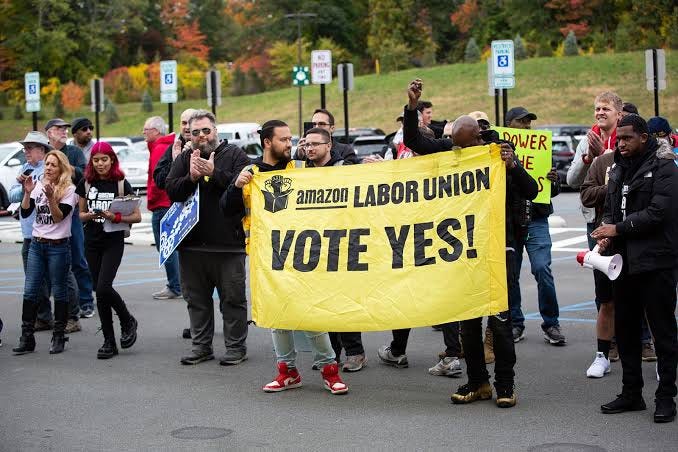
The Board has affirmed an administrative law judge’s findings that Amazon committed a series of violations of the NLRA during the Amazon Labor Union’s 2021 organizing campaign at the JFK8 fulfillment center on Staten Island, while dismissing one allegation involving the discharge of an employee at a nearby delivery station.
The Board upheld findings that contracted security guards acted as Amazon’s agents when they told an employee he needed permission to distribute union literature, confiscated the literature, and photographed his badge to report him to human resources. In a separate incident about a week later, another security guard created the impression that employees’ union activities were under surveillance by pointing a phone at organizers and workers during a union event. The Board also affirmed that Amazon violated the law in June 2021 when a manager and a human resources employee separately told employees they could not hand out union literature on their own time in nonwork areas and confiscated the literature, and when another human resources employee did the same later that day.
The Board dismissed the allegation that Amazon violated the law by firing employee Daequan Smith from a nearby delivery station. The Union had argued that a manager who had displayed hostility toward Smith’s union activity manipulated his time records to trigger his firing over a negative unpaid-time balance, a theory drawn from the Supreme Court’s “cat’s paw” doctrine in Staub v. Proctor Hospital. The Board found the record did not establish that any such manipulation occurred, so neither the General Counsel nor the Union could show that a biased Amazon agent caused the termination.
On the remedy, the Board corrected an error in how backpay for Smith’s earlier unlawful early dismissal should be calculated, and a plurality of two members declined to take a position on whether the expanded remedies from Thryv, Inc. are lawful, while agreeing to apply them for now. A third member, Member Prouty, would have gone further and required Amazon to read the notice aloud to employees and hand-deliver it to supervisors, citing the company’s pattern of restricting employees’ access to information about their organizing rights while flooding them with anti-union messaging through its own communication channels.
Significant Cases Cited
Staub v. Proctor Hospital, 562 U.S. 411 (2011): Established the “cat’s paw” theory of discrimination, under which an employer can be liable for an adverse action influenced by a biased supervisor’s actions even if the ultimate decisionmaker held no discriminatory animus.
Thryv, Inc., 372 NLRB No. 22 (2022): Announced expanded standard remedies requiring employers to compensate employees for all direct or foreseeable pecuniary harms resulting from unfair labor practices, not just traditional backpay.
F. W. Woolworth Co., 90 NLRB 289 (1950): Set the standard method for computing backpay in NLRB remedial orders.
New Horizons, 283 NLRB 1173 (1987): Established the interest rate applied to backpay awards in Board remedies.
Standard Dry Wall Products, 91 NLRB 544 (1950): Set the Board’s policy against overturning an administrative law judge’s credibility findings absent a clear preponderance of contrary evidence.
Riverside Healthcare System, L.P., D/B/a Riverside Community Hospital, 374 NLRB No. 139, 21-CA-347056 (Published Board Decision)
The hospital refused to bargain with the union after a self-determination election added a small group of specialized registered nurse classifications (including trauma registry, quality coordination, and sepsis coordinator roles) to an existing nurse bargaining unit. Rather than litigating a fresh unfair labor practice defense, the hospital used the refusal as a vehicle to get court review of the underlying representation case, arguing that these nurses were actually managerial and supervisory employees excluded from the NLRA's coverage.
The Board rejected this approach because the hospital had already raised, and lost, this same managerial and supervisory argument during the representation proceeding, including in a request for Board review that was denied in January. Since the hospital did not offer any newly discovered evidence or point to special circumstances justifying a second look, the Board found there was no litigable issue and granted the General Counsel's summary judgment motion, citing Pittsburgh Plate Glass Co. v. NLRB for the principle that such re-litigation is barred.
The hospital's answer also included several denials that the Board found legally insufficient to block summary judgment, including disputing that it was served the charge (contradicted by a certified affidavit of service) and disputing a business relationship already stipulated to in the representation case. The hospital additionally raised broad constitutional challenges: that Board members and administrative law judges are unconstitutionally shielded from removal, that the NLRB's structure violates separation of powers and due process, and that the Board's adjudication of unfair labor practice remedies violates the Seventh Amendment right to a jury trial. The Board rejected all of these as unsupported, bare assertions, noting the hospital had not shown any actual harm from the removal protections and that the Supreme Court has already held that NLRB adjudication does not implicate the Seventh Amendment, since the Act creates a public right that Congress may assign to administrative adjudication.
Having found the refusal to bargain unlawful under Section 8(a)(5) and (1), the Board ordered the hospital to bargain with the union on request, post the standard notice both physically and electronically, and file a compliance certification within 21 days. The Board declined the General Counsel's request to extend the union's certification year, since that remedy does not apply when the underlying election was a self-determination election rather than a first-time certification vote.
Significant Cases Cited
Pittsburgh Plate Glass Co. v. NLRB, 313 U.S. 146, 162 (1941): Established that representation issues already litigated (or that could have been litigated) in the underlying representation proceeding cannot be relitigated in a subsequent unfair labor practice case absent newly discovered evidence or special circumstances.
NLRB v. Jones & Laughlin Steel Corp., 301 U.S. 1 (1937): Held that the NLRA does not violate the Seventh Amendment because it involves a public right that Congress may assign to administrative adjudication rather than a jury trial.
Atlas Roofing Co. v. OSHRC, 430 U.S. 442 (1977): Reaffirmed that Congress may assign adjudication of public rights created by statute to an administrative agency without violating the Seventh Amendment.
Winkie Mfg. Co., 338 NLRB 787 (2003): Held that the Mar-Jac Poultry certification-year extension remedy is inappropriate where the underlying election was a self-determination election rather than an initial certification election.
Collins v. Yellen, 594 U.S. 220 (2021): Addressed the standard for showing harm from unconstitutional removal restrictions on agency officials, requiring a showing of actual compensable harm.
Nexstar Media Inc., D/B/a WJET-TV/WFXP-TV/Yourerie.com, 374 NLRB No. 137, 06-CA-343546 (Published Board Decision)
The Board granted summary judgment against Nexstar Media Inc., which operates television stations WJET-TV, WFXP-TV, and Yourerie.com in Erie, Pennsylvania, ordering the company to bargain with the Screen Actors Guild-American Federation of Television and Radio Artists after it refused to recognize the union following certification.
The case followed a familiar pattern used by employers seeking court review of a certification: after the union won an election among on-air employees in March 2024 and was certified as the bargaining representative, the company refused to bargain, allowing it to contest the certification through an unfair labor practice proceeding rather than only through the representation case itself. Nexstar admitted it had refused to bargain but argued it had no obligation to do so because the certification was invalid.
Nexstar's central argument was that a now-rescinded General Counsel memo, which addressed employees' right to refuse captive audience meetings, had tainted the "laboratory conditions" needed for a fair election. The Board rejected this and other arguments as previously litigated and rejected in the underlying representation case, noting Nexstar offered no newly discovered evidence or special circumstances that would justify revisiting the earlier decision. Under established Board precedent, a party generally cannot relitigate representation issues in a later unfair labor practice case unless such new evidence exists.
The company also raised several constitutional and procedural defenses, all of which the Board dismissed. It argued that Board proceedings violated its Seventh Amendment right to a jury trial, a claim the Board rejected by citing longstanding Supreme Court precedent holding that the National Labor Relations Act creates public rights that Congress may assign to administrative adjudication without a jury. Nexstar also challenged the removal protections afforded to Board members and administrative law judges, but the Board found no evidence that Nexstar suffered any actual harm from those protections, following recent precedent on the issue. Additional defenses, including claims that the proceeding was barred by the Act's limitations period or tainted by fraud, were rejected for lack of any factual support.
Having found no litigable issues, the Board concluded that Nexstar's continued refusal to bargain since May 2024 violated Section 8(a)(5) and (1) of the NLRA. It ordered the company to bargain with the union on request, post notices at its Erie facility, and certify compliance with the Regional Director within 21 days.
Significant Cases Cited
NLRB v. Jones & Laughlin Steel Corp., 301 U.S. 1 (1937): Held that the National Labor Relations Act's adjudicatory scheme does not violate the Seventh Amendment right to a jury trial.
Pittsburgh Plate Glass Co. v. NLRB, 313 U.S. 146 (1941): Established that representation issues litigated or litigable in a prior representation proceeding cannot be relitigated in a subsequent unfair labor practice case absent newly discovered evidence.
Atlas Roofing Co. v. OSHRC, 430 U.S. 442 (1977): Reaffirmed that Congress may assign adjudication of public rights, including under labor law, to an administrative agency without violating the Seventh Amendment.
SJT Holdings, Inc., 372 NLRB No. 82 (2023): Held that a respondent must show actual harm from unconstitutional removal protections to obtain relief on that basis.
Mar-Jac Poultry Co., 136 NLRB 785 (1962): Established that the certification year begins running from the date an employer actually begins bargaining in good faith, not from the certification date, when the employer has unlawfully refused to bargain.
Atlassian Corp., JD-43-26, 16-CA-324971 (ALJ Decision)
An administrative law judge has ruled that Atlassian US, Inc. violated the NLRA when it fired a longtime senior site reliability engineer for a series of internal posts criticizing company decisions, and separately found that severance agreements the company offered her contained unlawfully broad confidentiality and nondisparagement clauses, and that four provisions in its "Community Guidelines" were themselves unlawfully overbroad.
The engineer, employed for about 11 years, was coached or reprimanded on three occasions for posts on internal Confluence and Slack channels: a 2019 post questioning a job-title overhaul, a May 2023 post describing coworkers' complaints about a new "stack ranking" performance system, and a June 2023 post criticizing a co-CEO's angry response to employees who questioned planned manager layoffs at a town hall. She was fired days after the third post, with the company's stated reason citing a "pattern" of "acrimonious communications and ad hominem attacks" going back to 2019.
The judge found all three posts were protected concerted activity because each raised or built on group concerns about terms and conditions of employment, including job titles, performance evaluations, and management's treatment of employees during layoff-related changes. Applying the totality-of-the-circumstances test from Desert Springs Hospital Medical Center, the judge found the engineer did not lose the Act's protection: the post was made in an internal, non-public channel designed for employee feedback, other employees made similar or harsher comments without discipline, and the company's own guidelines against "ad hominem attacks" had never previously been enforced. The judge also found that even under the alternative Wright Line burden-shifting framework, the company failed to show it would have fired her absent her protected activity, citing disparate treatment of other employees, suspicious timing, and shifting justifications between the termination itself and the company's litigation position.
On the severance agreements, the judge applied McLaren Macomb and found the confidentiality and nondisparagement clauses, which broadly barred discussing the agreement's existence or making any "negative comments" about the company's integrity, practices, or personnel, were not narrowly tailored and would reasonably chill employees from filing charges or discussing labor disputes. The company's argument that the agreements were sent to her by clerical error was rejected because it never told her so or attempted to rescind them, and, under McLaren Macomb, the mere proffer of an unlawful agreement violates the Act regardless of whether it's signed.
Finally, applying the Stericycle framework, the judge found four separate rules in the company's Community Guidelines unlawfully overbroad: a rule against employees making "demands," a ban on "ad hominem attacks" targeting a person's motives, a rule against communications that could "negatively impact" partners or shareholders, and a rule against disclosing "confidential" information that the company's own ethics code defined to include employee compensation.
The remedy orders reinstatement, backpay, rescission of the unlawful agreement provisions and guideline rules, and a notice-posting requirement.
Significant Cases Cited
McLaren Macomb, 372 NLRB No. 58 (2023): An employer violates Section 8(a)(1) by merely offering a severance agreement with overly broad confidentiality or nondisparagement provisions that aren't narrowly tailored to Section 7 rights, regardless of surrounding circumstances.
Lion Elastomers LLC, 372 NLRB No. 83 (2023): Reinstated setting-specific standards (including the totality-of-the-circumstances test) for evaluating whether an employee lost the Act's protection during otherwise-protected activity, overruling General Motors.
Stericycle, Inc., 372 NLRB No. 113 (2023): Set the framework for evaluating facially neutral work rules, asking whether a reasonable employee would interpret the rule to restrict Section 7 activity, with the employer bearing the burden to justify overbroad language.
Desert Springs Hospital Medical Center, 363 NLRB 1824 (2016): Established the totality-of-the-circumstances standard for evaluating employee misconduct during workplace conversations and social-media posts among coworkers.
Wright Line, 251 NLRB 1083 (1980): Set the burden-shifting framework for analyzing whether an employer's adverse action against an employee was motivated by protected activity.
Providence Regional Medical Center Everett, 19-RC-387865 (Regional Election Decision)
A regional director for the NLRB has ordered an election for a unit of pharmacists at Providence Regional Medical Center Everett in Washington, rejecting the union's proposed unit of inpatient pharmacists only and instead directing a vote covering all of the hospital's pharmacists, including those in its ambulatory care and retail departments.
The Pharmacy Guild/International Association of Machinists and Aerospace Workers had petitioned to represent only the roughly 44 inpatient pharmacists at the hospital's Everett campuses, arguing they were distinct from the hospital's other pharmacists because they worked around-the-clock shifts, used specialized medication-tracking technology, and needed a post-graduate residency that ambulatory and retail pharmacists did not. The Employer countered that the proposed unit was inappropriate on two grounds: the inpatient pharmacists should instead be given a chance to vote on joining an existing bargaining unit represented by United Food and Commercial Workers Local 3000, and any standalone unit would improperly exclude the hospital's other pharmacists.
The regional director's analysis centered on how two areas of Board law intersect in acute-care hospitals. Under the Board's 1987 Health Care Rule, only eight types of bargaining units are generally appropriate in acute care settings, including a single unit covering all professionals apart from registered nurses and physicians, in order to prevent excessive fragmentation of hospital workforces. Separately, the Board's long-standing residual unit doctrine holds that a group of employees left out of an existing bargaining unit can only form its own appropriate unit if it is truly separate and distinct, or if it is "residual," meaning it covers all remaining unrepresented employees of that type.
Because UFCW, which already represents a broad professional unit at the hospital, had declined to seek to add the pharmacists to its existing unit, the option of a self-determination election to fold inpatient pharmacists into that unit was off the table. That left the residual unit doctrine as the operative framework. The decision explains that non-incumbent unions, unlike incumbent ones, may organize a residual unit of employees omitted from an existing bargaining structure, but only if that unit sweeps in all of the unrepresented employees of the relevant type, not just a subset. Since the petitioned-for unit covered only inpatient pharmacists and left the ambulatory care and retail pharmacists unrepresented, it did not qualify as a proper residual unit under the case law. The union indicated at the hearing it was willing to proceed to an election among all of the hospital's pharmacists if the narrower unit was found inappropriate, and the regional director accepted that broader unit of roughly 72 employees as satisfying both the Health Care Rule's anti-proliferation goal and the residual unit requirement. An election was set for July 28, 2026.
Significant Cases Cited
Fleming Foods, 313 NLRB 948 (1994): A petitioned-for unit of employees omitted from an established bargaining unit is appropriate only if it is separate and distinct or if it is residual, covering all unrepresented employees of that type.
St. John's Hospital, 307 NLRB 767 (1992): An incumbent union's petition for a new unit covering only some of the remaining unrepresented employees of a type it already represented was found inappropriate because it risked proliferating units.
St. Vincent Charity Medical Center, 357 NLRB 854 (2011): An incumbent union may seek a self-determination election to add a group of unrepresented employees to an existing unit even if some employees remain unrepresented, since this does not create additional units.
St. Mary's Duluth Clinic Health System, 332 NLRB 1419 (2000): A non-incumbent union may represent a separate residual unit in an acute care hospital if that unit includes all remaining unrepresented employees of one of the Health Care Rule's eight types.
Budd Co., 154 NLRB 421 (1965): An incumbent union cannot petition for a new unit of the same type it already represents and instead must seek to add employees to its existing unit.
The Rochester General Hospital, United Memorial Medical Center, and Unity Hospital, 03-RC-384306 (Regional Election Decision)
Rochester Union of Nurses and Allied Professionals petitioned to represent physicians, nurse practitioners, physician assistants, and registered nurses at Rochester Regional Health's eleven urgent care centers across the Finger Lakes region of New York. The employer, which operates the centers through hospital staff from Rochester General Hospital, United Memorial Medical Center, and Unity Hospital, argued that registered nurses should be excluded from the unit because they lack a community of interest with the physicians, nurse practitioners, and physician assistants (collectively, "providers"). The union countered that all four job classifications share professional employee status, distinguishing them from the licensed practical nurses, medical assistants, and access associates who round out the urgent care staff.
Following an April 21, 2026 hearing, the Regional Director sided with the employer and excluded the registered nurses from the unit.
Applying the Board's community of interest framework, the decision found that most factors weighed against grouping registered nurses with the providers. On skills and functions, providers all diagnose patients, prescribe medications and treatments, and write discharge instructions, and hold advanced degrees along with credentialing and privileging obligations and 50 annual hours of continuing medical education. Registered nurses, by contrast, generally lack a bachelor's degree, do not need continuing medical education or privileging, and cannot diagnose, prescribe, or write discharge instructions. Their duties center on rooming patients, administering treatments providers order, and giving discharge instructions written by others, with only IV medication administration and TB test reading exceeding what licensed practical nurses and medical assistants can do.
The decision also found little functional integration or interchangeability between the two groups, since registered nurses cannot perform provider duties or fill in for an absent provider, while providers rarely perform registered nurse tasks in practice. Supervision differs as well: providers are overseen through a medical director and executive director chain, while registered nurses report through a separate nursing chain of command. Terms and conditions of employment diverge too, with providers salaried and under individual contracts while registered nurses are hourly, accrue overtime, and follow different schedules, dress codes, and evaluation processes.
The decision did find that providers and registered nurses share common work sites and have meaningful contact given the collaborative nature of urgent care, but concluded these two factors were outweighed by the others. The directed unit therefore includes only physicians, physician assistants, and nurse practitioners across the eleven urgent care locations, with a mail ballot election scheduled for mid-June to early July 2026.
Significant Cases Cited
American Steel Construction, Inc., 372 NLRB No. 23 (2022): Overruled PCC Structurals and reinstated the Specialty Healthcare standard, holding that a petitioned-for unit of a subdivision of employees is appropriate if it shares an internal community of interest, is readily identifiable as a group, and is sufficiently distinct.
PCC Structurals, Inc., 365 NLRB No. 160 (2017): Established a stricter standard for evaluating petitioned-for units that required comparing the shared interests of included and excluded employees, later overruled by American Steel Construction.
Specialty Healthcare & Rehabilitation Center of Mobile, 357 NLRB 934 (2011): Set the original standard giving deference to a union's proposed unit unless excluded employees share an overwhelming community of interest with included employees, later reinstated by American Steel Construction.
United Operations, Inc., 338 NLRB 123 (2002): Applied traditional community of interest factors, including skills, functions, integration, interchange, supervision, and working conditions, in determining an appropriate bargaining unit.
Cranemasters, 13-RD-372038 (Unpublished Board Decision)
The Board denied the employer's request for review of a regional director's decision to hold a decertification petition in abeyance under the Board's blocking-charge rule.
A worker had filed a petition to decertify IOUE Local 150 as the union representing employees at Cranemasters, Inc. The union asked the regional director to block that petition from moving forward, and the regional director agreed, putting the petition on hold. The employer challenged that ruling, asking the Board to review it.
The Board found the employer's request raised no substantial issues warranting review. It concluded that the regional director had not abused her discretion in holding the petition in abeyance under Section 103.20(c) of the Board's Rules and Regulations, which addresses the standards for blocking charges. Because the Board resolved the case on that basis, it did not decide whether blocking was also justified under Section 103.20(b).
In a footnote, Chairman Murphy and Member Mayer noted they were applying existing law for institutional reasons and did not offer their own views on whether that policy was correctly decided.
Ge Appliances, a Haier Company, 09-CA-332521 (Unpublished Board Decision)
The Board denied a motion for reconsideration filed by the Charging Party, La Donna S. Dawson, following its earlier decision in the case. Dawson had titled her filing a "Supplemental Exception, Motion for reconsideration, and Request to reopen the record," and asked the Board both to reconsider its prior ruling and to reopen the record to admit new evidence.
The Board found that Dawson had not identified any material error or extraordinary circumstances that would justify reconsideration under the Board's rules. To the extent she raised arguments she had not previously made before the administrative law judge or in her exceptions to the Board, including challenges to the judge's factual findings and credibility determinations and to the admission of supplemental payroll and banking records, the Board held those arguments were waived because they were not timely raised.
As for reopening the record, Dawson sought to introduce additional evidence such as payroll election records, payroll transaction histories, banking correspondence, and account documentation, along with evidence about inaccessible or charged-off bank accounts. The Board explained that a party seeking to reopen the record must show that the evidence was not available earlier and that, if admitted and credited, it would produce a different result. Dawson did not make that showing, nor did she explain how the additional documents bore on whether the General Counsel had met the burden of proving that the employer violated the NLRA. As a result, the Board denied the request to reopen the record.
Significant Cases Cited
H&M Int'l Transportation, 363 NLRB 1861 (2016): Issues not previously raised before the judge or in exceptions to the Board are deemed waived.
REM Services, Inc. And Transdev Services, Inc., as Joint Employers, 16-RC-367048 (Unpublished Board Decision)
The Board has denied requests for review filed by REM Services, Inc. and Transdev Services, Inc. challenging a Regional Director's decision that found the two companies to be joint employers of bus operators represented by Teamsters Local Union No. 988. The Board concluded the requests raised no substantial issues warranting review.
The Board affirmed the finding that Transdev exercises substantial direct and immediate control over the supervision of the petitioned-for employees. It pointed to Transdev's monthly mandatory safety trainings, its "drive cam" monitoring system, and one-on-one meetings with operators as evidence of that control. The Board also found that Transdev's highly detailed standard operating procedures, which dictate matters such as the sequence of pre-trip bus inspections, when operators must pull away from a stop as other buses approach, how to handle a passenger who insists on exiting away from an official stop, minimum following distances, maximum wait times with a passenger aboard, and time limits for post-trip inspections, further demonstrated Transdev's control over how the work is performed. The Board noted that Transdev's SOPs also strictly limit operators to two 15-minute breaks per shift and require management approval for 5-minute bathroom breaks.
In a footnote, the Board clarified how the burden of proof works under the joint-employer rule at Section 103.40(a). Where the evidence on a particular essential term is deemed "inconclusive," the Board explained, that does not create a middle ground: since the party asserting joint-employer status bears the burden of proof, an inconclusive record means that party has failed to carry its burden, and the term in question does not favor a joint-employer finding. On this basis, the Board declined to rely on the Regional Director's characterization of Transdev's control over the "discipline" essential term as merely "inconclusive."
The Board also declined to rely on the Regional Director's finding that the absence of REM's onsite supervisor during much of the workday supported a finding of Transdev's control, explaining that the proper inquiry focuses on the functions performed by whatever supervisor is present, not which company employs that supervisor. Because a "podium" supervisor present at the worksite provides only "limited and routine" supervision, the fact that this supervisor works for Transdev rather than REM was not material to the joint-employer analysis.
The Board found it unnecessary to decide whether Transdev also exercises control over the separate essential term of "direction," since Transdev's control over supervision alone was sufficient to establish joint-employer status. Member Prouty, concurring in that conclusion, wrote separately to add that he would also have found Transdev exercised substantial control over direction, for the reasons given by the Regional Director.
Finally, the Board held that the Regional Director had properly based his conclusions on the hearing transcript and exhibits, and had properly disregarded irrelevant considerations, such as employees' subjective impressions, past union organizing efforts, or the terms of the contract between REM and Transdev, none of which bear on the joint-employer question under the Board's rules.
Significant Cases Cited
Phelps Community Medical Center, 295 NLRB 486 (1989): Applied the principle that when evidence on a disputed issue is inconclusive, the party bearing the burden of proof has failed to satisfy it, in the context of Section 2(11) supervisory status.
Cognizant Technology Solutions U.S. Corp. and Google, LLC, 372 NLRB No. 108 (2023): Addressed how detailed standard operating procedures issued by a user-employer can establish substantial direct and immediate control over employees' supervision for joint-employer purposes.
G. Wes Ltd. Co., 309 NLRB 225 (1992): Held that in assessing a putative joint employer's control over supervision, the focus is on the functions performed by whatever supervisor is present at the worksite, not on which company employs that supervisor.
Starbucks, 03-RD-361063 (Unpublished Board Decision)
The Board denied requests for review from both the employer and the petitioning employee, upholding a regional director's decision to dismiss a decertification petition against Workers United at Starbucks.
The petition was dismissed under a "merit-determination dismissal," a mechanism that allows a regional director to set aside a decertification petition when the General Counsel has found merit in certain unfair labor practice charges against the employer. Here, the dismissal rested on consolidated complaints alleging violations in two separate cases. The Board found this was proper under the standard set out in Rieth-Riley Construction Co.
The Board rejected the argument that the regional director needed to first establish a "causal nexus" between the unfair labor practices and the decertification petition before dismissing it. It explained that the unfair labor practice complaints included allegations that the employer unlawfully refused to bargain, and if those allegations are proven, the remedy could include an affirmative bargaining order or an extension of the union's certification year, either of which would independently require dismissal of the petition regardless of whether any causal link to the petition existed.
The employer had also asked Board Member David Prouty to recuse himself, citing his past ties to the Service Employees International Union and its affiliates, including Workers United. Prouty determined, after consulting with the NLRB's ethics official, that no recusal was warranted.
Two of the three Board members who decided the case, Chairman James Murphy and Member Scott Mayer, noted they had not participated in the original Rieth-Riley decision but applied it as existing law. Mayer separately reiterated his view, expressed in an earlier Starbucks case, that the Rieth-Riley standard deserves reconsideration because of how long it can delay employees' ability to freely choose whether to keep, reject, or change their union representation.
Significant Cases Cited
Rieth-Riley Construction Co., Inc., 371 NLRB No. 109 (2022): Established the standard governing when a regional director may dismiss a decertification petition, subject to reinstatement, based on a merit determination regarding certain unfair labor practice charges.
Starbucks Corp., 373 NLRB No. 74 (2024): Addressed the relationship between unfair labor practice remedies, such as bargaining orders or certification year extensions, and the dismissal of pending decertification petitions.
BOC Group, 323 NLRB 1100 (1997): Cited for the principle that certain unfair labor practice remedies can independently require dismissal of a decertification petition.
Big Three Industries, Inc., 201 NLRB 197 (1973): Cited alongside BOC Group for the same principle regarding remedies requiring petition dismissal.
Starbucks Corporation, 372 NLRB No. 156 (2023): Held that dismissal of a petition on these grounds does not depend on the existence of a causal nexus between the unfair labor practices and the petition.
Board's Interest Rate Increases to 7 Percent for the Third Quarter, Calendar Year 2026, OM 26-08 (OM Memo)
The interest rate the NLRB uses to calculate backpay and other monetary remedies has increased to 7 percent for the third quarter of 2026, covering July 1 through September 30. The rate tracks the Internal Revenue Service's underpayment rate, which the Board has used as its benchmark since New Horizons. The new rate is up one point from the 6 percent rate that applied in the second quarter, April through June 2026, though it matches the 7 percent rate in effect from January 2025 through March 2026.
Significant Cases Cited
New Horizons, 283 NLRB 1173 (1987): Established that the Board calculates interest on backpay and other monetary remedies using the IRS underpayment rate rather than a fixed rate.