
The Oil Man Corporation (D/B/a Enright & Sons), 374 NLRB No. 136, 04-CA-368560 (Published Board Decision)
The Board granted a default judgment against The Oil Man Corporation, an HVAC contractor in Sewell, New Jersey, finding it violated Section 8(a)(5) and (1) of the NLRA by refusing to sign a successor collective bargaining agreement it had already reached with Sheet Metal Workers Local 19.
The underlying facts, deemed admitted by default, are straightforward: the parties reached complete agreement on contract terms on June 10, 2025, and the Union requested execution beginning July 1, 2025. The company simply refused to sign.
The more contested issue was whether the Respondent had good cause for missing the deadline to answer the complaint. The company argued it never received the complaint and that its attorney missed deadlines due to illness. The Board rejected both claims. On notice, the record showed the complaint was successfully served electronically to both the company and its attorney, even though neither opened the emails. On illness, the Board acknowledged the attorney's personal circumstances but held they did not excuse the failure to request an extension of time, noting that a simple extension request could have been made in the attorney's own April 8 reply email to the Region. The attorney then failed to respond at all to the Region's April 10 follow-up.
The Board reiterated established doctrine on each of the Respondent's arguments: inadvertent inattention of counsel does not establish good cause; a claimed meritorious defense is irrelevant absent a showing of good cause; and prejudice to the General Counsel need not be shown to enforce the Board's procedural rules.
The remedy orders the company to execute the agreement with retroactive effect to July 1, 2025, make employees whole for lost earnings and other direct or foreseeable pecuniary harms under Thryv, and compensate employees for adverse tax consequences of any lump-sum backpay awards.
Significant Cases Cited
King Courier, 344 NLRB 485 (2005): Inadvertent inattention of counsel is not sufficient to establish good cause for failing to file a timely answer under Board Rules Section 102.20.
South Atlantic Trucking, 327 NLRB 534 (1999): It is not necessary to show prejudice to the General Counsel to require a respondent to comply with the Board's procedural rules.
Thryv, Inc., 372 NLRB No. 22 (2022): Established that respondents must compensate affected employees for direct or foreseeable pecuniary harms beyond traditional backpay.
New Horizons, 283 NLRB 1173 (1987): Sets the interest rate applicable to backpay awards.
Kentucky River Medical Center, 356 NLRB 6 (2010): Requires that interest on backpay be compounded daily.
Endurance Environmental Solutions, LLC, JD-41-26, 28-CA-278714 (ALJ Decision)
An administrative law judge found that a Las Vegas waste hauling company engaged in a sustained campaign of unlawful retaliation against union-supporting drivers spanning more than two years, beginning when workers first organized and continuing well after a majority voted to unionize.
Endurance Environmental Solutions operated a fleet of truck drivers who hauled trash and recycling from pickup locations to an Apex landfill. When employees began organizing with Teamsters Local 631 in early 2021, the company became aware of the campaign almost immediately. What followed, the ALJ found, was a pattern of coercive conduct and discriminatory discipline directed at the workers most visibly involved.
Surveillance and Coercion
On the day after about 25 employees held an off-site union meeting in a local park, a supervisor asked a driver how "the meeting" went, repeating the question when the driver feigned ignorance. Around the same time, an operations manager texted a leading organizer to say he had not been invited to the "party" at the park, signaling that management had an informant feeding it information about employees' union activities. The ALJ found both interactions unlawfully created the impression of surveillance. The text exchange also crossed into unlawful interrogation when the manager asked whether shop employees were involved in the campaign, and into unlawful solicitation of grievances when he asked what the "real problem" was behind the organizing effort — an inquiry the Board treats as an implied promise to remedy employees' complaints.
At a meeting in June 2021, the company further violated the NLRA when a regional manager introduced hired labor consultants to a driver by saying they were "advisors with the Union or the National Labor Board." The ALJ found that misidentification had a reasonable tendency to coerce because the driver could reasonably but mistakenly assume the consultants were neutral or pro-union, when they were actually retained to help the company oppose the campaign. The consultants also unlawfully solicited grievances during the meeting by inviting employees to tell them "what some of the problems are."
Working Condition Changes
Beginning in May 2021, shortly after the organizing campaign became known to management, the company made a series of changes to drivers' working conditions. It moved truck keys from assigned vehicles to the office, requiring drivers to wait until the exact start of their shift to retrieve them. It altered shift schedules in ways that pushed some drivers into heavier daytime traffic, reducing the number of loads — and therefore pay — they could complete in a shift. One key organizer saw his shift start time changed twice in two weeks, cutting his load count from eight or nine to six. Later changes included assigning damaged equipment, dispatching drivers to stations with longer wait times, and requiring shifts beyond the customary 12 hours. The ALJ found all of these changes were motivated by anti-union animus and violated Section 8(a)(3).
Discipline and Discharge
The company disciplined union supporters for conduct it had previously tolerated or ignored. Luis Garibay, Sr., who had initiated the organizing campaign, received a verbal warning for declining a long-distance pickup near the end of his shift after a supervisor had already approved his decision. He was written up for arriving 45 minutes late when Respondent had no prior practice of disciplining employees for tardiness. He was suspended for leaving when his assigned truck was unavailable at shift start, a departure the night supervisor had approved. He was suspended again for not wearing a hard hat at a pickup station, even though managers had routinely observed drivers without hard hats in the same circumstances and said nothing. He was ultimately terminated in December 2021 for using profanity — describing a complaint about his equipment to a mechanic — while the company had never before disciplined employees for profanity and had not acted when another driver directed profanity at a supervisor months earlier.
Martin Tapia, who served on the union's bargaining team and signed a collective letter to the Board, received a written warning in February 2022 for driving a trailer with broken leaf springs that he had not detected during his pre-trip inspection — a type of equipment issue for which the company had no pre-campaign history of issuing discipline.
Yaniel Cervantes was fired in June 2022 after his truck axle broke when he hit a pothole at the landfill. The company conducted minimal investigation and did not discipline another driver who experienced similar axle damage a week earlier, a driver who was not a union supporter. The ALJ found the disparate treatment was evidence of discriminatory motive.
Luis Garibay, Jr., who supported the union from early in the organizing campaign and participated in a one-day strike over bargaining delays, accumulated discipline over 2022 and 2023 for a series of equipment and conduct incidents — including accidentally bumping a boulder, a trailer rolling back into a nearby truck while machinery was compacting trash, and falling asleep in his cab while waiting in a lengthy landfill line. The ALJ noted the company had previously tolerated drivers napping while waiting in line and had not placed employees on probation before the organizing campaign. The discharge in April 2023 was further tainted because it was based in part on the unlawful 60-day probation the company had imposed the prior month.
Information Request
Starting in December 2022, the union requested data on employees' paid sick time balances and the sick time paid out to one specific driver. The company deflected and never provided the information. Since sick time is a term and condition of employment for bargaining unit members, the information was presumptively relevant to the union's role as collective bargaining representative, and the failure to provide it violated Section 8(a)(5).
Respondent's counsel withdrew from the case just weeks before trial, and the company did not appear at the hearing, present witnesses, or file a post-trial brief. The ALJ declined to draw sweeping adverse inferences from the company's subpoena noncompliance, finding the General Counsel's unrebutted evidence sufficient on its own. The remedy includes reinstatement and backpay for the three discharged employees, make-whole relief for suspensions and working condition changes, expungement of unlawful disciplinary records, and production of the withheld sick-time information.
Significant Cases Cited
Wright Line, 251 NLRB 1083 (1980): Established the burden-shifting framework for mixed-motive discrimination cases under the NLRA, requiring the General Counsel to show union activity was a motivating factor, then shifting the burden to the employer to show it would have taken the same action absent the protected activity.
Rossmore House, 269 NLRB 1176 (1984): Set forth the totality-of-circumstances test for evaluating whether employer interrogation of employees about union activities is unlawfully coercive.
Thryv, Inc., 372 NLRB No. 22 (2022): Expanded the Board's make-whole remedy to include compensation for all direct or foreseeable pecuniary harms resulting from unlawful conduct, not just lost wages.
Mek Arden, LLC d/b/a Post Acute Rehab, 365 NLRB 1065 (2017): Held that soliciting grievances during a union organizing campaign inherently constitutes an implied promise to remedy them, unless the employer rebuts that inference with evidence of a prior practice.
Care Manor of Farmington, Inc., 318 NLRB 725 (1995): Held that a discharge decision is tainted and therefore unlawful when it relies on prior discipline that was itself unlawful.
Amazon.com Services, LLC, JD-39-26, 20-CA-353378 (ALJ Decision)
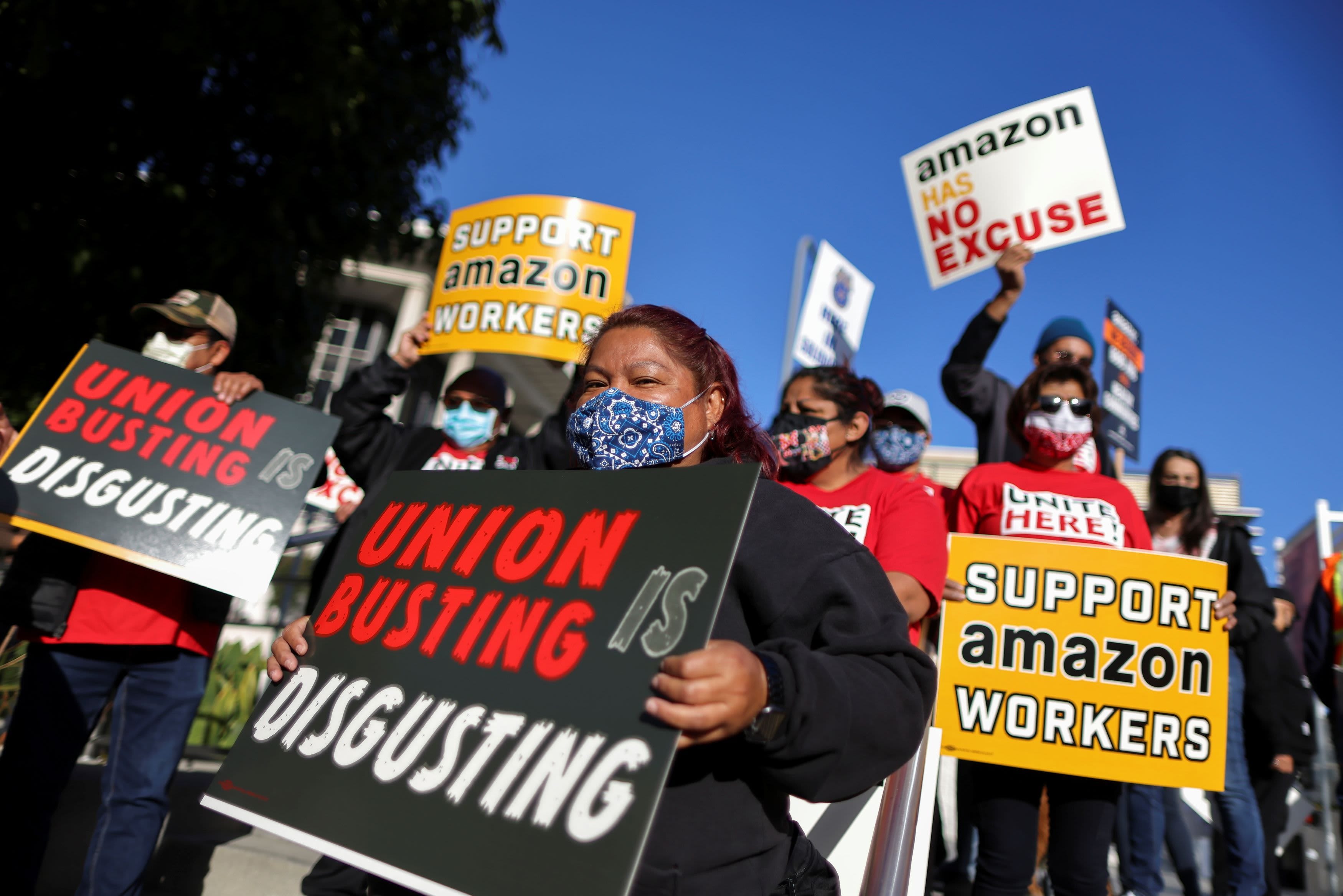
An administrative law judge has found that Amazon violated Section 8(a)(5) of the NLRA by refusing to recognize the Teamsters at its DCK6 delivery warehouse in San Francisco and failing to file an RM-petition after the union presented a majority card showing. The ALJ acknowledged it is the first case fully litigated under the framework established in Cemex Construction Materials Pacific, LLC, which created a new path to union recognition without a Board election.
The Teamsters formed an organizing committee at DCK6 in 2023, and by the fall of 2024 had gathered signed authorization cards from 80 of the facility's 121 Tier 1 warehouse associates, representing roughly 66 percent of the proposed unit. On October 2, 2024, union supporters gathered in the DCK6 break room around 3:00am, confronted the acting site lead, and presented a written demand for recognition. Amazon neither recognized the union nor filed an RM-petition within the two-week window Cemex requires. The union followed up with additional letters on October 17 and 18; Amazon did not respond to those either.
The ALJ found the authorization cards valid. Witnesses authenticated the signatures, and Amazon presented virtually no evidence of fraud or misrepresentation in the solicitation process. Under any count, a clear majority supported the union: even dropping three cards the union itself chose not to rely on, 77 of 121 Tier 1 associates had signed.
On unit appropriateness, the ALJ found the Tier 1 sortation associates formed a coherent, appropriate unit. They are the only employees at the L1 pay grade performing core warehouse tasks, wear different safety vests than process assistants, and are supervised by process assistants who carry laptops to monitor productivity and reassign workers. Amazon put on no evidence that the excluded employees shared an overwhelming community of interest with the Tier 1 workers, so the burden it bore to block the proposed unit went unmet.
Amazon argued that Cemex should not be followed, raising several legal challenges: that it conflicts with the Supreme Court's ruling in Linden Lumber Division, Summer & Co., that the Board used adjudication to announce a new generally applicable rule in violation of the Administrative Procedure Act, that the relevant Cemex language overruling Linden Lumber is non-binding dicta, and that allowing the Board to shift from one policy to the other violates the Major Questions and Non-Delegation Doctrines. The ALJ acknowledged these arguments as serious enough that they "could be persuasive" if the Board had not already considered and rejected each of them, noting that the Cemex dissent raised the same points. Because the Board majority directly addressed and rejected every one of these objections, the ALJ said he was bound to follow extant Board precedent and could not adopt the dissenter's reasoning.
The ALJ ordered Amazon to recognize and bargain with the Teamsters on request, with the bargaining obligation retroactive to October 2, 2024, the date of the union's initial demand.
Significant Cases Cited
Cemex Construction Materials Pacific, LLC, 372 NLRB No. 130 (2023): Overruled Linden Lumber and held that an employer violates Section 8(a)(5) by refusing to recognize a union that has demonstrated majority support unless the employer promptly files an RM-petition.
Linden Lumber Division, Summer & Co., 190 NLRB 718 (1971): Held that an employer confronted with a union recognition demand is not obligated to file its own election petition, allowing employers to simply decline recognition and force the union to pursue a Board election.
NLRB v. Gissel Packing Co., 395 U.S. 575 (1969): Recognized that a Board election is not the exclusive method for establishing union majority status, since Section 9(a) does not specify how employee representatives must be chosen.
American Steel Construction, Inc., 372 NLRB No. 23 (2023): Set out the Board's three-part test for determining whether a petitioned-for unit is appropriate, requiring a community of interest, ready identifiability as a group, and sufficient distinctness from excluded employees.
Cumberland Shoe, 144 NLRB 1268 (1963): Established that an unambiguous authorization card is valid unless rendered invalid by solicitation that misrepresents the card's sole purpose.
American President Lines, LLC and APL Marine Services, Ltd., JD-40-26, 21-CA-347811 (ALJ Decision)
An ALJ found that a maritime employer violated the NLRA on three separate fronts involving a confidentiality policy and surveillance cameras installed on its new fleet of container ships.
Confidentiality Policy
American President Lines required licensed deck officers (LDOs) to sign an onboarding document containing two provisions: one directing employees to protect "APL proprietary information" and ensure non-APL information is handled appropriately, and a second prohibiting them from removing, copying, or emailing "any company document" without written permission from the Fleet Director. Applying the framework from Stericycle, the ALJ found the policy had a reasonable tendency to chill Section 7 activity because it swept in virtually all company documents, including those directly relevant to the employees' terms and conditions of employment.
The employer argued the policy served legitimate interests, pointing to LDOs' access to sensitive cargo manifests (including military shipments) and crew medical records. The ALJ acknowledged those interests but found the policy far too broad: it covered nonsmoking policies, social media policies, wage records, and timecards alongside genuinely sensitive materials, and the employer had not shown it could not protect its legitimate interests with a narrower rule. Because LDOs routinely shared ship logbooks and other documents with the Union to support grievances, including to prove a logbook had been altered after the Union filed a complaint, the policy had a real chilling effect. The Union's ability to investigate grievances slowed materially after the policy took effect. The ALJ found violations of both Section 8(a)(1) and 8(a)(5), the latter because the employer implemented the policy without any notice to or bargaining with the Union.
Camera Surveillance
When the employer phased in seven newly constructed 5500 class ships between mid-2024 and early 2025, each arrived with two inward-facing cameras on the bridge, covering the LDOs' entire work area around the clock. The live feed was visible on screens in the bridge and the cargo control office, where operators could zoom and reposition it. This was a significant departure from prior practice: the employer's older ships had cameras in the engine room (aimed at equipment, not workers), at exterior points like the gangway, bow, and stern, and, on some routes, outward-facing cameras for anti-piracy purposes. The ALJ credited testimony that the anti-piracy cameras on the bridge of older ships faced outward and at most caught "a little bit" of the bridge incidentally.
The employer maintained it had no duty to bargain because the ships were built under contract specifications agreed to in 2020 and flagged in from a foreign flag under a contractual provision the Union had agreed to accept ships "as is." The ALJ declined to reach the decision-bargaining question because the complaint alleged only a failure to bargain over effects. On that narrower question, the employer's argument failed: it had ample forewarning that the ships would have inward-facing bridge cameras (the specs were finalized years before the ships arrived), NLRB precedent firmly establishes that workplace cameras are a mandatory bargaining subject, and the employer neither gave the Union pre-implementation notice nor responded to the Union's May 30, 2024, bargaining request with anything other than a flat refusal. After the Union made repeated written requests and offered a specific bargaining date, the employer's labor relations director closed the door entirely, stating "I have nothing further on this subject." The ALJ found the employer's conduct mirrored the conduct found unlawful in Endurance Environmental Solutions, where the Board held that similar stonewalling justified a union's conclusion that further requests would be futile.
Information Requests
The Union submitted a detailed set of information requests alongside its bargaining demand. The employer responded partially and late, taking the position throughout that it had no bargaining obligation and providing only what it chose in the interest of "transparency." The ALJ worked through each request individually, sustaining most violations and dismissing a handful where the employer had provided responsive information.
Among the sustained violations: the employer never disclosed the location or number of cameras on its older ships (information relevant to whether the new ships represented a change), never answered whether it intended to discipline employees based on camera footage, never provided its camera policies or the Coast Guard regulation it claimed barred their release, and never disclosed who was responsible for the data or what duties, if any, the captain and other LDOs bore with respect to the cameras. The employer also failed to supply information about the make and model of the cameras or answer training-related requests about the non-Safer Seas Act cameras. The ALJ dismissed a smaller number of requests where the employer's responses were found adequate, including requests about who could see the live feed and how the cameras operated.
The remedy requires the employer to rescind the confidentiality provisions, make whole any employees terminated under them, bargain with the Union on request over the camera effects, and supply the outstanding information. The ALJ declined to impose a Transmarine bargaining remedy for the camera violations, finding no economic losses to employees resulted from the installation.
Significant Cases Cited
Stericycle Inc., 372 NLRB No. 113 (2023): Established the current two-step test for evaluating facially neutral work rules, under which a rule is presumed unlawful if it has a reasonable tendency to chill Section 7 activity unless the employer shows a legitimate and substantial business interest that cannot be served by a narrower rule.
Anheuser-Busch, Inc., 342 NLRB 560 (2004): Held that the installation and use of surveillance cameras to observe employees at work is a mandatory subject of bargaining, particularly where the footage may be used to discipline employees.
First National Maintenance Corp. v. NLRB, 452 U.S. 666 (1981): Established that employers have a statutory duty to bargain over the effects of a managerial decision on employees even when they have no obligation to bargain over the decision itself.
Endurance Environmental Solutions, LLC, 373 NLRB No. 141 (2024): Found an employer violated Section 8(a)(5) by refusing to engage in effects bargaining over workplace cameras and holding that a union need not make repeated futile requests to bargain when the employer has made its refusal clear.
Willamette Tug & Barge Co., 300 NLRB 282 (1990): Held that where the effects of a management decision on working conditions are reasonably foreseeable, the employer's duty includes giving the union pre-implementation notice to allow time for effects bargaining.
Dawn Trucking Inc., JD-38-26, 29-CA-171337 (ALJ Decision)
A Brooklyn trucking company's sole owner has been found personally liable for over $330,000 in backpay owed to six drivers he illegally fired for supporting a Teamsters union, after an administrative law judge determined he systematically drained the company's assets to avoid paying the debt.
The underlying violations were decided nearly a decade ago. In 2017, the Board found that Henry Burey, owner of Dawn Trucking, had unlawfully discharged six drivers after Local 282 won a representation election in November 2015, conditioned reinstatement offers on their rejection of the union, and bypassed the union to deal directly with employees. The Board ordered backpay, and the Second Circuit enforced that order in 2018. By the time a compliance proceeding was filed in 2025, Dawn Trucking was insolvent and unable to pay.
The central question in this supplemental proceeding was whether Burey could be held personally responsible for satisfying the company's remedial obligations, a remedy available when the "corporate veil" is pierced under the Board's standard from White Oak Coal Co.
The ALJ found the evidence overwhelmingly supported piercing the veil on both required elements. First, the personalities and finances of Burey and Dawn Trucking were effectively indistinguishable. Burey used company funds to make monthly loan payments on three personally owned vehicles (a Mercedes, Honda, and Toyota) throughout 2016 and 2017. He charged his personal homeowner's insurance in Port St. Lucie, Florida, to the company's American Express card. He used that same corporate card for personal expenditures at Home Depot, Sam's Club, Walmart, and a pool supply store after moving to Florida. He paid his personal Barclaycard credit card bills from the corporate account nine times. He and his wife received over $800,000 in "profit distributions" with no documentation explaining how those amounts were calculated, and his wife, who was not even a shareholder, received $465,000 of that total. Numerous other checks to family members, including his daughters, were entirely unexplained. The company held only two corporate meetings across its entire 18-year existence.
The ALJ found Burey himself to be an unreliable witness. His professed inability to recall the basis for hundreds of thousands of dollars in disbursements went well beyond normal fading of memory. His explanations for personal charges on corporate accounts, including that Florida fuel and grocery purchases might relate to company business after he had already testified the company shut down in July 2017, were described as "patently implausible." His own statements at the hearing, such as characterizing a corporate loan as "my wife lent me the money" and reasoning that a driver in Florida "has to be related to the company because he's working for me," demonstrated that he treated himself and the corporation as one and the same.
Second, the ALJ found that adhering to the corporate form would promote injustice. Burey personally committed the underlying unfair labor practices, and then, after charges were filed and after the ALJ's initial decision issued against him, continued redirecting corporate assets, including $210,000 from truck sales, through profit distributions and personal expenditures, leaving the company unable to satisfy its remedial obligations. The ALJ rejected Respondents' argument that the six-month statute of limitations in Section 10(b) of the NLRA barred the proceeding, noting the Board has long held that provision does not apply in compliance proceedings. The ALJ also rejected the argument that asset diversion is permissible after a company ceases operations, noting that creditors and those with valid claims may follow corporate assets even after distribution to shareholders.
Burey and Dawn Trucking were ordered jointly and severally to pay a total of approximately $330,919 to the six discriminatees.
Significant Cases Cited
White Oak Coal Co., 318 NLRB 732 (1995): Established the two-part Board standard for piercing the corporate veil, requiring a unity of interest between the individual and corporation and a showing that adherence to the corporate form would sanction fraud, promote injustice, or lead to evasion of legal obligations.
Domsey Trading Corp., 357 NLRB 2161 (2011): Held that corporate principals may not dissolve a corporate entity and walk away from backpay obligations owed to employees as a result of statutory violations.
D.L. Baker, Inc., 351 NLRB 515 (2007): Held that no specific showing of corporate insolvency is required for veil-piercing if the natural and foreseeable consequence of individual misuse of corporate assets is to diminish the corporation's ability to meet its statutory obligations.
Bolivar Tees, Inc., 349 NLRB 720 (2007): Found that a principal's personal usurpation of corporate assets satisfied the fraud or injustice element of the veil-piercing standard, and held that after cessation of operations a corporation's officers retain responsibility to preserve assets for remedying unfair labor practices.
Rome Electrical Systems, Inc., 356 NLRB 170 (2010): Applied the White Oak standard to find personal liability where a corporate owner used company funds for personal country club membership fees and failed to maintain adequate corporate records beyond initial incorporation documents.
HPC Industrial Group, LLC, Formerly Known as Hydrochem Industrial Cleaning LLC, JD-37-26, 07-CA-308650 (ALJ Decision)
A contract cleaner working at a Ford Motor Company plant was fired in August 2022 after a minor forklift accident, in part because he refused to go to an employer-mandated drug and alcohol test without a union representative. The ALJ found that the refusal was a material reason for the termination, and that the General Counsel met its initial burden under the Wright Line framework. But the complaint was dismissed because the union waived the employee's Weingarten rights through its handling of the grievance.
The accident itself was minor: Marlon Hemmingway struck an overhead beam while operating a Ford-owned forklift he had borrowed because HPC's own forklift was inoperative. No one was injured and the only damage was a displaced fog light. A Ford witness noted that Hemmingway was not impaired. When supervisors later directed him to the plant clinic for a post-accident drug and alcohol test, Hemmingway asked for his union steward to accompany him. He was told no union representative was required. He refused to go alone, and HPC's branch manager decided to terminate him.
On the substantive Weingarten question, the ALJ declined to resolve whether an automatic post-accident drug test constitutes an "investigatory interview" triggering the right to union representation under NLRB v. J. Weingarten, Inc. The ALJ noted the absence of binding precedent and observed that such a test can reveal drug use and raise legitimate concerns about specimen handling, even when the employer lacks a reasonable suspicion of impairment. Applying Manhattan Beer Distributors, the ALJ concluded that HPC violated the Act by discharging Hemmingway for exercising what appeared to be a valid Weingarten request, and that the company failed to show it would have fired him regardless.
The case turned on waiver. The union filed a grievance on Hemmingway's behalf but never argued that his Weingarten rights had been violated, either in the grievance form or at any step of the process. At step three of the grievance procedure, the union accepted HPC's termination decision without pressing the union-representation issue. The union also never filed an unfair labor practice charge of its own.
The ALJ applied the "clear and unmistakable" waiver standard under Endurance Environmental Solutions, which the Board reinstated in 2024 after a period under the looser "contract coverage" doctrine established by M.V. Transportation. The collective bargaining agreement and an MOU between HPC and UAW Local 600 addressed post-accident testing procedures but said nothing about whether an employee could bring a union representative to the clinic. There was also no history of any employee before Hemmingway ever requesting union representation for post-accident testing.
Given that the grievance identified Hemmingway's "failure to follow supervisor instructions" as a basis for the discharge, and that his only refusal was to go to the clinic without a union representative, the ALJ found the union was aware of the Weingarten issue and made a conscious decision not to pursue it. Whether or not the union received anything in exchange for accepting the termination, that decision constituted a clear and unmistakable waiver of Hemmingway's rights. The complaint was dismissed.
Significant Cases Cited
NLRB v. J. Weingarten, Inc., 420 U.S. 251 (1975): Established that employees have the right to union representation during investigatory interviews that the employee reasonably believes may result in discipline.
Wright Line, 251 NLRB 1083 (1980): Set the burden-shifting framework for mixed-motive discharge cases, requiring the General Counsel to show protected activity was a motivating factor and the employer to prove it would have acted the same absent that activity.
Manhattan Beer Distributors, 362 NLRB 1731 (2015): Held that an employer violates the NLRA by denying union representation at a drug test and by discharging an employee for refusing to take the test without a representative present.
Endurance Environmental Solutions, LLC, 373 NLRB No. 141 (2024): Overruled M.V. Transportation and reinstated the "clear and unmistakable" waiver standard for determining whether a union has waived statutory bargaining rights through a contract or its conduct.
Prudential Insurance Co., 275 NLRB 208 (1985): Held that a union may waive a bargaining unit member's statutory Weingarten rights.
Laborers International Union of North America, Local 872, AFL-CIO (Various Employers, Including The, 28-CB-239339 (Unpublished Board Decision)
The Board denied Laborers Local 872's motion for reconsideration of its earlier decision in this case, finding that the union failed to identify any material error or extraordinary circumstances as required under the Board's rules for reconsideration to be granted.
The order notes that Member Prouty recused himself and took no part in the decision, leaving Chairman Murphy and Member Mayer as the deciding panel. A footnote addresses the procedural validity of a two-member panel acting in this posture, citing New Process Steel, L.P. v. NLRB for the proposition that when one panel member is disqualified, the remaining two members retain a quorum sufficient to issue a decision.
Significant Cases Cited
New Process Steel, L.P. v. NLRB, 560 U.S. 674 (2010): Held that the NLRA's group quorum provision allows a three-member panel to issue decisions with only two members when one member is disqualified.
NLRB v. New Vista Nursing & Rehabilitation, 870 F.3d 113 (3d Cir. 2017): Applied New Process Steel to uphold the validity of two-member panel decisions where one member was recused.
D. R. Horton, Inc., 357 NLRB 2277 (2012): Recognized the Board's practice of proceeding with a two-member quorum when a panel member is disqualified.