
Amazon.com Services, LLC, JD-33-26, 20-CA-353627 (ALJ Decision)
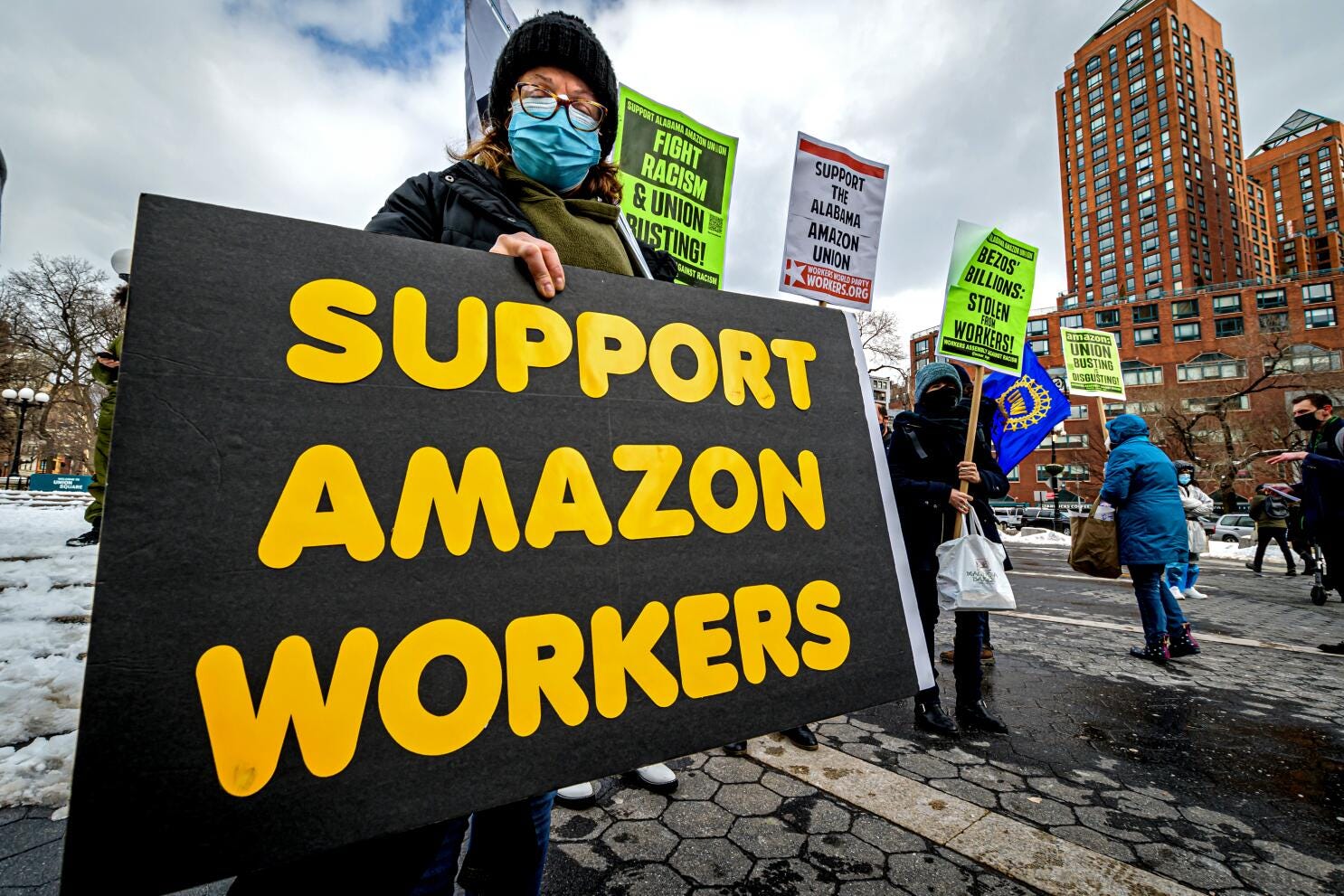
An administrative law judge sustained four unfair labor practice allegations against Amazon arising from its response to a Teamsters organizing campaign at its DCK6 last-mile delivery station in San Francisco, while dismissing the bulk of a wide-ranging complaint.
The campaign began in September 2024, culminating in an October 2 “March on the Boss” at which employees demanded recognition. Amazon neither recognized the union nor filed an RM petition. It responded instead with an influx of outside managers and HR personnel, voluntary information sessions, facility-wide anti-union messaging, distribution of branded safety vests, and increased food giveaways. The ALJ dismissed all allegations arising from those responses. The surge in management presence lacked evidence of coercive conduct. The facility-branded vests were content-neutral and distinguishable from explicitly anti-union apparel. The food giveaways fell within established Board precedent permitting employers to provide meals during a campaign. The information sessions accurately described the status quo obligation and were carefully scripted.
Four violations were sustained. Manager Adam Carr unlawfully interrogated employee Domenic Daniele on two occasions — asking whether he had signed an authorization card and whether he supported the union — without allaying fears of retaliation, satisfying the coerciveness factors from Rossmore House. Amazon also violated Section 8(a)(3) by applying its off-duty access policy more strictly against Johnny Nalls, a visible organizing committee member who had routinely stayed in the breakroom after his shift for eighteen months without incident; within a week of the March on the Boss, two managers told him he had to leave within ten to fifteen minutes. A related allegation involving Leah Pensler was dismissed because she had entered the facility on a day she was not scheduled to work, and the policy had never been applied permissively in that situation. The ALJ also found that Amazon violated Section 8(a)(3) by effectively withdrawing Pensler’s prior acceptance into an unpaid learning ambassador training role after she became a prominent organizing committee member, crediting her account over the employer’s and finding the employer’s documentary evidence internally inconsistent.
The decision’s most detailed analysis addresses Nalls’ December 2024 termination. Amazon fired Nalls after a corporate investigation concluded he had used a racial epithet toward co-worker Paramveer Singh during a confrontation on October 23 — the same day Nalls had retrieved a Teamsters vest for Singh and then approached him after Singh removed it, apparently at a manager’s urging. The ALJ found that Nalls did use the N-word once, but colloquially rather than as a slur. Applying the totality-of-the-circumstances test reinstated by the Board in Lion Elastomers, the ALJ found the balance strongly favored continued protection: the employer’s own potentially unlawful interference provoked the exchange; the subject matter went to the core of Section 7 activity; Nalls acted impulsively without threats or physical contact; and credited testimony established that the N-word was used conversationally at DCK6 on a near-daily basis in management’s presence without prior discipline. The ALJ also noted that Singh’s own written statements, made shortly after the incident, did not mention the epithet — it surfaced only when the investigator asked a leading question. Amazon produced no documentation to support its claim that similar conduct had always resulted in termination elsewhere. In an alternative Wright Line analysis, the ALJ reached the same conclusion: Amazon could not show it would have discharged Nalls absent his protected activity given the complete absence of prior discipline for comparable language at the facility.
Amazon is ordered to reinstate Nalls with full back pay, reinstate Pensler’s invitation to the learning ambassador program, and cease the unlawful interrogation and access policy practices.
Significant Cases Cited
Lion Elastomers, LLC, 372 NLRB No. 83 (2023): Restored setting-specific, totality-of-the-circumstances standards for evaluating whether employee misconduct during Section 7 activity is sufficiently egregious to forfeit the Act’s protection.
Wright Line, 251 NLRB 1083 (1980): Established the burden-shifting framework for mixed-motive discharge cases under Section 8(a)(3).
Rossmore House, 269 NLRB 1176 (1984): Set out the totality-of-the-circumstances standard for evaluating whether employer interrogation of employees about union activities constitutes unlawful coercion.
Cemex Construction Materials Pacific, LLC, 372 NLRB No. 130 (2023): Established that an employer facing a majority demand for recognition must either recognize the union or promptly file an RM petition.
Desert Springs Hospital Medical Center, 363 NLRB 1824 (2016): Applied the setting-specific totality test for employee misconduct occurring during Section 7 activity, reinstated by Lion Elastomers and directly applied to the Nalls analysis.
Starbucks Corporation, JD-32-26, 19-CA-297589 (ALJ Decision)
An administrative law judge has dismissed all unfair labor practice allegations against Starbucks arising from the company’s creation of its “Heritage Market” — a three-store district in downtown Seattle comprising the Pike Place, 1st and Pike, and 1st and University locations — during the height of a 2022 union organizing campaign by Workers United.
The General Counsel alleged four categories of violations: that Starbucks unlawfully solicited employee grievances during April 2022 “collaboration sessions” held at its stores; that a manager interrogated a union supporter during a Heritage Market job interview; that the company created the Heritage Market itself as an anti-union restructuring; and that approximately 29 employees who were not rehired into the Heritage Market were discriminatorily denied the positions, denied the accompanying raises and benefits, and constructively discharged.
Grievance Solicitation. On the solicitation allegations, the ALJ found the General Counsel had not established that an organizing campaign was underway at the Pike Place store — as opposed to the nearby 1st and Pike store — at the time of the April 18 and April 25 sessions. Without knowledge of active union organizing among the specific employees addressed at the sessions, the inference that the solicitation implied a promise to remedy grievances did not attach. The ALJ also found that the collaboration sessions did not represent a meaningful departure from Starbucks’ pre-existing practice of soliciting employee feedback through a variety of formats, relying on Wal-Mart Stores, MacDonald Machinery Co., and Longview Fibre Paper & Packaging for the proposition that an employer with an established practice may continue it during an organizing campaign without violating the NLRA.
Interrogation. The ALJ rejected the interrogation allegation involving Jo Cormier, a 5th and Pike barista and known union supporter who interviewed for a Heritage shift supervisor role. The General Counsel argued that the interviewer’s question — asking what Cormier would do if she disagreed with the company — was targeted at her union activity, particularly because the interviewer had seen Cormier on a picket line. The ALJ found that the question was part of the standard Heritage Market interview script, was posed to multiple applicants, and was not the “only reasonable inference” of an attempt to probe union sympathy, applying Rossmore House and Aloha Temporary Service.
Heritage Market Creation. On the core restructuring allegation, the ALJ applied the Wright Line burden-shifting framework and found the General Counsel had not established sufficient animus. Though district manager Quesenberry’s knowledge of union activity at 1st and Pike was imputed to Starbucks, the ALJ found no evidence of animus directed at the employees of the two other stores that anchored the Heritage Market concept. The ALJ also declined to infer animus from ALJ-level findings in other Starbucks cases that had not yet been affirmed by the Board, and from Board decisions involving different actors in different locations.
Failure to Hire and Constructive Discharge. The failure-to-hire allegations were analyzed under FES (A Division of Thermo Power). The ALJ found the General Counsel failed to establish the second required element — that the rejected applicants had the experience relevant to the posted positions — because the Heritage Market barista and shift supervisor roles contained materially elevated requirements compared to their core counterparts, and the General Counsel did not demonstrate that the unsuccessful applicants met those requirements or that the requirements were pretextual. On constructive discharge, applying Yellow Ambulance Service, the ALJ found that requiring employees to apply for the Heritage positions and transferring those not selected did not constitute deliberately unbearable working conditions, comparing the circumstance to lawful reorganizations in El Paso Natural Gas Company and San Antonio Portland Cement Company.
The complaint was dismissed in its entirety.
Significant Cases Cited
Wright Line, 251 NLRB 1083 (1980): Establishes the burden-shifting framework for mixed-motive cases under Section 8(a)(3), requiring the General Counsel to show union activity was a motivating factor before the burden shifts to the employer to prove it would have taken the same action regardless.
FES (A Division of Thermo Power), 331 NLRB 9 (2000): Sets out the three-part prima facie case the General Counsel must establish in refusal-to-hire allegations, including that applicants had experience relevant to the announced job requirements and that union animus contributed to the decision.
Rossmore House, 269 NLRB 1176 (1984): Requires that alleged interrogation be assessed under all surrounding circumstances to determine whether it reasonably tended to restrain or coerce employees in the exercise of their NLRA rights.
Amptech, Inc., 342 NLRB 1131 (2004): Holds that solicitation of grievances during a union campaign raises an inference of an implicit promise to remedy them, particularly when the solicitation significantly departs from the employer’s pre-existing practices.
Yellow Ambulance Service, 342 NLRB 804 (2004): Defines the traditional constructive discharge standard, requiring proof that the employer deliberately made working conditions unbearable and intended that result, with intent assessed by whether the employer reasonably should have foreseen that its actions would cause a resignation.
Civic Influencers, Inc., JD-34-26, 05-CA-345478 (ALJ Decision)
A Delaware nonprofit that ran a youth civic engagement program violated the NLRA by discharging seven employees and rescinding one promotion in retaliation for protected concerted activity and union organizing, ALJ Michael Rosas ruled on May 29.
Background
Civic Influencers employed a staff of organizers and program coordinators who worked remotely to recruit college students for voter engagement work. In April 2024, several employees sent the board of directors a letter criticizing CEO Maxim Thorne’s leadership and management. Those same employees voiced similar concerns during a company retreat later that month. Shortly after, employees began organizing and, in June 2024, sought voluntary recognition from the employer. The union filed a representation petition on June 26, and three employees testified at the pre-election hearing in July.
The Handbook Rule
The ALJ found that a rule in Respondent’s employee handbook — prohibiting “behavior that lowers morale of fellow employees” — was unlawful under Stericycle, Inc., the Board’s current standard for evaluating work rules. Applying that framework, the ALJ concluded that a reasonable employee contemplating protected activity would read the rule to cover discussions about wages, hours, or working conditions. Respondent offered no evidence that the rule served a legitimate business interest that could not be addressed more narrowly, and the record showed the company had actually invoked it to silence criticism of the CEO.
The Discharges and Rescinded Promotion
The ALJ applied the Wright-Line burden-shifting test. Respondent conceded that all eight affected employees had engaged in protected concerted activity and union activity, and that management knew about it. The burden thus shifted to Respondent to show the adverse actions would have occurred regardless. It failed to do so.
The ALJ found extensive evidence of unlawful motivation. Four employees — Katrina Cousins, Kathleen Hutton, Emily Yost, and Kameryn Point — were discharged on June 21, just nine days after the union sought voluntary recognition and two days after the union declined to delay its petition until after the November elections. Elise Orlick’s promotion was rescinded the same day. The company simultaneously continued interviewing and hiring contractors for many of the same roles it had just eliminated, undercutting its stated financial rationale. Audrey Ferguson, Anna Cubbage, and Cornell Duckworth were discharged on December 31, roughly three weeks after completing an end-of-year report the company needed for fundraising — and the ALJ noted that Respondent had internally decided to terminate them in mid-August, shortly after they testified at the representation hearing.
Respondent’s defenses — financial hardship, poor performance, and a strategic shift to digital organizing — were all rejected as pretextual. Post-discharge performance reviews were generated retroactively. Respondent’s own position statements shifted between financial and performance justifications, a pattern the ALJ treated as evidence of discriminatory motive. And despite claiming financial distress, the company entered January 2025 with nearly $300,000 in net assets and proceeded to hire a dozen contractors over the following weeks.
Remedy
The ALJ ordered reinstatement with backpay for all seven discharged employees and restoration of Orlick’s promotion, along with standard make-whole remedies. Because Respondent had committed eight “hallmark” violations — the kind the Board has long recognized as likely to poison the election atmosphere — the ALJ granted a Gissel bargaining order, bypassing the election process and requiring the company to bargain with United Professional Organizers on request.
Significant Cases Cited
Wright-Line, 251 NLRB 1083 (1980): Established the burden-shifting framework for determining whether an adverse employment action was unlawfully motivated by an employee’s protected or union activity.
Stericycle, Inc., 372 NLRB No. 113 (2023): Set the current Board standard for evaluating work rules, requiring that rules be assessed from the perspective of an economically dependent employee contemplating protected activity, with ambiguities resolved against the employer.
NLRB v. Gissel Packing Co., 395 U.S. 575 (1969): Authorized the Board to issue a bargaining order — rather than directing an election — where an employer’s unfair labor practices are so serious that a fair election is unlikely.
Donaldson Bros. Ready Mix, Inc., 341 NLRB 958 (2004): Clarified that under Wright-Line, once the General Counsel establishes that an employer’s stated reasons are pretextual, the employer automatically fails to carry its rebuttal burden.
Tschiggfrie Properties, Ltd., 368 NLRB No. 120 (2019): Confirmed that discriminatory intent may be proven through circumstantial evidence, including timing, the presence of other unfair labor practices, and disparate treatment of employees who engaged in protected activity.
Carter BloodCare, JD(SF)-12-26, 16-CA-345182 (ALJ Decision)
An ALJ has ruled that Carter BloodCare, a Dallas-Fort Worth blood donation nonprofit, violated the NLRA when it interrogated a phlebotomist about a Facebook post and then removed him from a promotional development program because of it.
The employee, Steven Holmes, posted on Facebook encouraging coworkers to wear black scrubs on Sundays to protest unwanted Sunday shift assignments, using hashtags like “#Solidarity” and “#TogetherWeCan.” About 20 employees participated. Three weeks later, Holmes was summoned to a meeting with a manager and an HR specialist, where management showed him the post, asked whether he intended to incite a “rebellion,” and demanded he explain what he meant by “solidarity.” He was then told he was being removed from the company’s Leadership Development Plan (LDP) — a six-month program he had enrolled in to regain a promotion he had lost years earlier.
Interrogation. Applying the multi-factor test from Westwood Healthcare Center, the ALJ found the May 21 meeting constituted an unlawful interrogation. Holmes was unexpectedly summoned to a formal meeting with a senior manager and HR representative, questioned about his protected activity as a precursor to an adverse employment action, and warned he might face further discipline — all of which the ALJ found would reasonably tend to coerce an employee from exercising Section 7 rights.
Supervisory Status. Carter argued Holmes was a statutory supervisor under Section 2(11) during his LDP participation and therefore not protected by the NLRA. The ALJ rejected that defense. Relying on Kentucky River Community Care v. NLRB and the Board’s decisions in Chevron Shipping Co. and Dynamic Science, Inc., the ALJ found that Holmes’ limited role in assigning phlebotomists to intake or blood draw duties at smaller drives was routine and entirely circumscribed by Mobile Supervisor oversight. Because all phlebotomists are interchangeably qualified to perform both functions, those assignments required no independent judgment sufficient to confer supervisory status.
Removal from the LDP. Under the Wright Line framework, the ALJ found the General Counsel established a prima facie case through Holmes’ protected Facebook post (activity), management’s direct reference to the post at the May 21 meeting (knowledge), and the interrogation itself combined with the close timing between the post and Holmes’ removal (animus). Carter then failed to show it would have removed Holmes absent his protected activity. The ALJ pointed to several weaknesses in Carter’s defense: management explicitly linked the post to the LDP removal at the meeting; Holmes was ousted less than two months into a six-month program designed for employees with prior performance issues; and a comparator employee without protected activity was given four full months under her LDP despite similar errors. The ALJ also drew an adverse inference from Carter’s failure to call Holmes’ direct supervisor — who had provided him with favorable evaluations — as a witness.
The ALJ ordered Carter to make Holmes whole for losses connected to the LDP removal, expunge related records, and post the standard remedial notice.
Significant Cases Cited
Wright Line, 251 NLRB 1083 (1980): Establishes the burden-shifting framework for analyzing whether protected activity was a motivating factor in an adverse employment action.
Kentucky River Community Care v. NLRB, 532 U.S. 706 (2001): Supreme Court decision clarifying the “independent judgment” standard for determining supervisory status under Section 2(11) of the NLRA.
Meyers Industries (Meyers II), 281 NLRB 882 (1986): Defines the standard for “concerted activity,” including individual conduct aimed at initiating or inducing group action.
Westwood Healthcare Center, 330 NLRB 935 (2000): Sets out the multi-factor test for determining whether employer questioning constitutes an unlawful interrogation under the NLRA.
Dynamic Science, Inc., 334 NLRB 391 (2001): Held that employees whose work direction was tightly constrained by detailed employer regulations did not exercise sufficient independent judgment to qualify as statutory supervisors.
Penske Truck Leasing, LP v. Central States Southeast and Southwest Areas Pension Plan, 25-1738, (7th Circuit)
The Seventh Circuit’s May 2026 decision in Penske Truck Leasing, LP v. Central States Pension Plan touched on NLRA issues only briefly, as a secondary argument in a broader ERISA/MPPAA dispute, but the court’s treatment is worth noting.
Penske argued that if it were expelled from the pension plan for one of its bargaining units — Local 745, representing Dallas-area employees — it would be unable to maintain the pension contributions that were part of the status quo under the expired collective bargaining agreement, thereby forcing it into an unfair labor practice under NLRA Section 8(a)(5). Under that provision, an employer must maintain existing terms and conditions of employment after a contract expires until the parties reach a new agreement or bargain to a good-faith impasse. Penske relied on NLRB v. Katz, which established that unilateral changes during bargaining violate the duty to bargain collectively.
The Seventh Circuit was unpersuaded. The court reasoned that a pension fund’s expulsion of a bargaining unit is effectively a guarantee that negotiations have reached an impasse — and once impasse is reached, the employer’s obligation to maintain the status quo is no longer absolute. The court acknowledged that the NLRB, not federal courts, has exclusive authority to determine whether an unfair labor practice has actually occurred, and that the Board could theoretically reach a different conclusion. Under the specific facts, however — where Central States had terminated negotiations entirely — the court was satisfied that Local 745’s expulsion would not put Penske in violation of the NLRA.
The court distinguished the case from Staffco of Brooklyn, LLC, a 2016 Board decision in which an employer unilaterally stopped contributing to a pension plan after a contract expired without first bargaining to impasse. The court found that case meaningfully different because there, the Board found no impasse — whereas here, the fund itself had ended the relationship.
Significant Cases Cited
NLRB v. Katz, 369 U.S. 736 (1962): Established that an employer’s unilateral changes to terms and conditions of employment during bargaining violate the NLRA duty to bargain collectively under Section 8(a)(5).
Staffco of Brooklyn, LLC & New York State Nurses Ass’n, 364 NLRB 1500 (2016): Board decision finding that an employer’s unilateral cessation of pension contributions after contract expiration, without bargaining to impasse, constituted an unfair labor practice.
General Service Employees Union, Local No. 73 v. NLRB, 230 F.3d 909 (7th Cir. 2000): Seventh Circuit decision explaining the status quo obligation — that employers must maintain existing conditions after a contract expires until a new agreement is reached or the parties bargain to impasse.
RiverStone Group v. Midwest Operating Engineers Fringe Benefit Funds, 33 F.4th 424 (7th Cir. 2022): Defined “impasse” under labor law as the point at which the parties have exhausted prospects for agreement and further negotiation would be futile.