
Starbucks v. NLRB, 24-60649, (Circuit Court)
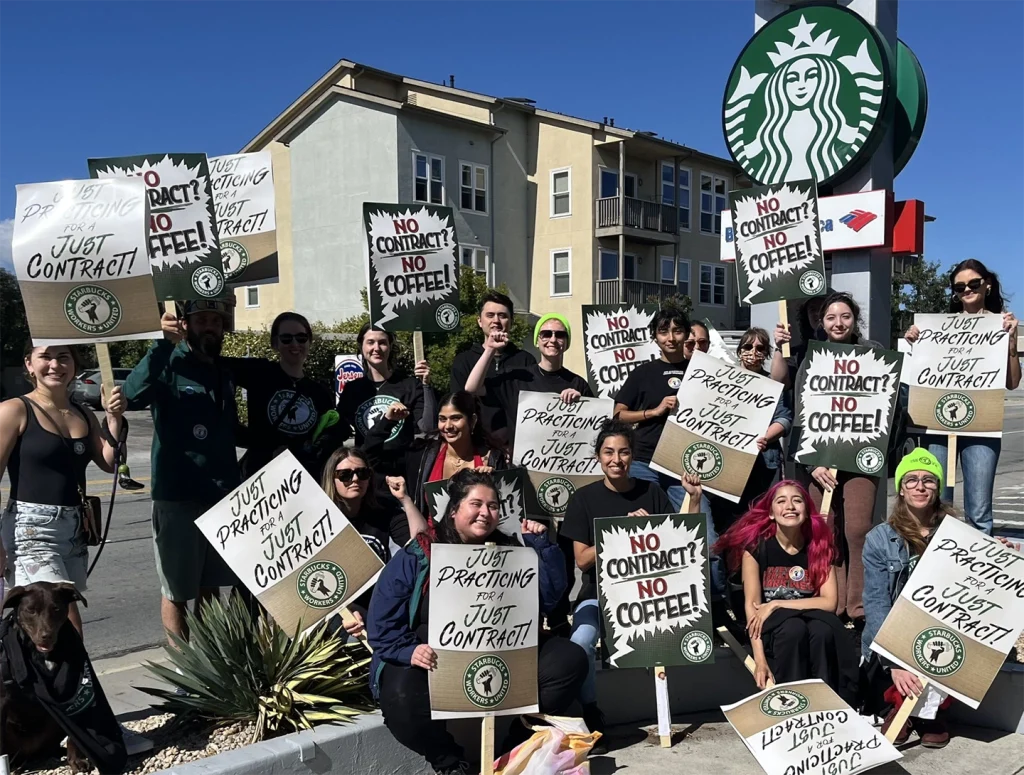
The Fifth Circuit last week vacated and remanded a Board decision finding that Starbucks unlawfully terminated a union organizer at its Latham, New York store.
The case arose from unionizing campaigns at two upstate New York Starbucks locations in spring 2022. At the Latham store, shift supervisor and union organizer James Schenk was fired after a series of workplace infractions, including sending sexually explicit and profane messages about a coworker in a group chat, failing to complete closing tasks while on a final warning, and opening a letter addressed to Starbucks. An ALJ found the termination lawful, but the Board reversed, concluding Starbucks would not have disciplined or fired Schenk absent his union activity.
The Fifth Circuit, applying the substantial evidence standard from Universal Camera Corp. v. NLRB, granted Starbucks’s petition and sent the case back to the Board. The court identified several pieces of contradictory evidence the Board failed to adequately address: evidence that no other employee had directed comparably extreme and sexist language at coworkers; the fact that Schenk’s prior discipline also involved profanity, which the Board dismissed as not “relevantly similar” without considering whether Starbucks viewed the incidents as an escalating pattern; the absence of any other shift supervisor who failed to complete closing tasks while on final warning; and Schenk’s own admission that he opened official NLRB mail believing the company would not share its contents with employees. The court, citing Entergy Mississippi, Inc. v. NLRB and Dish Network Corp. v. NLRB, held that the Board must “grapple with countervailing portions of the record” and had failed to do so. A separate issue regarding a district manager’s increased store presence—found to constitute unlawful surveillance at the Stuyvesant location—was not disturbed.
Judge Oldham concurred in the result but would have reversed outright rather than remand, arguing the Board had deviated from “fairminded, law-based adjudication” and citing the court’s recent decision in Space Exploration Technologies Corp. v. NLRB.
Significant Cases Cited
Universal Camera Corp. v. NLRB, 340 U.S. 474 (1951): Established that courts reviewing Board decisions must consider the record as a whole, including evidence that fairly detracts from the Board’s findings.
Entergy Mississippi, Inc. v. NLRB, 810 F.3d 287 (5th Cir. 2015): Held that a court may vacate and remand when the Board ignores relevant contradictory evidence in explaining its reasoning.
Dish Network Corp. v. NLRB, 953 F.3d 370 (5th Cir. 2020): Reaffirmed that the Board must grapple with countervailing portions of the record when making its determinations.
Space Exploration Technologies Corp. v. NLRB, 151 F.4th 761 (5th Cir. 2025): Cited by Judge Oldham for the proposition that the Board has shown troubling departures from neutral, law-based adjudication.
Renew Home Health v. NLRB, 95 F.4th 231 (5th Cir. 2024): Articulated the substantial evidence standard applicable to appellate review of Board factual findings.
Apple Inc., 374 NLRB No. 109, 32-CA-306609 (Published Board Decision)
The Board unanimously affirmed an ALJ’s dismissal of all unfair labor practice allegations against Apple, Inc., arising from the discipline and discharge of Ellen Shen, a software engineer who spent years escalating a personal workplace dispute through increasingly disruptive mass emails to hundreds of coworkers.
The Board’s analysis was brief, resting on a narrow and dispositive threshold finding: the General Counsel failed to establish that Shen engaged in concerted activity in the first place. Without concerted activity, there is no protected conduct under Section 7, and the discipline and discharge allegations necessarily fail. The Board declined to reach the question of whether Apple’s conduct was otherwise motivated by anti-protected-activity animus, relying solely on that threshold deficiency.
On the related Section 8(a)(1) allegations — that Apple threatened, coerced, and interrogated Shen in response to her mass emails, and threatened further discipline if she sent additional messages — the Board adopted the ALJ’s dismissals, adding only that Apple’s communications to Shen were not made in response to protected concerted activity, and that no reasonable employee would have perceived them as limiting Section 7 rights going forward. The standard applied was whether the conduct had a reasonable tendency to coerce employees in the exercise of those rights, per KSM Industries.
The Board also addressed a credibility challenge, declining to disturb the ALJ’s witness credibility determinations under the deferential standard from Standard Dry Wall Products, finding no clear preponderance of evidence requiring reversal.
The underlying facts, as resolved by the ALJ, involved Shen’s persistent effort to relitigate a 2020 technical disagreement over a software project. After Apple’s internal investigation dismissed her complaints, Shen sent four mass emails — ultimately reaching all 240 employees in her division as well as Apple’s CEO — and a mass Slack message, each returning to the same personal grievances. The ALJ found no credible evidence that any coworker shared her concerns or that she was acting on anyone’s behalf. Under Meyers Industries, activity is concerted only when engaged in with or on the authority of other employees, or when it constitutes a logical outgrowth of group concerns — neither of which was present here.
Significant Cases Cited
Wright Line, 251 NLRB 1083 (1980): Established the burden-shifting framework for mixed-motive discharge cases, requiring the General Counsel to first show protected activity was a motivating factor before the burden shifts to the employer to prove it would have acted the same regardless.
Meyers Industries (Meyers II), 281 NLRB 882 (1986): Defined concerted activity as conduct engaged in with or on the authority of other employees, or conduct by an individual seeking to initiate, induce, or prepare group action on truly group complaints.
Atlantic Steel Co., 245 NLRB 814 (1979): Set out a four-factor balancing test for determining whether otherwise-protected conduct loses the Act’s protection due to its egregious nature, examining the place, subject matter, nature of the outburst, and whether it was provoked by an employer unfair labor practice.
Fresh & Easy Neighborhood Market, 361 NLRB 151 (2014): Clarified that to be protected, employee conduct must be both concerted and engaged in for mutual aid or protection, and that concertedness is assessed under an objective standard tied to whether the activity is linked to coworkers’ interests.
Standard Dry Wall Products, 91 NLRB 544 (1950): Established the Board’s policy of deferring to ALJ credibility resolutions unless the clear preponderance of all relevant evidence demonstrates they are incorrect.
Laborers International Union of North America, Local 872, AFL-CIO, 374 NLRB No. 108, 28-CB-239339 (Published Board Decision)
The Board affirmed an ALJ’s dismissal of all unfair labor practice allegations against Laborers Local 872 (Las Vegas), which operates an exclusive hiring hall for construction laborers. The case was decided by a two-member quorum after Member Prouty recused himself.
The charges were brought by two union members who alleged the union ran its hiring hall arbitrarily, withheld registration information, and used its attorney to intimidate them for filing unfair labor practice charges. The ALJ rejected every theory. She found the union’s unwritten dispatch practices—waiving penalties for workers who twice refused the same job, or who faced genuine hardship—served legitimate purposes and were not arbitrary. She found the union had not withheld registration information from charging party Vela, but had simply required him to complete paperwork in person, as it required of everyone. The attorney’s two-word email to the other charging party (”another loss”) was protected expression under Section 8(c), and allegations about intimidating evidence-preservation letters were time-barred. Allegations made by charging party Colvin were dismissed as a sanction for his repeated delays and bad-faith litigation conduct throughout the lengthy proceeding.
The Board adopted the ALJ’s decision without substantive comment, noting only that no party had challenged the propriety of dismissing Colvin’s allegations as a sanction against him rather than against the General Counsel, who controls the complaint.
Significant Cases Cited
Vaca v. Sipes, 386 U.S. 171 (1967): Established that a union breaches its duty of fair representation when its conduct is arbitrary, discriminatory, or in bad faith.
Breininger v. Sheet Metal Workers Local 6, 493 U.S. 67 (1989): Held that the duty of fair representation is implied from a union’s exclusive bargaining authority under Section 9(a).
NABET–CWA (American Broadcasting Cos., Inc.), 371 NLRB No. 15 (2021): Found that nearly identical evidence-preservation letters sent by the same attorney violated Section 8(b)(1)(A).
New Process Steel, L.P. v. NLRB, 560 U.S. 674 (2010): Confirmed that the Board may act with a two-member quorum when a panel member is recused.
Camelot Terrace, 357 NLRB 1934 (2011): Affirmed ALJs’ inherent authority to dismiss complaint allegations as a sanction for bad-faith litigation conduct.
Ge Appliances, a Haier Company, 374 NLRB No. 110, 09-CA-332521 (Published Board Decision)
The Board affirmed an ALJ’s dismissal of an unfair labor practice complaint against GE Appliances, a Haier Company, finding that the General Counsel failed to prove the company violated the NLRA when it issued a written warning and discharged a probationary employee, LaDonna Dawson.
The complaint alleged that GE Appliances disciplined and fired Dawson in retaliation for protected concerted activity — specifically, her repeated challenges to the company’s mandatory overtime notice procedures, which the General Counsel argued amounted to an attempt to enforce her collective bargaining agreement under the Interboro doctrine. The ALJ rejected that theory, concluding that Dawson lacked a reasonable and honest belief that the overtime requirements violated the CBA. Unlike the employee in King Soopers, Inc., whose similar belief was grounded in her union representative’s interpretation and her own workplace experience, Dawson simply refused to accept repeated explanations from coworkers, union stewards, and management that the overtime policy was being followed correctly.
The ALJ also rejected the alternative Wright Line discrimination theory. Although Respondent was aware that Dawson had sought union assistance, the record showed no animus toward that activity — management had consistently included union officials in its interactions with Dawson, responded promptly to their inquiries, and arranged for a union steward to be present when discipline was issued. The timing of the discipline, while coinciding with her union contacts, equally coincided with disruptive conduct on the shop floor. Comparative discipline evidence showed that other probationary employees had been discharged on similar timelines for similar behavior.
The Board adopted the ALJ’s decision without elaboration, but addressed two procedural matters in footnotes. First, it declined to strike the pro se Charging Party’s noncompliant exceptions, citing the Board’s practice of leniency toward unrepresented parties, though it disregarded supporting materials not introduced at the hearing. Second, the Board noted that Dawson’s exceptions failed to engage the ALJ’s factual findings or legal analysis, and that her arguments about unresolved payroll issues and a “toxic workplace” — even if meritorious — sounded in state law, not the NLRA.
Significant Cases Cited
NLRB v. City Disposal Systems, Inc., 465 U.S. 822 (1984): Established that an individual employee’s assertion of a right grounded in a collective bargaining agreement can constitute protected concerted activity under the NLRA.
Wright Line, a Division of Wright Line, Inc., 251 NLRB 1083 (1980): Set forth the burden-shifting framework for analyzing whether an employer’s adverse action was motivated by an employee’s protected activity.
King Soopers, Inc., 364 NLRB 1153 (2016): Found protected concerted activity where an employee’s belief that her contractual rights were being violated was supported by her union representative’s interpretation and her own workplace experience.
Tschiggfrie Properties, Ltd., 368 NLRB No. 120 (2019): Clarified the elements the General Counsel must establish under Wright Line, including that protected activity was a motivating factor causally linked to the adverse action.
Interboro Contractors, Inc., 157 NLRB 1295 (1966): Originated the doctrine that an individual employee’s invocation of a collectively bargained right can qualify as concerted activity protected by the NLRA.