
Starbucks Corporation, JD-18-26, 13-CA-322871 (ALJ Decision)
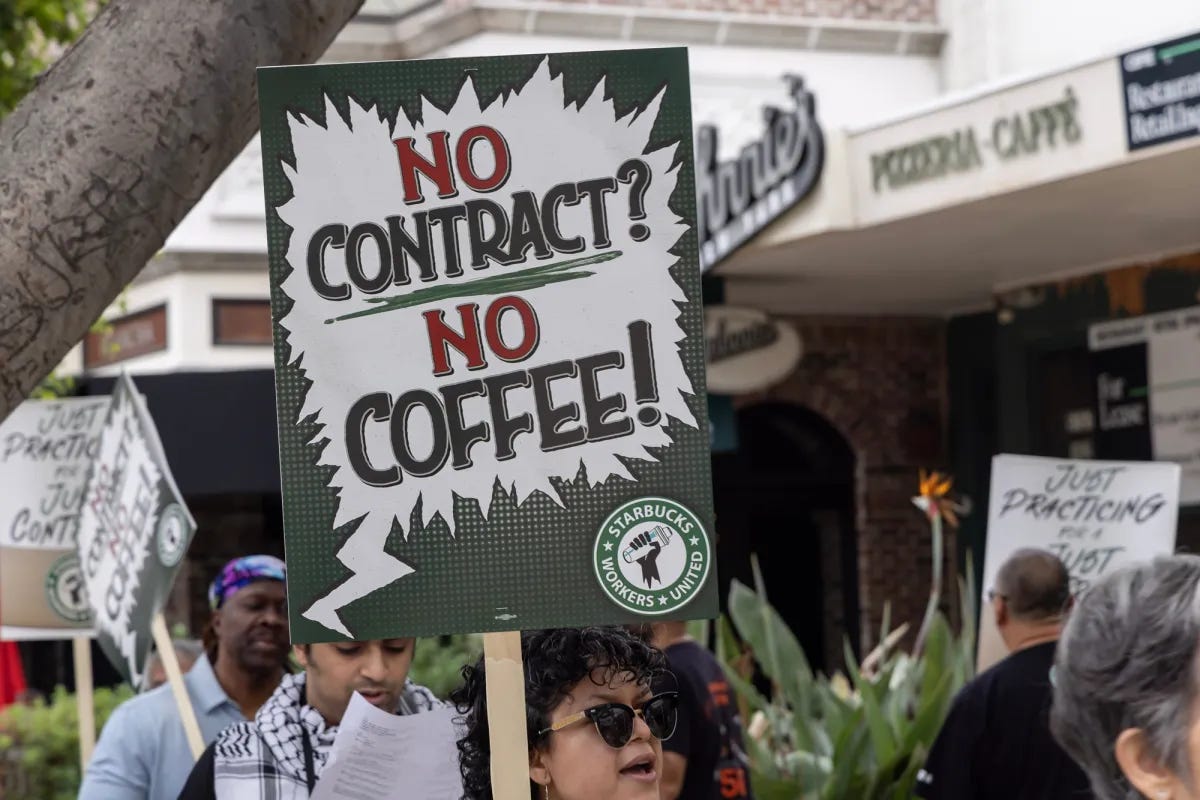
ALJ Keltner W. Locke dismissed all allegations against Starbucks arising from its enforcement of a dress code at a unionized Chicago store.
The ALJ dismissed two allegations that supervisors made unlawful statements after employee Russell Dahlman invoked his Weingarten rights. Store Manager Campbell’s comment that he “wouldn’t want anyone knowing his business” was protected employer speech under Gissel Packing — no threat or promise of benefit was communicated. District Manager Davis’s statement that management would “let [Dahlman] know” when he needed representation was found, in context, to mean only that the employer would flag investigatory interviews — not that it was controlling when Dahlman could invoke his rights.
The dress code — which bars logos other than a small manufacturer’s mark but permits one union pin or button — was found facially lawful. Under Tesla, Inc., any restriction on union insignia triggers the “special circumstances” requirement. The ALJ found those circumstances satisfied: Starbucks is a customer-facing retailer where employee appearance is integral to the brand experience, and the Second Circuit had previously upheld this same dress code. The ALJ applied Tesla notwithstanding the Fifth Circuit’s vacatur, as the relevant store is in the Seventh Circuit.
The disparate enforcement allegation failed on credibility grounds. Dahlman testified he regularly wore a White Sox cap to work without discipline, but the ALJ found that testimony outweighed by the failure of union-supporting coworker Nathan Wilson — who had both motive and opportunity to corroborate — to mention it.
The Section 8(a)(3) claims arising from employees being sent home on April 18, 2023, for wearing union T-shirts were dismissed. Because the employer undisputedly acted based on protected activity, Wright Line was inapplicable under Gross Electric, Inc. The discipline was lawful because the dress code itself was lawful. In the alternative, the ALJ found the April 18 action constituted an unprotected partial strike, as compliance with the dress code was a required job duty given Starbucks’s retail environment.
Significant Cases Cited
Tesla, Inc., 371 NLRB No. 131 (2022): Any employer restriction on union insignia — even partial — triggers the “special circumstances” requirement; permitting alternative union expression is irrelevant to that threshold.
Republic Aviation Corp. v. NLRB, 324 U.S. 793 (1945): Established the Board’s role in balancing employees’ Section 7 rights against employers’ rights to maintain workplace rules.
Wright Line, 251 NLRB 1083 (1980): Burden-shifting framework for Section 8(a)(3) mixed-motive discrimination claims.
NLRB v. J. Weingarten, Inc., 420 U.S. 251 (1975): Recognized represented employees’ right to union representation during investigatory interviews that could lead to discipline.
Ohio Bell Telephone Co., 370 NLRB No. 29 (2020): Addressed the line between protected concerted activity and unprotected partial or intermittent strikes where employees report to work out of compliance with a uniform policy.
HBC Management Services, Inc., 05-RC-382491 (Regional Election Decision)
A Regional Director in NLRB Region 5 dismissed a representation petition filed by Governed United Security Professionals seeking to represent security officers employed by HBC Management Services, Inc. at a Social Security Administration facility in Urbana, Maryland, where Union Rights for Security Officers already held bargaining rights.
The dismissal turned on the Board’s successor-bar doctrine. When HBC took over as a successor employer in July 2025, it did not expressly adopt the existing terms and conditions of employment — instead implementing some changes of its own. The incumbent union and the new employer began bargaining on September 5, 2025. The petition was filed approximately six months later, on March 9, 2026.
Under UGL-UNICCO Service Co., a successor employer who expressly adopts existing terms and conditions triggers a fixed six-month bar period from the first bargaining session. Where, as here, the successor establishes its own initial terms, the bar period instead ranges from six months to one year, with the precise duration determined by weighing five factors: (1) whether the parties are bargaining for an initial agreement; (2) the complexity of the issues and bargaining procedures; (3) the total time elapsed and number of sessions; (4) progress toward agreement; and (5) the presence or absence of impasse.
The Regional Director issued a Notice to Show Cause on March 16, 2026, inviting any party to argue why the petition should not be dismissed. No party responded by the March 20 deadline. The Regional Director accordingly dismissed the petition and withdrew the previously issued Notice of Representation Hearing, finding the filing barred under the successor-bar framework established in St. Elizabeth Manor, Inc. and elaborated in UGL-UNICCO.
Significant Cases Cited
St. Elizabeth Manor, Inc., 329 NLRB 341 (1999): Established that after a successor employer recognizes an incumbent union, any representation petition is barred for a “reasonable period of time.”
UGL-UNICCO Service Co., 357 NLRB 801 (2011): Defined the successor-bar period as a fixed six months when a successor expressly adopts existing terms and conditions, and a flexible six-month-to-one-year range when it does not, with five enumerated factors guiding the determination.
True Concord Voices and Orchestra, Inc., 28-RC-344449 (Regional Election Decision)
Regional Director Cornele A. Overstreet issued a Decision and Direction of Election ordering a mail ballot election among orchestra musicians employed by True Concord Voices and Orchestra, Inc., a Tucson, Arizona-based nonprofit choral and orchestral organization. The Tucson Federation of Musicians, AFM, Local 33 seeks to represent the unit.
Jurisdiction
The principal dispute concerned whether the Board’s discretionary jurisdictional standard for symphony orchestras under Rule 103.2 — requiring gross annual revenue of at least $1 million, excluding contributions “not available for use for operating expenses” — was satisfied. The Employer argued that revenue restricted by grantors to specific projects, such as recording albums, fell outside the rule’s threshold because such funds were not available for general “operating expenses.” The Regional Director rejected that argument. Drawing on the Board’s 1973 rulemaking commentary and Magic Mountain, Inc., the Regional Director reasoned that the Rule 103.2 exclusion was intended for non-recurring capital expenditures — such as contributions to endowments or building funds — not for funds tied to activities at the core of an employer’s recurring operations. Because recording is central to True Concord’s mission and is carried out regularly, contributions restricted to recording projects were deemed available for “operating expenses” under the rule. Applying that interpretation, gross revenues for fiscal year 2023–2024 exceeded $1 million even after excluding endowment contributions. Statutory jurisdiction was separately established based on the Employer’s receipt of a $25,000 NEA grant in June 2024, which constituted a direct interstate transfer of federal funds.
The Regional Director also noted that the Employer had failed to substantially comply with the Board’s subpoena duces tecum, which complicated the jurisdictional analysis but was ultimately not outcome-determinative.
Appropriate Unit
Applying the three-part framework from American Steel Construction, Inc., the Regional Director found the petitioned-for unit of full-time and regular part-time orchestra musicians to be homogeneous, identifiable, and sufficiently distinct. The orchestra musicians share common skills, training, and job function, and are used in only 10–15% of the Employer’s productions, giving them distinct terms and conditions of employment compared to the choral musicians. The choir and orchestra constitute separate departments with different skill sets, and the choir’s presence in all productions while the orchestra appears in only a fraction further underscores the rational basis for the unit line.
Significant Cases Cited
American Steel Construction, Inc., 372 NLRB No. 23 (2022): Established the three-part test — homogeneous, identifiable, and sufficiently distinct — for determining whether a petitioned-for unit is appropriate for collective bargaining.
Magic Mountain, Inc., 123 NLRB 1170 (1959): Distinguished between an employer’s recurring operations and non-recurring capital expenditures for purposes of the Board’s jurisdictional analysis, providing the interpretive foundation for the Rule 103.2 exclusion.
Aspirus Keweenaw, 370 NLRB No. 45 (2020): Articulated the Board’s preference for manual elections while recognizing circumstances — including employee schedules that are “scattered” in time — that may justify mail ballot elections.
Juilliard School, 208 NLRB 153 (1974): Established the voter eligibility standard for intermittently employed performing artists, requiring participation in two productions over one year or 15 days of employment over two years.
Overnite Transportation Co., 322 NLRB 723 (1996): Confirmed that a petitioner need only seek an appropriate unit, not the most appropriate unit, in a representation proceeding.
Netflix Inc., 32-CA-315576 (Advice Memo)
A Netflix employee was discharged in 2022 after posting a password-protected link to an internal all-hands meeting recording on Blind, a social media platform where employees can discuss their companies anonymously. The meeting had covered sensitive business information. The employee posted the link in response to a comment thread, identifying themselves as the person who had asked a question during the meeting about demotions, attrition, and pay. Netflix’s IT security team flagged the post, the link was disabled, the employee apologized and removed it, and the employee was nonetheless terminated the following day.
The NLRB’s Division of Advice concluded that the discharge was lawful on two independent grounds. First, Advice applied a balancing test — asking whether the employee’s interest in sharing the information outweighed Netflix’s interest in keeping it confidential. Under this framework, established in Beckley Appalachian Regional Hospital, when an employee is disciplined for conduct that is intertwined with otherwise protected activity and a confidentiality policy is in place, neither the employee’s nor the employer’s interest automatically wins; the Board weighs them against each other. Even though the underlying Blind post — raising concerns about working conditions — was Section 7-protected activity, the inclusion of the link stripped the post of NLRA protection. Advice reasoned that the employee had adequate alternative means to engage coworkers on those concerns without sharing the link, that the employee’s own apology made it difficult to argue the violation was unintentional, and that Netflix’s confidentiality interests were substantial given the sensitive business content of the meeting. The fact that Netflix had previously shared similar links with third parties did not materially undercut this analysis, because those instances primarily involved employee benefits information rather than core business strategy.
Second, Advice concluded the discharge was independently lawful under Continental Group, Inc., because the policy under which the employee was terminated — Netflix’s Confidential Information and Communications Guidelines — was itself facially lawful. Applying Stericycle, Inc., Advice evaluated the policy from the perspective of a reasonable employee. Although the Protecting Confidential Information section contains broad language covering anything an employee “learns” or “obtains” while at Netflix, Advice found that the specific examples enumerated — financial data, content strategies, subscriber counts, business plans — would lead a reasonable employee to understand “confidential information” as limited to legitimate business secrets, not terms and conditions of employment. Accordingly, the prohibition on discussing such information on social media would not reasonably tend to chill Section 7 activity.
Advice similarly found the policy’s media-contact provisions lawful. The broad prohibition on initiating contact with press or answering media questions was, in context, reasonably read as restricting employees from speaking as Netflix’s representative on business matters — not from discussing labor disputes or working conditions with the media. Citing LA Specialty Produce Co., Advice noted that employees have no Section 7 right to serve as a company spokesperson on business matters. The Region was instructed to dismiss all allegations absent withdrawal.
Significant Cases Cited
Continental Group, Inc., 357 NLRB 409 (2011): Establishes the standard under which an employee’s discharge pursuant to a facially lawful confidentiality policy is assessed for NLRA compliance.
Stericycle, Inc., 372 NLRB No. 113 (2023): Sets the current Board standard for evaluating work rules, asking whether a rule would reasonably tend to chill employees in the exercise of Section 7 rights from the perspective of a reasonable employee.
Beckley Appalachian Regional Hospital, 318 NLRB 907 (1995): Articulates the balancing test for determining the lawfulness of discipline imposed for conduct intertwined with Section 7-protected activity where a confidentiality rule is in place.
LA Specialty Produce Co., 368 NLRB No. 93 (2019): Holds that employees have no Section 7 right to act as a spokesperson for their employer on business matters.
Center for Economic and Policy Research, 05-CA-352812 (Advice Memo)
The NLRB’s Division of Advice recommended dismissal of an unfair labor practice charge alleging that a workplace-harassment provision in a collective-bargaining agreement between the Center for Economic and Policy Research and the International Federation of Professional and Technical Engineers (Local 70) violated the NLRA.
The charge was evaluated under the framework established by Stericycle Inc. for assessing potentially unlawful workplace rules. However, the Division noted that the Board has not clearly applied Stericycle — or its predecessor handbook-rule standards — to collectively bargained provisions. Instead, the governing framework for CBA provisions is derived from NLRB v. Magnavox Co., under which a union may not waive employees’ individual, nonwaivable Section 7 rights, particularly those implicating employees’ right to oppose or support their bargaining representative. The Division distinguished between waivable rights (such as the right to strike, which is primarily economic) and nonwaivable rights (such as the right to express views about unionization).
Applying Magnavox, the Division concluded that employees would not reasonably construe the harassment provision as restricting Section 7 activity. The provision’s examples of prohibited conduct are directed at workplace misconduct unconnected to protected concerted activity or union-related expression. The Division distinguished cases where the Board had invalidated overbroad CBA provisions, such as Universal Fuels (restricting communications about contractual pay and benefits) and Teachers AFT New Mexico (restricting participation in the employer’s “internal politics”), finding those provisions actually chilled employees’ right to voice views about their union representation — something not present here. The Division also noted DTM Corp. as instructive, even though it was issued by an improperly constituted panel under NLRB v. Noel Canning, citing DHL Express, Inc. v. NLRB for the proposition that voided Board decisions may still be persuasive authority.
Significant Cases Cited
NLRB v. Magnavox Co., 415 U.S. 322 (1974): The Supreme Court held that a union cannot waive employees’ individual Section 7 right to distribute union-related literature on employer property, as that right is nonwaivable because it implicates employees’ freedom to choose or oppose their bargaining representative.
Stericycle Inc., 372 NLRB No. 113 (2023): The Board established a revised standard for evaluating potentially overbroad employer workplace rules, assessing whether employees would reasonably interpret a rule to chill Section 7 activity.
Universal Fuels, 298 NLRB 254 (1990): The Board applied Magnavox to invalidate a CBA provision restricting employee communications about contractual pay and benefits, finding it destructive of employees’ nonwaivable right to oppose or support their union.
Teachers AFT New Mexico, 360 NLRB 438 (2014): The Board found a CBA provision prohibiting employee participation in the employer’s “internal politics” unlawfully interfered with employees’ Section 7 rights related to union representation and collective bargaining.
DTM Corp., 358 NLRB 974 (2012): The Board (though later invalidated as improperly constituted) found a CBA provision lawful because, under the most reasonable construction, it restricted only strike-related Section 7 activity — a waivable right.