
Today brings us a Board decision granting a request for review in a strange case of a phantom union local, as well as two less-strange ALJ decisions involving soliciting grievances and unilateral changes, and a regional election decision ordering a self-determination election.
Paragon Systems, Inc., 03-RC-336208 (Unpublished Board Decision)
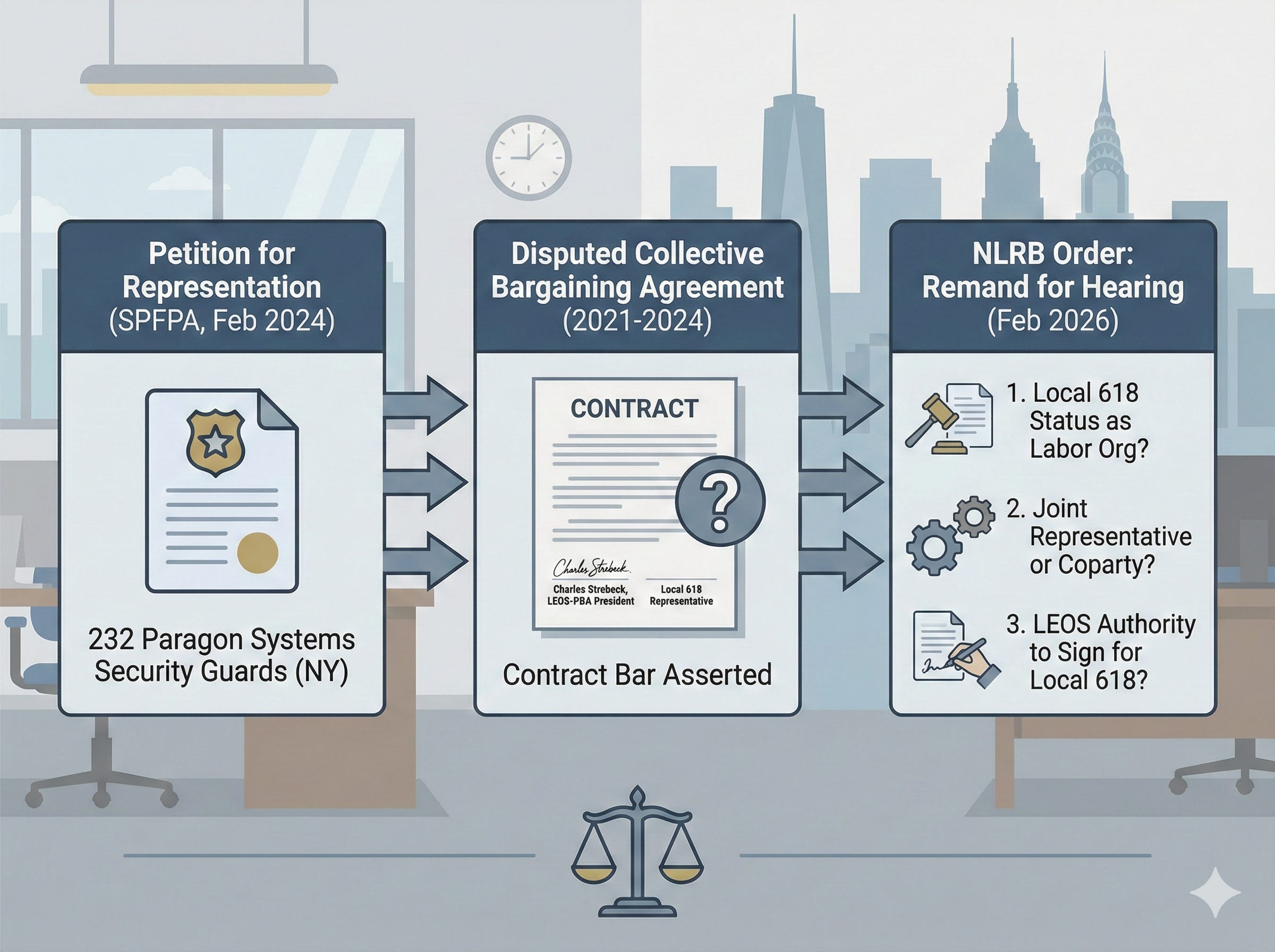
The NLRB granted SPFPA’s request for review and remanded a representation case to the Regional Director, finding that disputed questions about “Local 618’s” legal status required an evidentiary hearing.
In February 2024, SPFPA filed a petition to represent approximately 232 Paragon Systems security guards in New York. Intervenor LEOS-PBA asserted a contract bar based on a 2021-2024 collective bargaining agreement listing parties as “United Federation of Special Police and Security Officers Inc. Affiliated with United Federation/LEOS-PBA And its Local 618.” Only LEOS-PBA President Charles Strebeck signed the agreement—no Local 618 representative signed.
Regional Director Leslie dismissed the petition as untimely in March 2024, finding it filed outside the window period based on a June 15, 2024 contract expiration. She resolved conflicting expiration dates by examining wage provisions and five memoranda referencing the 2024 date. On the signature issue, she found the contract satisfied requirements based on LEOS’s representations during investigation that Local 618 did not exist as a separate organization post-2021 merger and applying Pharmaseal Laboratories.
SPFPA requested review, arguing the Regional Director improperly relied on extrinsic evidence about Local 618 in violation of the “four corners” doctrine, that Crothall Hospital Services requires all named union parties to sign, and that Pharmaseal Laboratories applies only to jointly certified unions. SPFPA attached evidence suggesting Local 618 members participated in negotiations and that LEOS may have other local unions. LEOS opposed, defending the Regional Director’s reliance on contract documents and application of Pharmaseal.
The Board granted review in February 2026, identifying three questions requiring hearing development. First, whether Local 618 is a labor organization under Section 2(5)—the Board found LEOS’s representations insufficient to resolve this question and noted SPFPA’s contrary evidence. Second, if Local 618 is a labor organization, whether it is a joint representative with LEOS (analyzed under Pharmaseal Laboratories) or a separate coparty (analyzed under Crothall Hospital Services). Third, what evidence exists concerning LEOS’s authority to sign on Local 618’s behalf, including course of conduct under Pharmaseal or agency/apparent authority under Crothall exceptions. Because LEOS bears the contract bar burden, the Board remanded for a hearing to develop the factual record.
Significant Cases Cited
Pharmaseal Laboratories, 199 NLRB 324 (1972): Held that course of conduct may establish one joint representative’s authority to sign on behalf of all joint representatives.
Crothall Hospital Services, Inc., 270 NLRB 1420 (1984): Required both parent and subordinate unions to sign an agreement listing both as parties for the agreement to bar an election.
International Paper, 325 NLRB 689 (1998): Applied joint representative analysis beyond jointly certified unions and found negotiating history may establish joint representative status.
Appalachian Shale Products Co., 121 NLRB 1160 (1958): Established that a contract must be signed by all parties to bar an election petition.
C. Hager & Sons Hinge Mfg. Co., 80 NLRB 163 (1948): Found parent union acting as local’s agent may sign without local’s signature.
Starbucks Corporation, JD(SF)-03-26, 19-CA-325519 (ALJ Decision)
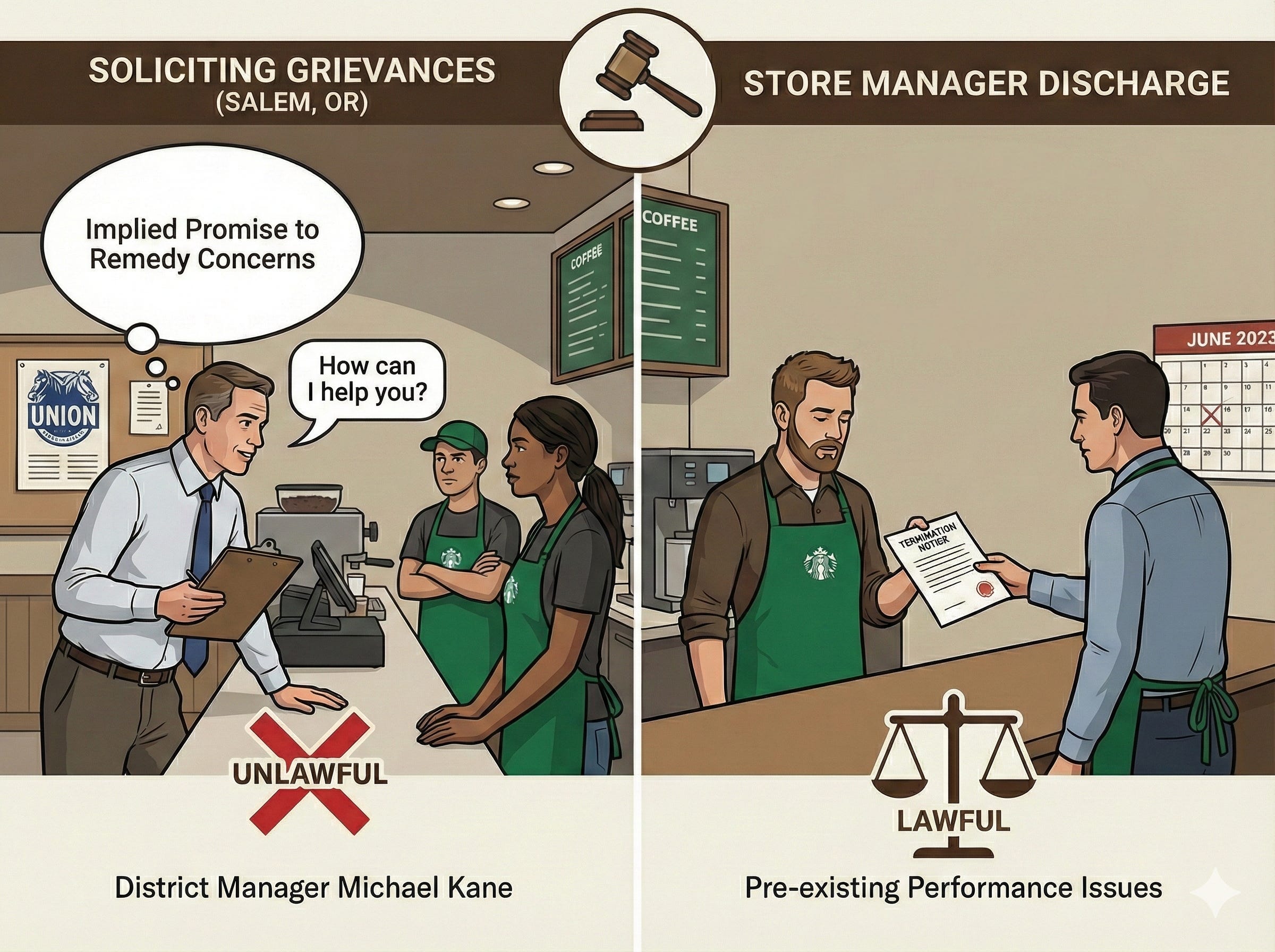
An NLRB Administrative Law Judge found Starbucks violated the National Labor Relations Act when District Manager Michael Kane solicited grievances from employees at a Salem, Oregon store during a 2023 union campaign, impliedly promising to remedy workplace concerns. The judge ordered Starbucks to post notices but dismissed allegations that the company unlawfully fired Store Manager Wade Russell for refusing to commit unfair labor practices, finding the discharge would have occurred anyway due to pre-existing performance issues.
After employees filed a union petition in June 2023, Kane held individual meetings asking workers if there was anything he could do to help them—a departure from past practice. The judge credited employee testimony over Kane’s denials, noting Kane’s evasive use of “corporate speak” rather than direct answers.
The complaint also alleged Russell was terminated for refusing Kane’s post-petition instructions to identify union supporters, eavesdrop on employee conversations, and change disciplinary practices. The judge credited Russell’s testimony that he repeatedly refused these requests. However, applying the Wright Line framework, the judge found that while anti-union animus contributed to the decision, Starbucks proved Russell would have been fired anyway for ongoing cleanliness and pest control failures. Kane had requested Russell’s termination on June 28—before the June 29 petition filing—with no evidence management knew of organizing activity at that time.
Corporate Speak Instances
The judge specifically identified Kane’s use of “corporate speak” instead of straightforward answers:
Referred to employee discipline as “accountability”
Called employee terminations “involuntary separations”
Described the dirty store as having “a degree of cleanliness opportunity when [Russell] stepped in to lead the store”
Significant Cases Cited
Wright Line, 251 NLRB 1083 (1980): Established burden-shifting framework requiring employers to prove they would have taken the same action absent protected activity.
Parker-Robb Chevrolet, Inc., 262 NLRB 402 (1982): Discharging supervisors for refusing to commit unfair labor practices violates Section 8(a)(1).
Register Guard, 344 NLRB 1142 (2005): Soliciting grievances during union campaigns without prior practice creates inference of implied promise to remedy them.
Capitol Emi Music, 311 NLRB 997 (1993): Solicitation of grievances during organizing inherently constitutes implied promise to remedy them.
Durham School Services, 361 NLRB 407 (2014): Managers observing union activity in manner “out of the ordinary” from normal duties constitutes unlawful surveillance.
Servicios Legales De Puerto Rico Inc / SLPR, JD-10-26, 12-CA-301971 (ALJ Decision)
An Administrative Law Judge ruled that Servicios Legales de Puerto Rico violated federal labor law by unilaterally eliminating attorney pay for partial-day absences and reducing vacation and sick leave benefits without proper bargaining with two unions representing its employees.
After the Legal Services Corporation (LSC), SLPR’s primary funder, imposed special grant conditions following union complaints, SLPR immediately changed how it paid attorneys and reduced leave benefits for all unionized employees. The organization claimed it had no bargaining obligation based on contract language and economic necessity.
The ALJ rejected SLPR’s defenses. The expired contract’s “flexibility” provision referred to work scheduling, not pay practices, and did not clearly authorize unilateral compensation changes. SLPR failed to prove economic exigency—LSC’s conditions set deadlines but didn’t threaten immediate funding termination, and the organization had time to bargain. Neither LSC regulations nor the special grant conditions specifically mandated SLPR’s chosen remedies; LSC only required that partial-day absences be charged to leave categories and that a market analysis determine if changes were “appropriate.”
The judge found SLPR violated Section 8(a)(1) by distributing memorandums misrepresenting that LSC imposed conditions “as a result of” union letters, while concealing that SLPR’s own letter to LSC—which first raised concerns about leave provisions—triggered the investigation. SLPR also mischaracterized union positions by claiming unions refused to negotiate when SLPR had consistently maintained it had no bargaining obligation.
The ALJ ordered SLPR to rescind both changes, restore previous practices until reaching agreement or lawful impasse, make employees whole with interest, and post remedial notices.
Significant Cases Cited
Litton Financial Printing Div. v. NLRB, 501 U.S. 190 (1991): When a collective-bargaining agreement expires, parties must maintain existing terms until reaching agreement or overall impasse.
Bottom Line Enterprises, 302 NLRB 373 (1991): Economic exigency exception requires extraordinary, unforeseen occurrences having major economic effect requiring immediate action.
Endurance Environmental Solutions, 373 NLRB No. 141 (2024): Clear and unmistakable waiver standard requires unequivocal expression of mutual intention to permit unilateral employer action.
Hospital Español Auxilio Mutuo de Puerto Rico, 374 NLRB No. 6 (2024): Board applied clear and unmistakable waiver standard retroactively where contract negotiated before MV Transportation decision.
Miller Waste Mills, Inc., 334 NLRB 466 (2001): Employer violated Section 8(a)(1) by sending letter blaming union for preventing employees from receiving wage increases, causing employees to lose faith in union representation.
Doctors Hospital of Manteca, Inc. D/B/a Doctors Hospital of Manteca, 32-RC-376933 (Regional Election Decision)
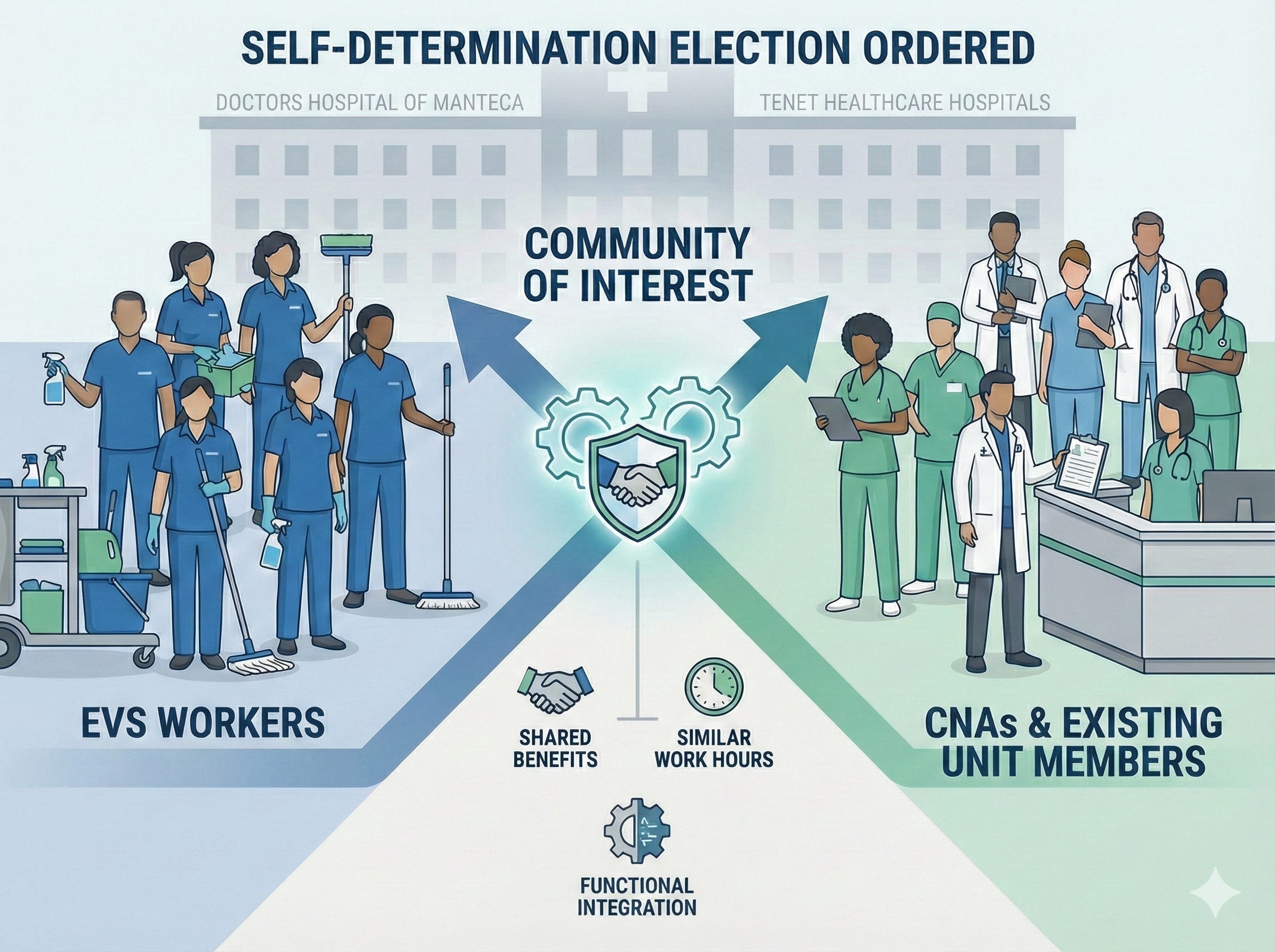
The NLRB Regional Director approved a self-determination election to allow approximately 28 environmental services (EVS) workers at Doctors Hospital of Manteca to vote on joining an existing multi-facility bargaining unit represented by SEIU-UHW that already covers employees across seven Tenet Healthcare hospitals in California.
The employer argued the petition should be dismissed because the existing unit is non-conforming under the Board’s Health Care Rule and the EVS workers lack a community of interest with current unit members. The Regional Director rejected these arguments, finding that EVS workers constitute a distinct and identifiable voting group and share sufficient community of interest with the existing unit.
The decision emphasized the close working relationship between EVS workers and certified nursing assistants (CNAs) already in the unit. EVS and CNAs interact four to eight times per shift, coordinate on patient room cleaning and sanitation, and CNAs perform EVS duties when EVS staff are unavailable. This functional integration, combined with shared benefits (health insurance, 401(k)), similar work hours, and comparable uniform and timekeeping requirements, supported finding a community of interest.
The Regional Director found the bargaining history particularly persuasive. The collective bargaining agreement’s recognition clause for Doctors Hospital of Manteca includes “all full time, regular part-time, and per diem Service & Maintenance and Business Office Clerical employees,” which should encompass EVS workers since the Board has consistently placed housekeeping workers in service and maintenance units. Additionally, EVS employees at three other hospitals in the existing unit are already covered by the contract.
The decision rejected the employer’s argument that adding EVS workers only at one facility was improper, noting that Armour-Globe elections need not perfect non-conforming units and citing St. Vincent Charity Medical Center and Rush University Medical Center v. NLRB for the principle that unions may add some, but not all, unrepresented employees to existing non-conforming units.
Significant Cases Cited
Armour & Co., 40 NLRB 1333 (1942): Established the self-determination election procedure for adding unrepresented employees to existing bargaining units.
St. Vincent Charity Medical Center, 357 NLRB 854 (2011): Held that directing an Armour-Globe election is not contrary to the Health Care Rule even when adding employees to an already non-conforming unit.
MV Transportation, Inc., 373 NLRB No. 8 (2023): Clarified that employees sought to be added need only share a community of interest with a minority of the existing unit, not the entire unit.
Warner-Lambert Co., 298 NLRB 993 (1990): Established the framework for determining whether a self-determination election is appropriate, requiring that employees share a community of interest and constitute an identifiable, distinct segment.
Rush University Medical Center v. NLRB, 833 F.3d 202 (D.C. Cir. 2016): Affirmed that Armour-Globe elections do not create “additional units” and therefore are not restricted by Section 103.30(c) of the Health Care Rule.