
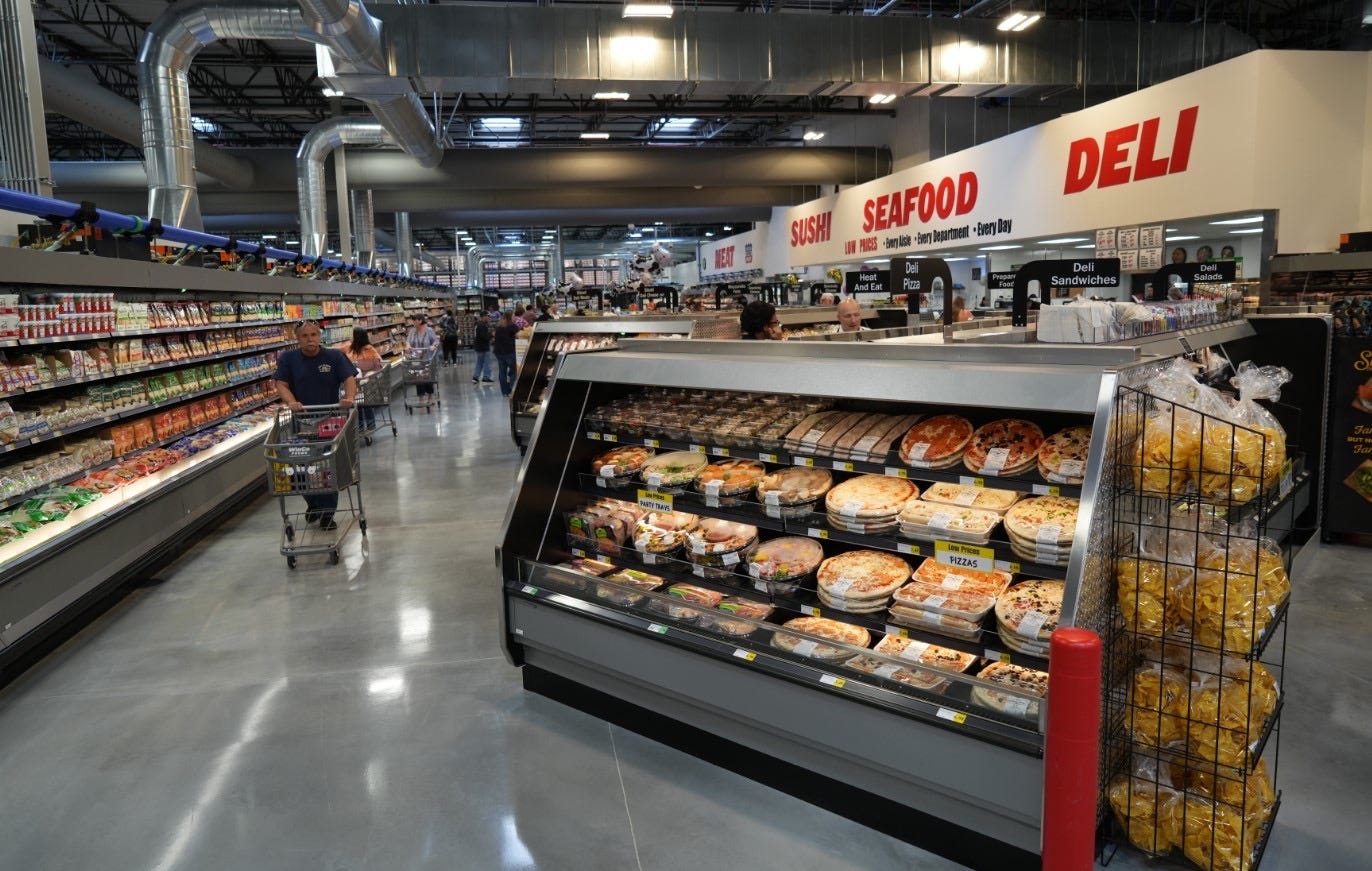
Winco Foods, 374 NLRB No. 37, 27-CA-345285 (Published Board Decision)
The NLRB found that Winco Holdings violated the NLRA by refusing to bargain with International Brotherhood of Teamsters, Local 22 after the union was certified as the bargaining representative for employees at a Salt Lake City grocery store. Following a February 2024 union election, the Regional Director certified the union in April 2024, and the Board denied the company’s request for review in June 2024. Despite the union’s repeated bargaining requests beginning in February 2024, the company refused to recognize or bargain with the union since May 2024.
The Board granted the Acting General Counsel’s motion for summary judgment, finding that all representation issues had been or could have been litigated in the underlying representation proceeding. The company’s objections to the election did not raise any issues warranting a hearing in the unfair labor practice case. The Board rejected the company’s various affirmative defenses, including constitutional challenges based on the Major Questions Doctrine, presidential removal power, and separation of powers. The Board found these assertions either unsupported or, in the case of the Article II removal claim, insufficient because the company failed to demonstrate any harm from removal protections.
The Board ordered Winco to recognize and bargain with the union and extended the certification period to begin when the company starts bargaining in good faith, ensuring employees receive the full benefit of their chosen representation.
Significant Cases Cited
Pittsburgh Plate Glass Co. v. NLRB, 313 U.S. 146 (1941): Representation issues that were or could have been litigated in a representation proceeding cannot be relitigated in an unfair labor practice proceeding.
Collins v. Yellen, 594 U.S. 220 (2021): Constitutional challenges to removal protections require showing actual harm from the allegedly unconstitutional provisions.
Mar-Jac Poultry Co., 136 NLRB 785 (1962): The certification period begins when an employer commences good-faith bargaining with the union.
Frontier Hotel, 265 NLRB 343 (1982): The Board may take official notice of the record in underlying representation proceedings.
Hackensack Meridian Health Carrier Clinic, 374 NLRB No. 35, 22-CA-360422 (Published Board Decision)
The National Labor Relations Board granted summary judgment against Hackensack Meridian Health Carrier Clinic, finding the behavioral health services provider violated the NLRA by refusing to bargain with District 1199J, National Union of Hospital and Healthcare Employees, after the union won a representation election.
The case arose after the union was certified following a May 2024 secret ballot election among mental health technicians at the employer’s Belle Mead, New Jersey facility. The Regional Director certified the union in October 2024, and the Board denied the employer’s request for review in December 2024. Despite the union’s repeated requests to bargain beginning in October 2024, Hackensack Meridian refused to recognize the union since December 11, 2024.
In its defense, the employer argued that the union’s certification was invalid due to alleged objectionable conduct during the election and claimed Board agent misconduct. The Board rejected these arguments under the Pittsburgh Plate Glass doctrine, which bars employers from relitigating representation issues in unfair labor practice proceedings when those issues were or could have been raised during the underlying representation case. The Board found the employer raised no new matters and offered no newly discovered evidence that would justify reopening the representation questions.
The Board also addressed the employer’s procedural challenge regarding Board composition. The employer claimed the Board lacked a quorum to issue its Notice to Show Cause after President Trump removed Member Gwynne A. Wilcox on January 27, 2025. The Board ratified its earlier notice and proceeded with a valid quorum.
Finding the refusal to bargain violated Section 8(a)(5) and (1) of the NLRA, the Board ordered the employer to recognize and bargain with the union. Under the Mar-Jac Poultry doctrine, the Board also ruled that the certification period will begin when the employer starts bargaining in good faith, ensuring employees receive the full benefit of their bargaining representative.
Significant Cases Cited
Pittsburgh Plate Glass Co. v. NLRB, 313 U.S. 146 (1941): Employers cannot relitigate representation issues in unfair labor practice proceedings when those issues were or could have been raised in the underlying representation case.
Mar-Jac Poultry Co., 136 NLRB 785 (1962): The initial certification period begins when the employer starts bargaining in good faith with the union, ensuring employees receive the full statutory period of representation.
Frontier Hotel, 265 NLRB 343 (1982): The Board may take official notice of the record in representation proceedings when adjudicating related unfair labor practice cases.
Samaritan Healthcare & Hospice, Inc., 04-RC-376445 (Regional Election Decision)
The National Labor Relations Board’s Region 4 office has directed a mail-ballot election for approximately 160 healthcare professionals at Samaritan Healthcare & Hospice after rejecting the employer’s attempts to exclude certain workers and narrow the bargaining unit.
Regional Director Kimberly Andrews ruled that Health Professionals and Allied Employees can proceed with organizing registered nurses, nurse practitioners, social workers, music therapists, spiritual support counselors, and bereavement counselors across the hospice provider’s three New Jersey facilities and field operations. The decision addresses several contested issues about who qualifies as a professional employee and whether religious functions can exclude workers from union representation.
Multi-Facility Unit Approved Despite Limited Interchange
The employer argued that field employees and inpatient unit (IPU) employees lack sufficient community of interest to form a single bargaining unit, pointing to minimal employee interchange and distinct working conditions. Field nurses work flexible 8-hour schedules visiting patients in homes, while IPU nurses work twelve-hour hospital shifts with different skill requirements.
The decision applied the Exemplar framework, finding that three of six community-of-interest factors supported the employer-wide unit: similar skills and training requirements, centralized HR and management control, and geographic proximity of all facilities within 5-15 miles. While functional integration was limited—with patient transfers between field and IPU occurring only monthly—this single contrary factor was “plainly outweighed” by other considerations.
The decision emphasized that all employees use the same electronic medical records system, participate in interdisciplinary care teams, receive identical benefits and PTO, and attend common orientation and annual skills training where seven of nine sessions are shared across all RN classifications.
Music Therapists Qualify as Professionals
The employer challenged music therapists’ inclusion, arguing their work resembles physical therapy rather than professional intellectual labor. The decision rejected this comparison, finding all four statutory criteria for professional employees were met under Section 2(12)(a) of the NLRA.
Music therapists must hold master’s degrees in music therapy and board certification requiring 1,200 clinical internship hours. Their work involves creating individualized treatment plans, assessing patients’ cognitive and emotional states, and employing specialized techniques like entrainment—using rhythm to physiologically calm patients and lower blood pressure. The decision noted they “consistently exercise discretion and judgment” in selecting interventions and cannot standardize their work’s output over time.
The decision distinguished Lakeshore Manor, where art and dance therapists lacked advanced degrees or professional certification. Here, both music therapists possess graduate education in a specialized field and maintain national board certification with continuing education requirements.
Spiritual Support Counselors Remain in Unit Despite Religious Duties
The decision rejected the employer’s argument that spiritual support counselors should be excluded to avoid entangling the NLRB in religious affairs. The employer contended these workers perform “explicitly religious, non-secular functions” and cited Bethany College‘s framework for religious educational institutions.
The decision distinguished Bethany College as applying only to religious employers themselves, not individual job classifications. It found no binding precedent excluding chaplain-type positions from NLRA coverage based on religious duties. The decision emphasized that Congress explicitly excluded certain workers from the Act’s definition of employee—agricultural laborers, domestic workers, supervisors—but not religious workers.
The decision noted that while spiritual support counselors pray with patients and discuss faith, their core function under Medicare regulations is addressing patients’ existential concerns about death through grief counseling and emotional support. Approximately 75% of their work involves non-denominational counseling, and they frequently serve patients of different faiths or no faith.
Program Coordinator Excluded as Non-Professional
The sole classification excluded from the unit was the Program and Clinical Coordinator, who coordinates student placements and observational programs. This position requires only a high school diploma and involves scheduling, data collection, and administrative coordination without direct patient care.
The decision found the coordinator fails to meet Section 2(12)(a)’s requirements for professional employees: the work lacks predominantly intellectual character, doesn’t require consistent exercise of discretion and judgment, and doesn’t demand advanced knowledge from specialized higher education. Since the petitioned-for unit explicitly excludes non-professional employees, this classification was removed.
Mail Ballot Ordered for Scattered Workforce
Rather than the employer’s proposed manual election at the main office or the union’s mixed manual-mail format, the decision directed an all-mail ballot to enfranchise the maximum number of workers and efficiently use Board resources.
Approximately 115 field employees travel directly from home to patients’ residences without reporting to any facility on most days. The remaining 46 employees work across three locations on varying shifts, including IPU nurses working twelve-hour shifts that rotate through all days of the week. The decision found that attempting manual voting would require multiple Board agents across multiple days at up to three locations, with no guarantee all eligible voters could attend.
Under San Diego Gas & Electric, mail ballots are appropriate when eligible voters are scattered geographically or temporally such that they cannot be at a common location at common times. The decision noted field employees only occasionally attend in-person meetings, with many interdisciplinary team meetings conducted virtually.
Ballots will be mailed February 13, 2026, with counting scheduled for March 13, 2026, at the Board’s Philadelphia regional office.
Significant Cases Cited
Exemplar, Inc., 363 NLRB 1500 (2016): Established six-factor community-of-interest test for multifacility units, finding lack of functional integration can be outweighed by other factors supporting community of interest.
San Diego Gas and Electric, 325 NLRB 1143 (1998): Mail-ballot elections are appropriate when eligible voters are scattered geographically or by work schedules such that they cannot be at common locations at common times.
Bethany College, 369 NLRB No. 98 (2020): Created three-prong test for exercising jurisdiction over religious educational institutions, requiring employer itself to be religious institution.
Avco Corp., 313 NLRB 1357 (1994): Professional employee status depends on work performed, not individual qualifications; employees with professional degrees generally meet “advanced knowledge” requirement.
Lakeshore Manor, Inc., 225 NLRB 908 (1976): Art and dance therapists at nursing home were not professional employees where they lacked advanced degrees, professional certification, or licensure requirements.
Frito-Lay North America, Inc., 04-RC-376082 (Regional Election Decision)
The National Labor Relations Board has directed a union election for bulk truck drivers at a Frito-Lay facility in King of Prussia, Pennsylvania, rejecting the company’s argument that a much larger bargaining unit was necessary.
Teamsters Local 929 petitioned to represent 26 employees classified as Sales Delivery Specialists, Delivery Specialist Leads, and Delivery Merchandising Specialists—workers who drive large bulk trucks to deliver snacks to supermarkets and other major customers. Frito-Lay argued these employees should be combined with 127 additional workers across seven job classifications in its Sales Organization, contending the smaller unit would be inappropriately “fractured.”
The decision applied the American Steel framework’s two-step analysis. First, it determined the petitioned-for unit was appropriate because the bulk truck drivers share an internal community of interest, are readily identifiable as a group, and are sufficiently distinct from other employees. These workers receive specialized training on liftgates and airbrakes unique to larger trucks, start their shifts between 1:00-3:00 a.m. (earlier than other employees), are paid hourly rather than on salary with performance incentives, and report to a dedicated supervisor.
The decision then examined whether Frito-Lay demonstrated an “overwhelming community of interest” between the drivers and contested employees—a burden the company failed to meet. The contested workers included Route Sales employees (109 workers) who perform strategic, sales-focused duties and either drive smaller trucks or work truckless, and merchandising employees (18 workers) who stock shelves using personal vehicles rather than company trucks.
The decision found minimal functional integration between groups. Route Sales workers have fundamentally different job functions focused on sales strategy rather than manual driving and delivery. Evidence showed only 72 instances of temporary interchange over nine months—primarily involving four specialists covering driver absences—which the decision deemed “trivial” for a workforce of 153 employees. The groups work in different locations, at different times, with separate supervisors, and the bulk truck drivers never performed contested employees’ work even temporarily.
The decision distinguished Casino Aztar, where significant interchange was found, noting that case involved employees working side-by-side in identical uniforms under the same supervision and sharing tips equally—circumstances absent here. It also rejected Frito-Lay’s argument that all employees’ possession of driver’s licenses created unity, observing that driving personal vehicles to work is fundamentally different from operating company bulk trucks as a core job duty.
Significant Cases Cited
American Steel Construction, Inc., 372 NLRB No. 23 (2022): Established the current two-step framework for unit determinations, requiring petitioned-for employees to share a community of interest and be readily identifiable, with additional employees included only if they share an “overwhelming community of interest” with the petitioned-for unit.
Specialty Healthcare & Rehabilitation Center of Mobile, 357 NLRB 934 (2011): Articulated the standard that a petitioner need only demonstrate an appropriate unit, not the most appropriate unit, and established the “overwhelming community of interest” test for including additional employees.
E.H. Koester Bakery Co., Inc., 136 NLRB 1006 (1962): Established the longstanding principle that drivers may constitute an appropriate unit separate from warehouse and production employees based on distinct working conditions and limited contact with other workers.
Triangle Building Products Corp., 338 NLRB 257 (2002): Held that drivers may constitute an appropriate separate unit unless they are so integrated with a larger unit that they have lost their separate identity.
WideOpenWest Illinois, LLC, 371 NLRB No. 107 (2022): Defined functional integration as requiring employees to “must work together and depend on one another to accomplish their tasks,” not merely participating in the same production process.