
United Community Action Partnership, Inc., 18-UC-364996 (Regional Election Decision)
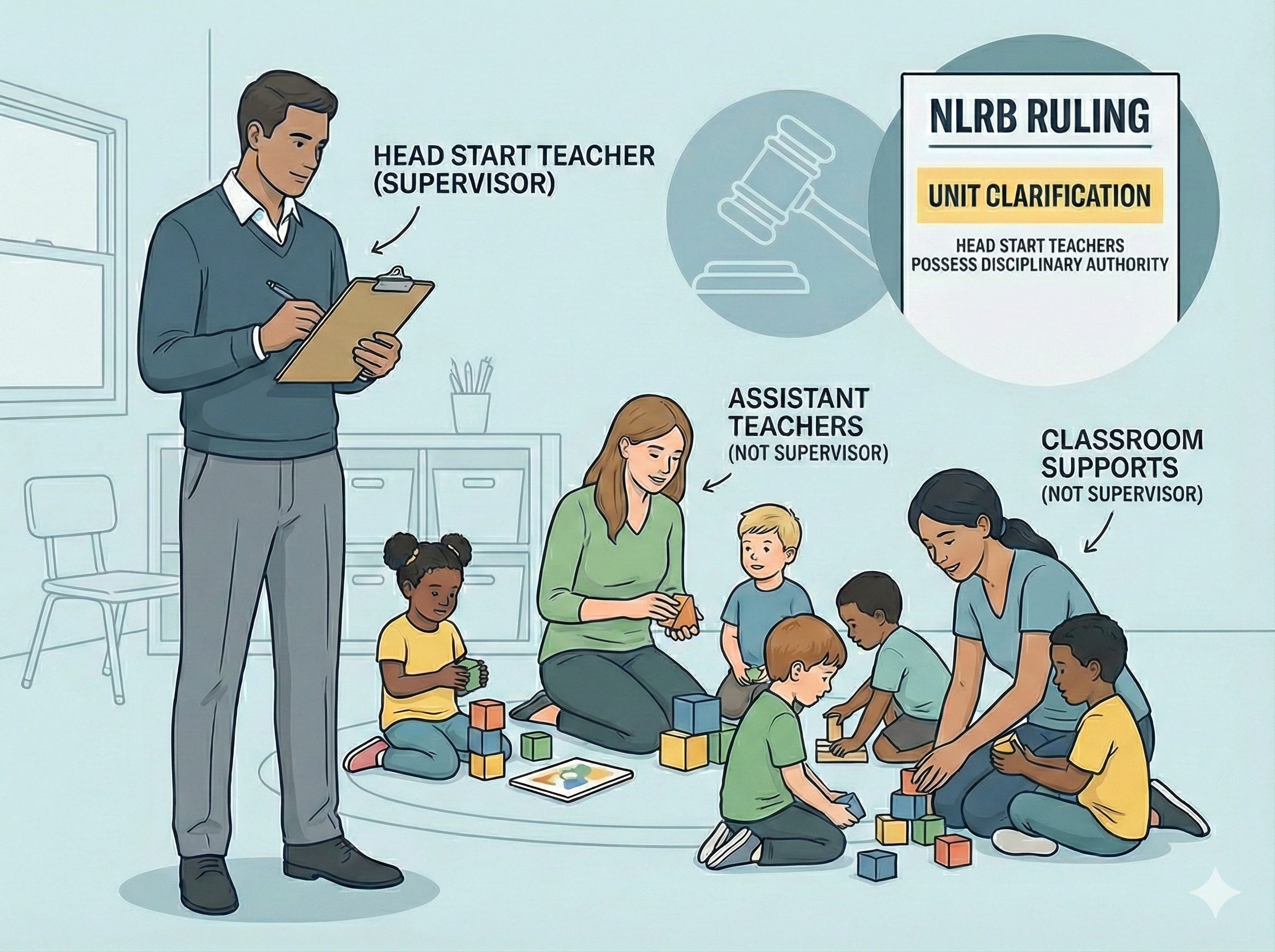
The NLRB Regional Director for Region 18 has ruled that Head Start Teachers at United Community Action Partnership are statutory supervisors under the NLRA and must be excluded from the bargaining unit represented by AFSCME Council 65, Local 3444.
The employer filed a unit clarification petition seeking to exclude Head Start Teachers from a bargaining unit certified in 1997, arguing they possess supervisory authority. The union contested this classification, maintaining the teachers should remain in the unit.
Following a hearing, the Regional Director applied the three-part supervisory test established in Kentucky River and Oakwood Healthcare: whether individuals (1) hold authority to engage in one of twelve supervisory functions, (2) exercise that authority using independent judgment rather than routine/clerical actions, and (3) act in the employer’s interest.
The decision focused primarily on the Head Start Teachers’ disciplinary authority. Teachers can issue both informal “supervisories” (documented performance conversations) and formal discipline including verbal and written warnings to Assistant Teachers and Classroom Supports. Critically, teachers have unfettered discretion to determine whether staff performance issues warrant informal discussion, documented supervisory meetings, or formal discipline—with no firm guidelines dictating when misconduct rises to each level. This discretion demonstrates independent judgment. The issued discipline is placed in personnel files and forms part of the progressive disciplinary system without independent investigation by higher management.
While the Regional Director found insufficient evidence that teachers possess hiring, assignment, responsible direction, reward, or grievance adjustment authority under Section 2(11), several secondary indicia supported the supervisory finding: teachers are designated as supervisors in employer documents, attend mandatory supervisory training, and approve time-off requests and timesheets for classroom staff.
The unit was clarified to exclude Head Start Teachers while continuing to include Early Head Start Teachers, Assistant Teachers, and Classroom Supports.
Significant Cases Cited
NLRB v. Kentucky River Community Care, Inc., 532 U.S. 706 (2001): Established the three-part test for determining supervisory status under Section 2(11) of the NLRA.
Oakwood Healthcare, Inc., 348 NLRB 686 (2006): Defined key supervisory functions including “assign,” “responsibly direct,” and “independent judgment,” requiring differentiation between routine instructions and actual supervisory authority.
Veolia Transportation Services, Inc., 363 NLRB 902 (2016): Held that discipline must lead to personnel action without independent investigation by upper management to establish supervisory authority.
Republican Co., 361 NLRB 93 (2014): Established that verbal reprimands serving limited reporting functions do not constitute supervisory disciplinary authority, but warnings within progressive discipline systems can.
Heartland of Beckley, 328 NLRB 1056 (1999): Found that verbal and written warnings constitute disciplinary action where retained in personnel files and part of employer’s progressive disciplinary system.
Aldridge Electric, Inc., JD-06-26, 05-CA-323420 (ALJ Decision)
An NLRB administrative law judge has dismissed all unfair labor practice charges against Aldridge Electric, Inc., finding the company did not violate the NLRA when it terminated union electrician Robert Stafford multiple times in 2023, despite evidence the employer initially placed him on a no-rehire list for filing a grievance.
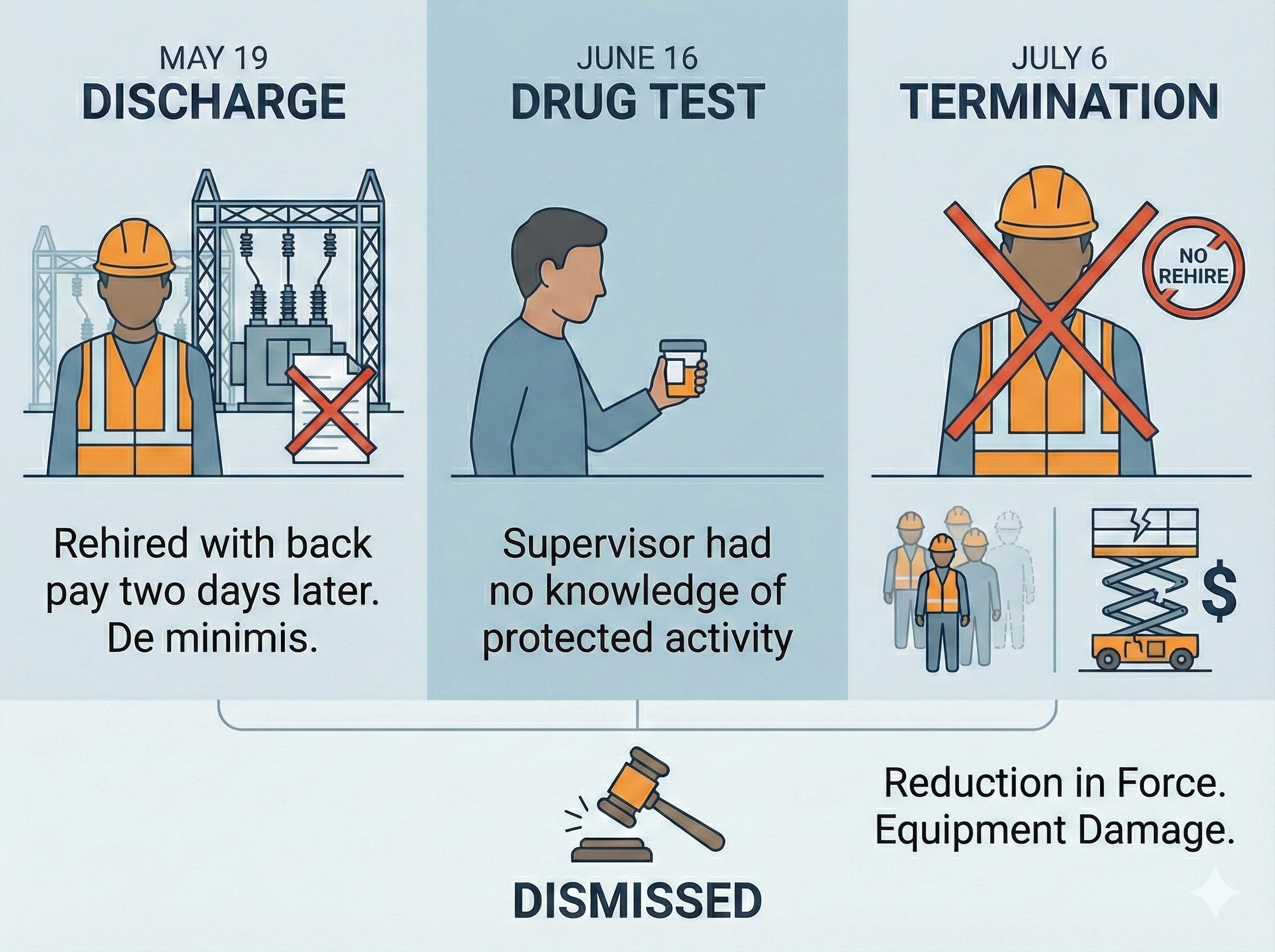
The case centered on three alleged violations: Stafford’s May 19, 2023 discharge after working half a day at a PEPCO substation project; a June 16, 2023 requirement that he submit to a directly-observed drug test following a workplace accident; and his July 6, 2023 termination with permanent no-rehire status.
While the judge found Aldridge violated the NLRA by discharging Stafford on May 19 because he appeared on a no-rehire list created after he filed a grievance in 2022, the judge dismissed this violation as de minimis because the company rescinded the termination two days later with full back pay. The judge emphasized that no evidence connected the superintendent who originally blacklisted Stafford to the later decision-makers at the Mount Vernon project, which operated under a different company division.
Regarding the observed drug test allegation, the judge found the company’s compliance officer who made that decision had no knowledge of Stafford’s prior protected activity and ordered direct observation solely because Stafford took nearly ten hours to complete his drug test after a 9:30 a.m. accident—raising concerns he might be attempting to avoid detection of substances in his system.
For the July 6 termination, the judge ruled the company met its burden under Wright Line by showing Stafford would have been laid off regardless of protected activity. The decision cited both a legitimate reduction in force affecting multiple electricians and Stafford’s responsibility for a workplace accident where he operated lift equipment without certification, causing $5,000-$9,999 in damage. The judge noted Stafford’s earlier refusal to return his security badge to Metro officials after a 2022 termination also justified denying reinstatement.
Significant Cases Cited
Wright Line, 251 NLRB 1083 (1980), enf’d on other grounds 662 F.2d 899 (1st Cir. 1981), cert. denied 455 U.S. 989 (1982): Established the burden-shifting framework for analyzing whether protected activity motivated an adverse employment action.
NLRB v. Transportation Management Corp., 462 U.S. 393 (1983): Supreme Court approved the Wright Line causation test for discrimination cases.
NLRB v. Disposal Systems, Inc., 465 U.S. 822 (1984): Established that filing a grievance to enforce collective bargaining agreement terms is undeniably protected concerted activity.
Fresh & Easy Neighborhood Market, Inc., 361 NLRB 151 (2014): Defined Section 7 protection as covering activity done with or with authority of other employees to improve or safeguard employment terms.
American Federation of Musicians, Local 76 (Jimmy Wakely Show), 202 NLRB 620 (1973): Established Board discretion to decline exercising jurisdiction over de minimis violations that are quickly remedied.