

Satellite Healthcare (Santa Rosa), 374 NLRB No. 25, 20-RC-360713 (Published Board Decision)
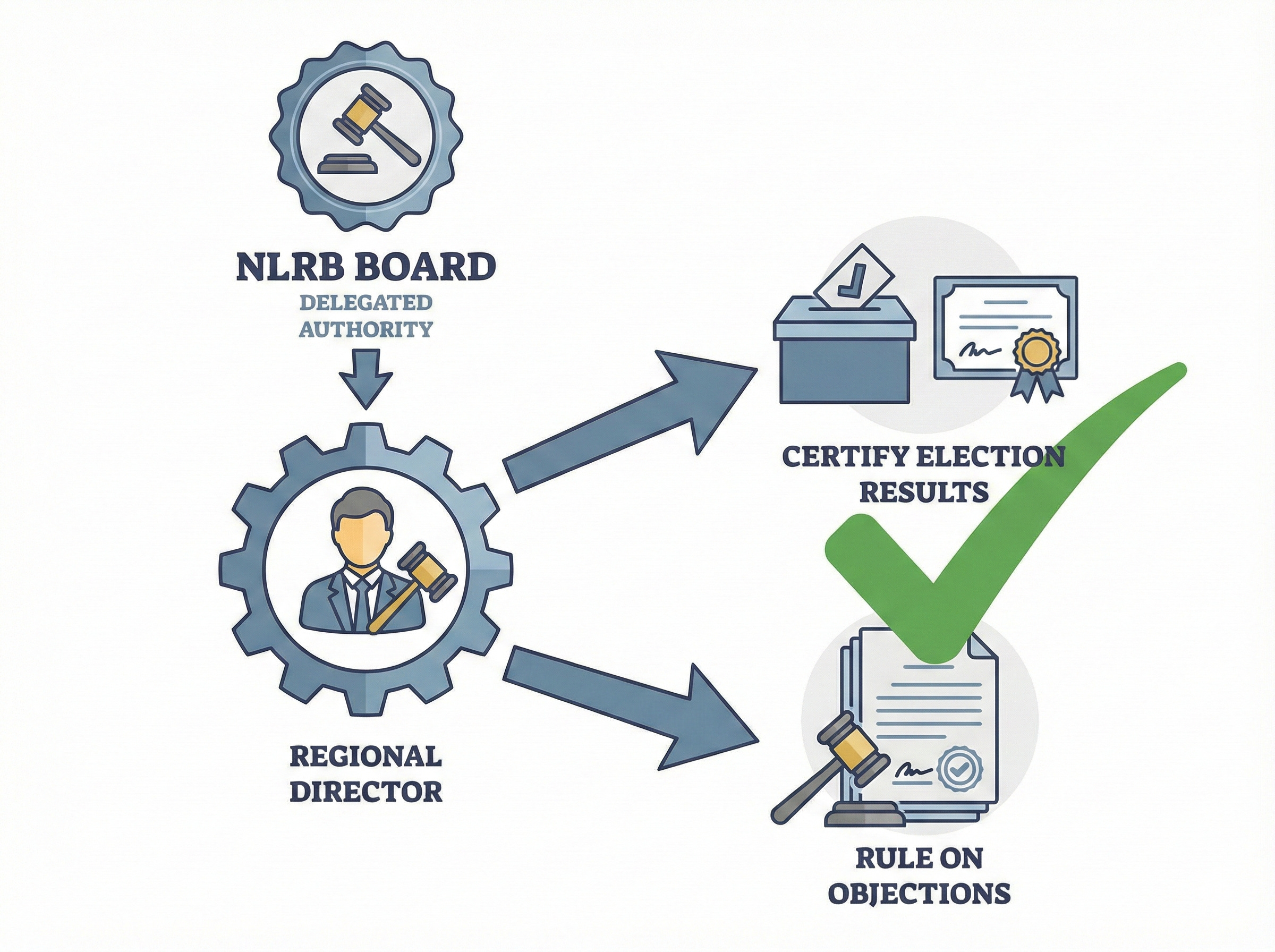
The NLRB denied an employer’s request for review of a regional director’s decision that overruled the employer’s election objection and certified a union as the bargaining representative. The employer argued that the regional director lacked authority to rule on objections or certify election results because the Board lacked a quorum when these actions occurred.
The Board rejected this argument, reaffirming its interpretation of Section 3(b) of the NLRA that permits regional directors to continue exercising their delegated authority even when the Board lacks a quorum. The Board cited its regulations stating that representation cases should continue to be processed and certifications issued by regional directors “to the extent practicable” despite pending review requests, and that normal agency operations should continue during quorum lapses “to the greatest extent permitted by law.”
The employer also contended that circuit court decisions upholding this interpretation under the Chevron framework were invalidated by the Supreme Court’s decision in Loper Bright, which overruled Chevron. The Board disagreed, noting that Loper Bright explicitly stated it did not call into question prior cases relying on Chevron and that holdings finding specific agency actions lawful remain subject to statutory stare decisis. The Board further reasoned that under Loper Bright‘s standard, its interpretation of Section 3(b) remains valid because it gives effect to each part of the statute, aligns with congressional intent behind the delegation provision, and is not contrary to the text, structure, or purpose of the NLRA.
Significant Cases Cited
Durham School Services, 361 NLRB 702 (2014): Established that regional directors may continue exercising delegated authority while the Board lacks a quorum.
Loper Bright Enterprises v. Raimondo, 603 U.S. 369 (2024): Overruled Chevron deference but preserved prior holdings that specific agency actions are lawful under statutory stare decisis.
UC Health v. NLRB, 803 F.3d 669 (D.C. Cir. 2015): Upheld the Board’s interpretation that Section 3(b) delegation authority remains effective regardless of Board composition.
Chevron, U.S.A., Inc. v. Natural Resources Defense Council, Inc., 467 U.S. 837 (1984): Previously established framework for judicial deference to agency interpretations of ambiguous statutes.
South Central Indiana Rural Electric Membership Corporation, 25-UC-363925 (Regional Election Decision)
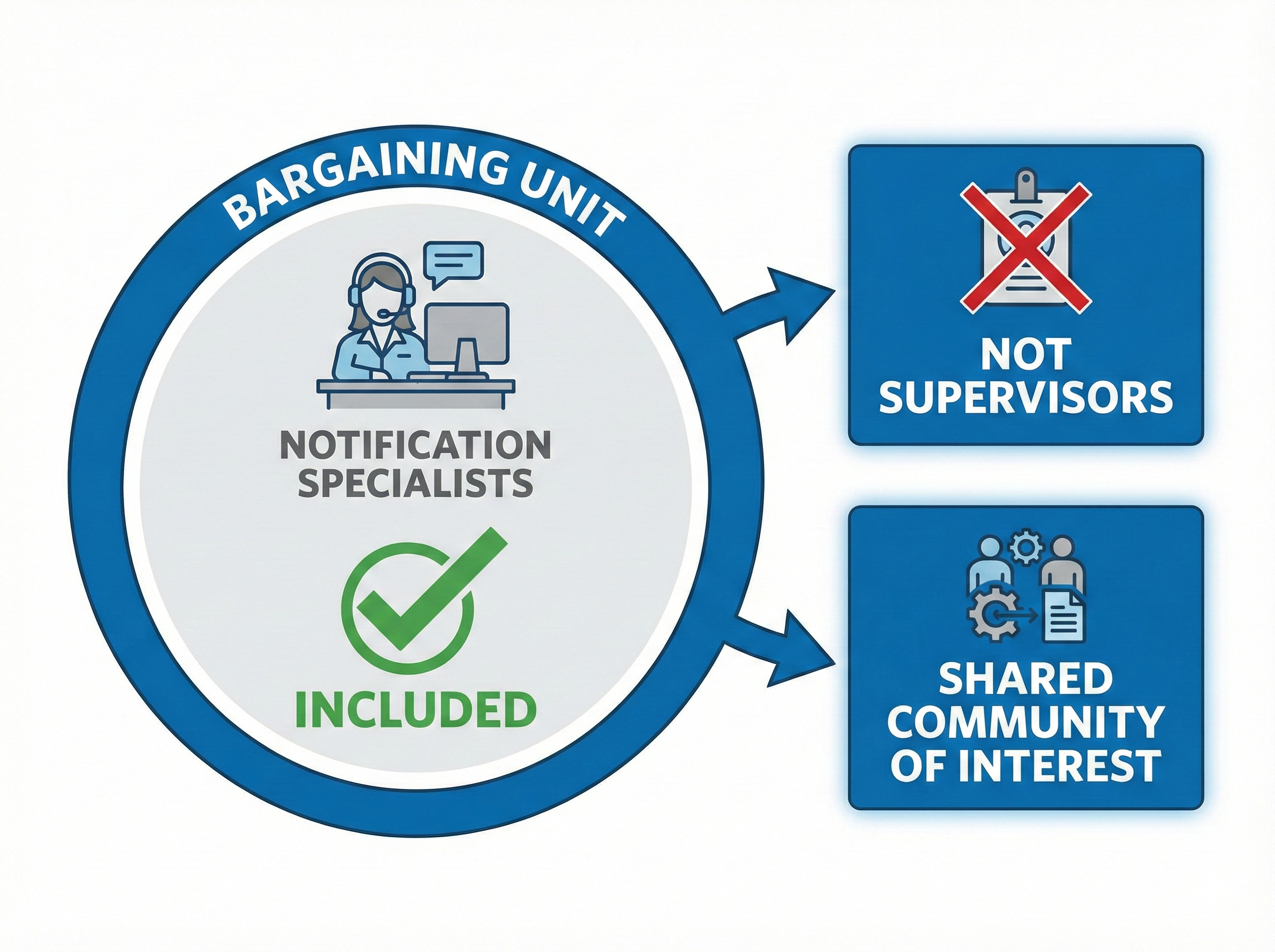
The NLRB Regional Director issued a decision clarifying that notification specialists should be included in the existing bargaining unit represented by IBEW Local 1393 at South Central Indiana Rural Electric Membership Corporation. The employer had argued that notification specialists are supervisors under Section 2(11) of the NLRA when they substitute for superintendents, but the Regional Director rejected this claim.
The decision found that notification specialists spend less than 10% of their time substituting for superintendents—insufficient to establish “regular and substantial” supervisory substitution under Board precedent. Even assuming such substitution was regular, the employer failed to prove notification specialists exercise meaningful supervisory authority. When acting as superintendent, they primarily serve as a point of contact and relay information to management rather than making independent decisions about assignments, discipline, transfers, or other supervisory functions.
Applying the traditional community-of-interest standard, the Regional Director found notification specialists share sufficient commonality with bargaining unit employees. Both groups work in the same department under common supervision, have daily contact, share similar wages and benefits, work the same schedule, and are functionally integrated in clearing vegetation from power lines. Although notification specialists’ primary duties differ from field crews, they regularly perform field crew functions, operate the same equipment, and typically progress into their roles from unit positions.
The unit was clarified to include notification specialists alongside groundmen, operators, foremen, and trimmers employed at the Martinsville facility.
Significant Cases Cited
Oakwood Healthcare, Inc., 348 NLRB 686 (2006): Established the framework for analyzing supervisory status under Section 2(11), requiring independent judgment in exercising supervisory functions and distinguishing between true supervision and routine instructions.
NLRB v. Kentucky River Community Care, Inc., 532 U.S. 706 (2001): Set forth the three-part test for supervisory status requiring authority over one of twelve listed functions, exercise of independent judgment, and authority held in the employer’s interest.
MV Transportation, Inc., 373 NLRB No. 8 (2023): Clarified that when a unit clarification petition resolves placement of employees who voted subject to challenge, the applicable standard is the same as would have applied before the election.
Specialty Healthcare & Rehabilitation Center of Mobile, 357 NLRB 934 (2011): Established the “overwhelming community of interest” standard applies only when a party contends a unit is inappropriate because it excludes insufficiently distinct employees.
Shaw, Inc., 350 NLRB 354 (2007): Held that sporadic exercise of supervisory authority is insufficient to transform an employee into a supervisor and that supervisory indicia are read in the disjunctive.