
Recreational Equipment, Inc., JD(SF)-02-26, 19-CA-316615 (ALJ Decision)
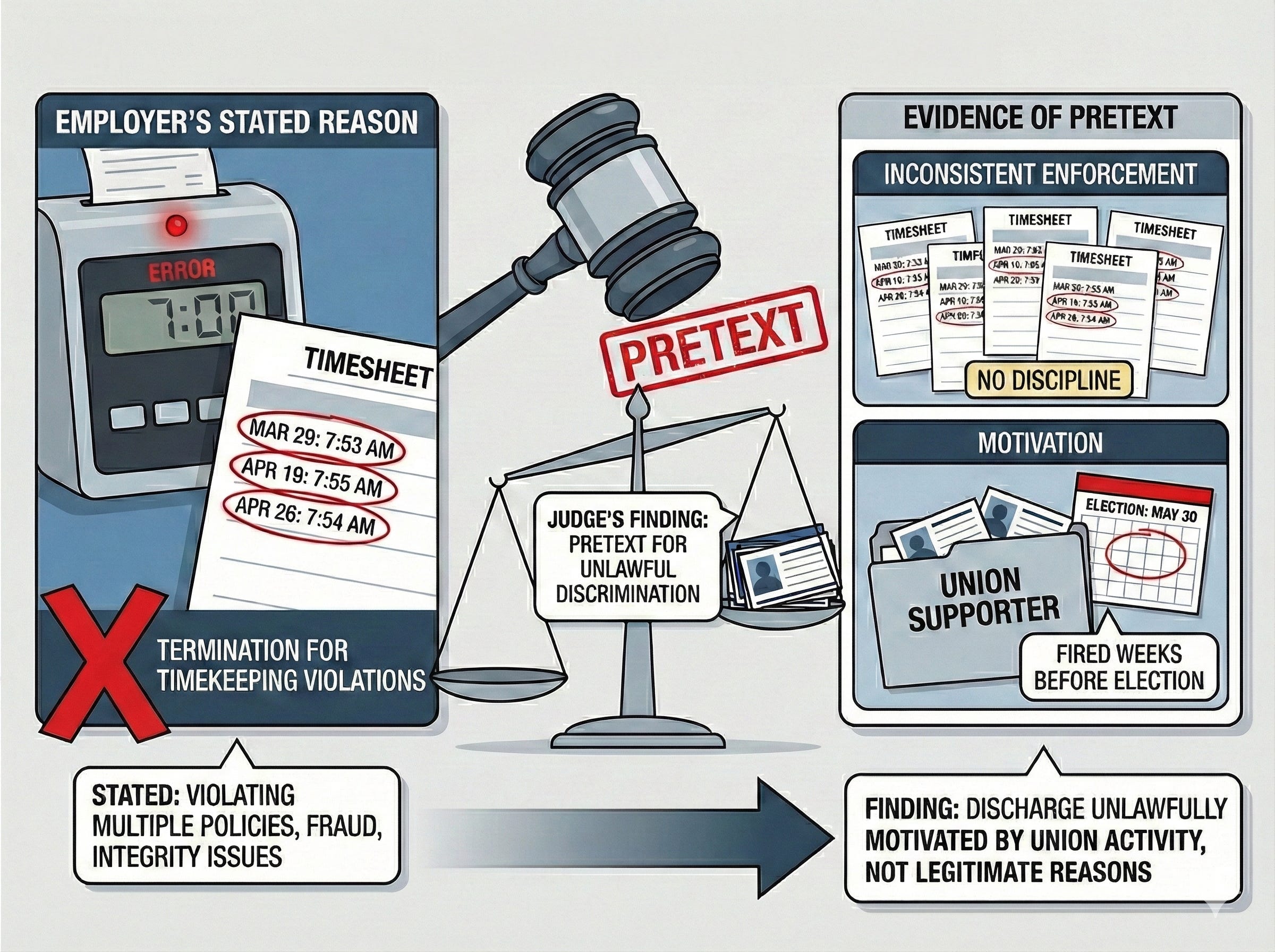
An Administrative Law Judge found that Recreational Equipment, Inc. (REI) violated the NLRA by terminating employee Lindlee Hamlin during a union organizing campaign at its Eugene, Oregon store. The judge applied the Wright Line analysis to determine that Hamlin’s discharge was unlawfully motivated by her union activity rather than legitimate business reasons.
Factual Background
In spring 2023, employees at REI’s Eugene store organized with United Food and Commercial Workers, Local 555. Hamlin, an 11-year bike shop employee, was among nine organizing committee members who publicly announced the union campaign on April 10, 2023. The union filed for representation after collecting authorization cards from 28 of 45 unit employees (62%). Shortly after the announcement, store manager Ben Sprague departed and was replaced by Kayla DeForest.
The Termination
On May 11, 2023—just weeks before the scheduled May 30 election—DeForest terminated Hamlin for allegedly falsifying timekeeping records. The stated reason was that Hamlin clocked in more than seven minutes early on three occasions (March 29, April 19, and April 26) without manager approval, violating multiple REI policies regarding timekeeping, fraud, and integrity.
The judge found this justification pretextual. Evidence showed that irregular time punches were commonplace under prior management, with numerous employees clocking in early or late without consistent enforcement. REI’s own attendance policy required four infractions within four weeks to trigger discipline, yet Hamlin was terminated for three minor discrepancies. Moreover, the purported “falsification” relied on comparing Hamlin’s handwritten times to CCTV timestamps, with differences of only minutes and no evidence the systems were synchronized. The judge concluded REI failed to establish Hamlin acted with intent to defraud.
Other Section 8(a)(1) Violations
The judge found two additional violations. First, bike shop manager Russell Anderson unlawfully interrogated organizing committee member Forrest Houldin by asking “what he hoped to achieve by unionizing” in a closed-door conversation. Applying the Rossmore House totality-of-circumstances test, the judge found the questioning coercive given the supervisor’s position, the private setting, and absence of assurances against reprisal.
Second, DeForest unlawfully instructed organizing committee member Parker Pease not to discuss terminated employees’ voting rights. This directive singled out union-related discussions and conveyed that REI could discharge union supporters and exclude them from voting, which the judge found inherently coercive under Jennie-O Foods.
Remedy
The judge ordered reinstatement of Hamlin with full backpay and consequential damages under Thryv, Inc. The election results (20 for union, 26 against) were set aside, with a new election to be conducted. The judge declined to issue a Gissel bargaining order despite the serious violations, finding significant factors weighed against it: substantial employee turnover (29-52% annually), the passage of over 2.5 years since the election, and evidence that employee sentiment toward management improved significantly after DeForest’s arrival. Instead, the judge ordered enhanced remedies including a notice reading by DeForest in the presence of a Board agent to ensure employees understand their rights before any rerun election.
Significant Cases Cited
Wright Line, 251 NLRB 1083 (1980): Establishes the burden-shifting framework for mixed-motive discrimination cases under Section 8(a)(3).
NLRB v. Gissel Packing Co., 395 U.S. 575 (1969): Authorizes remedial bargaining orders where unfair labor practices undermine union majority support or make fair elections unlikely.
Rossmore House, 269 NLRB 1176 (1984): Sets forth totality-of-circumstances test for determining whether employer questioning constitutes unlawful interrogation.
Thryv, Inc., 372 NLRB No. 22 (2022): Requires compensation for direct and foreseeable pecuniary harms from unlawful discharge, including search-for-work expenses.
Masland Industries, 311 NLRB 184 (1993): Recognizes that timing alone may suggest anti-union animus as a motivating factor in adverse employment actions.
Interstate Waste Services, 04-RC-371470 (Regional Election Decision)
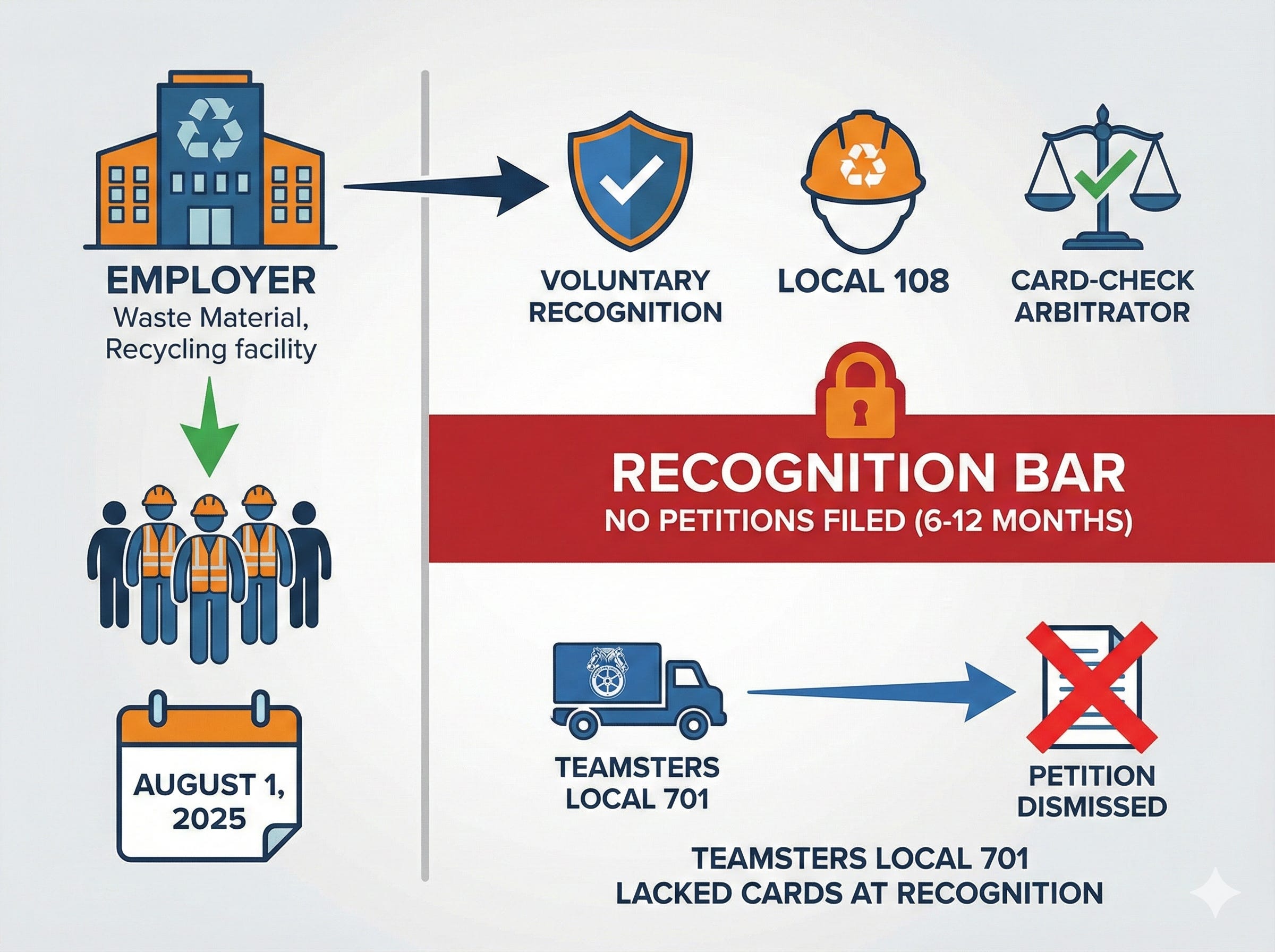
The NLRB Regional Director dismissed a representation petition filed by Teamsters Local 701 based on the recognition-bar doctrine. The Employer had voluntarily recognized Waste Material, Recycling and General Industrial Laborers’ Local 108 on August 1, 2025, following a card-check process overseen by an arbitrator. At the time of recognition, Local 108 was the only union actively organizing employees, and Teamsters Local 701 did not obtain authorization cards from employees until after the Employer had already recognized Local 108.
The Regional Director initially blocked the petition in August 2025 pending investigation of unfair labor practice charges filed by Teamsters Local 701 against both the Employer and Local 108. The charge against the Employer was dismissed in December 2025 due to insufficient evidence, while the charge against Local 108 remains pending.
Under the NLRB’s recognition-bar doctrine, an employer’s voluntary recognition of a union as the exclusive bargaining representative bars processing of an election petition for a reasonable period—defined as no less than six months and no more than one year after the parties’ first bargaining session. The bar applies even when multiple unions are simultaneously organizing if the petitioning union cannot demonstrate it had a 30-percent showing of interest at the time of recognition.
The investigation found insufficient evidence that unlawful conduct by Local 108’s agents invalidated enough authorization cards to undermine the union’s majority status. Because the voluntary recognition was valid and Teamsters Local 701 lacked authorization cards at the time of recognition, the recognition bar applies and the petition must be dismissed.
Significant Cases Cited
Lamons Gasket Co., 357 NLRB 739 (2011): Established the framework for the recognition-bar doctrine after reversal of the Dana Corp. notice requirement.
Sound Contractors Ass’n, 162 NLRB 364 (1966): Defined valid voluntary recognition as occurring in good faith based on demonstrated majority status when only one union is actively organizing.
Smith’s Food & Drug Centers, Inc., 320 NLRB 844 (1996): Held that voluntary recognition bars subsequent petitions unless the petitioner demonstrates 30-percent showing of interest at time of recognition.
Americold Logistics, LLC, 362 NLRB 493 (2015): Established that the recognition bar takes effect on the date of recognition.
NLRB v. Gissel Packing Co., 395 U.S. 575 (1969): Set standards for evaluating whether unlawful conduct invalidates authorization cards sufficient to undermine majority status.