

CenturyTel of Montana, Inc. V. NLRB, 24-1346, (DC Circuit)
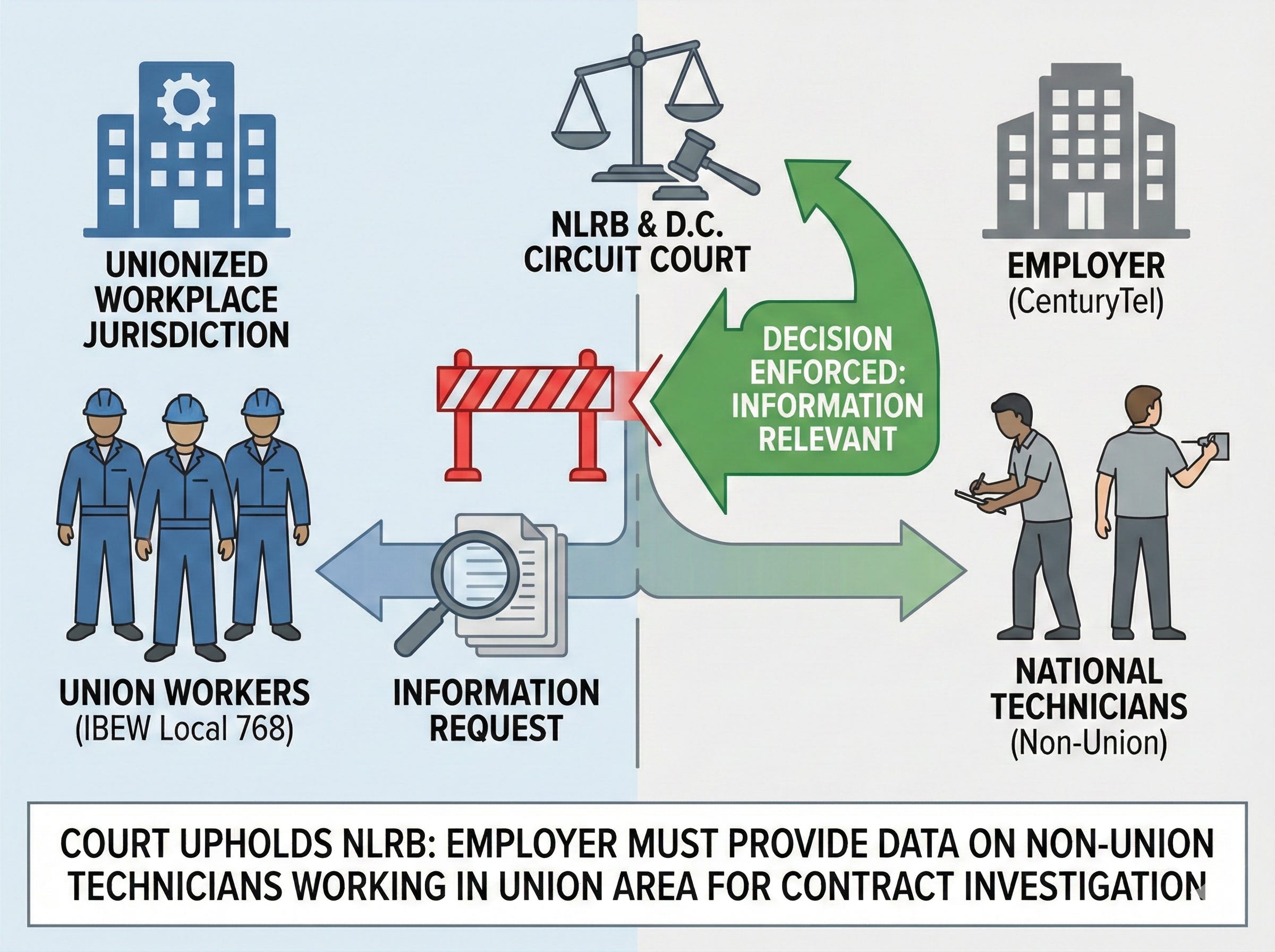
The D.C. Circuit enforced an NLRB decision finding that CenturyTel violated the NLRA by refusing to provide information about non-union National Technicians working in a unionized bargaining unit’s jurisdiction. The International Brotherhood of Electrical Workers Local 768 requested detailed information about National Technicians after learning from other union locals that such technicians were performing bargaining unit work in their areas. When CenturyTel’s manager confirmed during an August 2021 phone call that National Technicians had worked in the union’s jurisdiction “a few times,” the company was put on notice of potential work diversion but still failed to provide the requested information.
The court rejected CenturyTel’s arguments that the union failed to establish relevance of the information request. Applying a “discovery-type standard,” the court found substantial evidence supported the Board’s conclusion that the union had a reasonable belief the information was relevant to investigating potential contract violations. The court deferred to the Board’s credibility determinations regarding the August phone call and its assessment that the manager’s contemporaneous admission about National Technicians working in the union’s area established relevance. The court also upheld the Board’s longstanding precedent allowing the General Counsel to demonstrate relevance at the unfair labor practice hearing, rather than requiring the union to disclose its full factual basis when making the initial request.
CenturyTel argued the Board improperly relied on evidence not produced during discovery, including 2018 grievances involving similar work diversion allegations and internal union communications. The court found CenturyTel forfeited these procedural challenges by failing to raise them in exceptions to the administrative law judge’s decision or in petitions for Board rehearing. The court emphasized that the threshold for relevance is low under Board precedent and that the union need not demonstrate a particular controversy exists—probable or potential relevance to representational duties suffices to trigger the employer’s obligation to provide requested information.
Significant Cases Cited
NLRB v. Truitt Manufacturing Co., 351 U.S. 149 (1956): Established that good-faith bargaining requires employers to provide information bearing on the bargaining process, including financial information when claimed inability to pay is asserted.
New York & Presbyterian Hospital v. NLRB, 649 F.3d 723 (D.C. Cir. 2011): Set forth the standard that unions seeking information about non-unit employees must explain why the information is relevant, but relevance is assessed under a low “discovery-type standard” requiring only probable or potential relevance.
NLRB v. Acme Industrial Co., 385 U.S. 432 (1967): Affirmed that the statutory duty to bargain includes the obligation to provide relevant information to unions for contract administration purposes.
Detroit Edison Co. v. NLRB, 440 U.S. 301 (1979): Established that while a union’s bare assertion of need is insufficient, the union must explain to the employer why requested information is relevant to its representational responsibilities.
DirectSat USA LLC v. NLRB, 925 F.3d 1272 (D.C. Cir. 2019): Confirmed that unions must show a reasonable belief, supported by objective evidence, that requested information is relevant to their duties as bargaining representative.
United Parcel Service, Inc., JD-05-26, 12-CA-340701 (ALJ Decision)
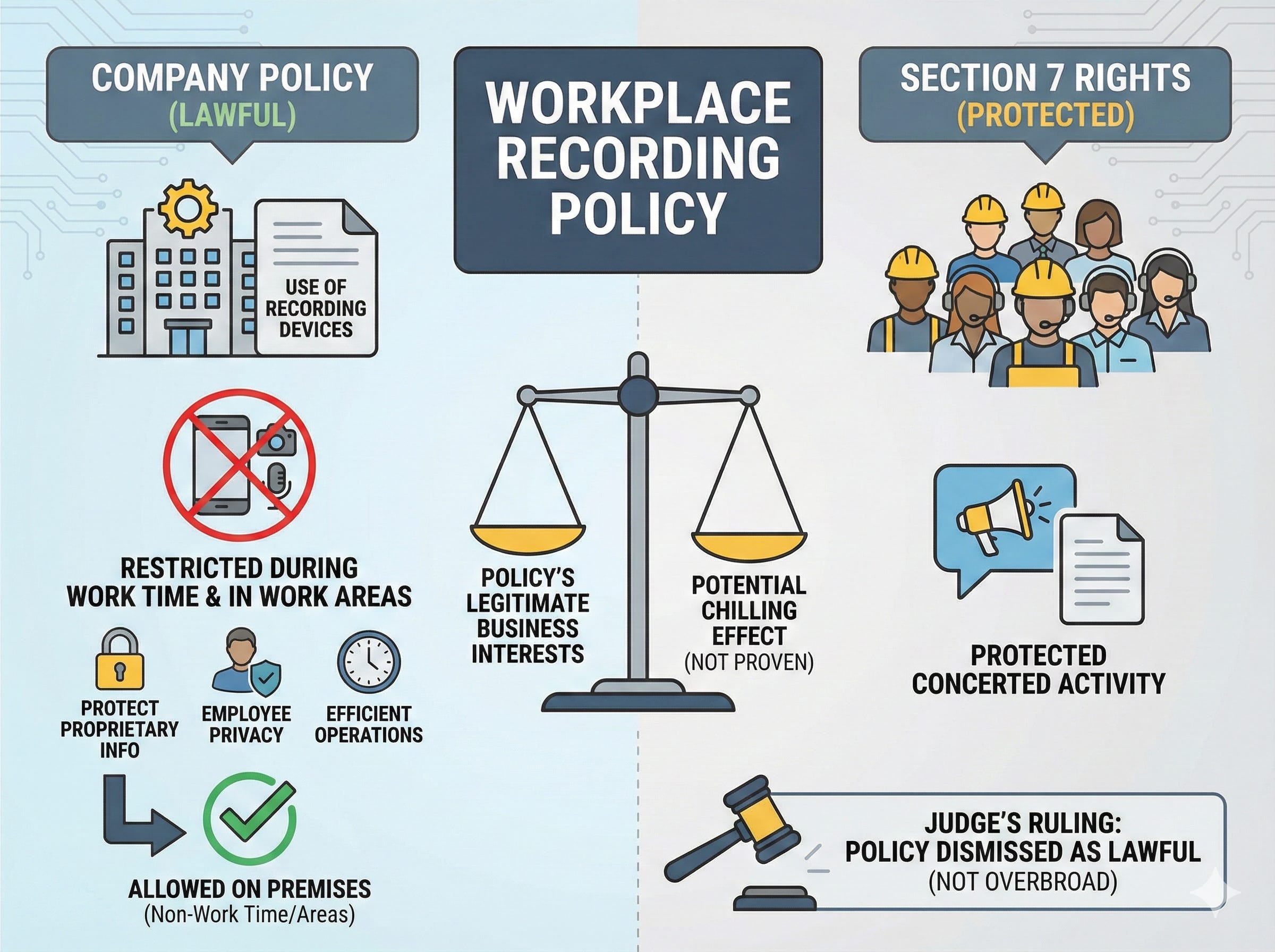
An Administrative Law Judge dismissed a complaint alleging that United Parcel Service violated the NLRA by maintaining a workplace policy restricting employee use of recording devices. The January 13, 2026 decision concluded that the General Counsel failed to prove the policy would reasonably chill employees’ Section 7 rights under the Stericycle framework.
The challenged policy, titled “Use of Recording Devices” and maintained since January 30, 2024, provides:
UPS seeks to encourage and foster spontaneous and honest dialogue, practical problem-solving, and direct and ethical dealings with its employees, vendors, and partners, all as a means to successful working relationships and effective customer service within today’s fast-moving and competitive environment.
As a result, the use of any recording devices in its facilities (whether cell phones, cameras, or other devices capable of recording pictures, video, or audio) while on work time and in work areas is subject to several important and business-driven limitations. Individuals who record are personally responsible for respecting these limitations.
One business reason for limiting recording is to eliminate the chilling effect that may inhibit the free exchange of information when one person is concerned that another is recording. Individuals who seek to record are responsible for respecting these important concerns.
Another business reason to limit recording is protecting UPS’s, its strategic partners’ and its customers’ proprietary information and trade secrets, protecting employees’ health related, background check, familial, or other information deemed private by applicable law, and protecting employees’ privacy in locker, changing, nursing, or rest rooms. Individuals who seek to record should ensure their recording will not interfere with these important business interests.
Finally, in some states or localities, creating or using recordings of conversations or information without the consent of others may violate the law. Individuals who record are personally responsible for understanding and complying with any applicable laws, and individuals who seek to record will be responsible for any failure to do so.
Examples of activities or work areas in which employees should be especially aware of the above limitations include, but are not limited to, pre-load, hub, center, yard, or ramp operations; warehouse activities; while on-car, or in PCMs, business meetings, or on conference calls involving UPS confidential/proprietary information of customers or partners. Individuals may possess recording devices while on UPS facilities, provided that the recording capabilities and recorded information are used in a manner consistent with this and other UPS policies regarding confidential/proprietary equipment, systems or information.
ALJ Jeffrey Gardner found the policy lawful because it permitted recording devices on UPS premises and only asked employees to respect reasonable limitations during work time and in work areas. The judge distinguished the policy from broader bans found unlawful in Rio All-Suites Hotel & Casino and Whole Foods Market, noting this policy lacked sweeping prohibitions and specified no disciplinary consequences. Critically, UPS counsel’s statement in briefing that the policy “does not apply to any recording activity that would be protected under the NLRA” bound the employer. The judge found the policy’s work-time restrictions comported with the longstanding principle from Republic Aviation that “working time is for work.”
Significant Cases Cited
Stericycle, Inc., 372 NLRB No. 113 (2023): Established the framework for analyzing facially neutral work rules, requiring the General Counsel to prove rules have a reasonable tendency to chill Section 7 rights before shifting burden to employers.
Republic Aviation Corp. v. NLRB, 324 U.S. 793 (1945): Affirmed the principle that “working time is for work,” establishing that employers may lawfully restrict employee activities during working time.
Rio All-Suites Hotel & Casino, 362 NLRB 1690 (2015): Found unlawful a broad workplace recording ban that applied without regard to work time or work areas.
Whole Foods Market, Inc., 363 NLRB 800 (2015): Found unlawful an unlimited recording restriction where the employer admitted the rule applied to protected activity.
Lutheran Heritage Village-Livonia, 343 NLRB 646 (2004): Established that employer work rules should be interpreted in context rather than in isolation.