
Kraton Corporation, 08-RC-375771 (Regional Election Decision)
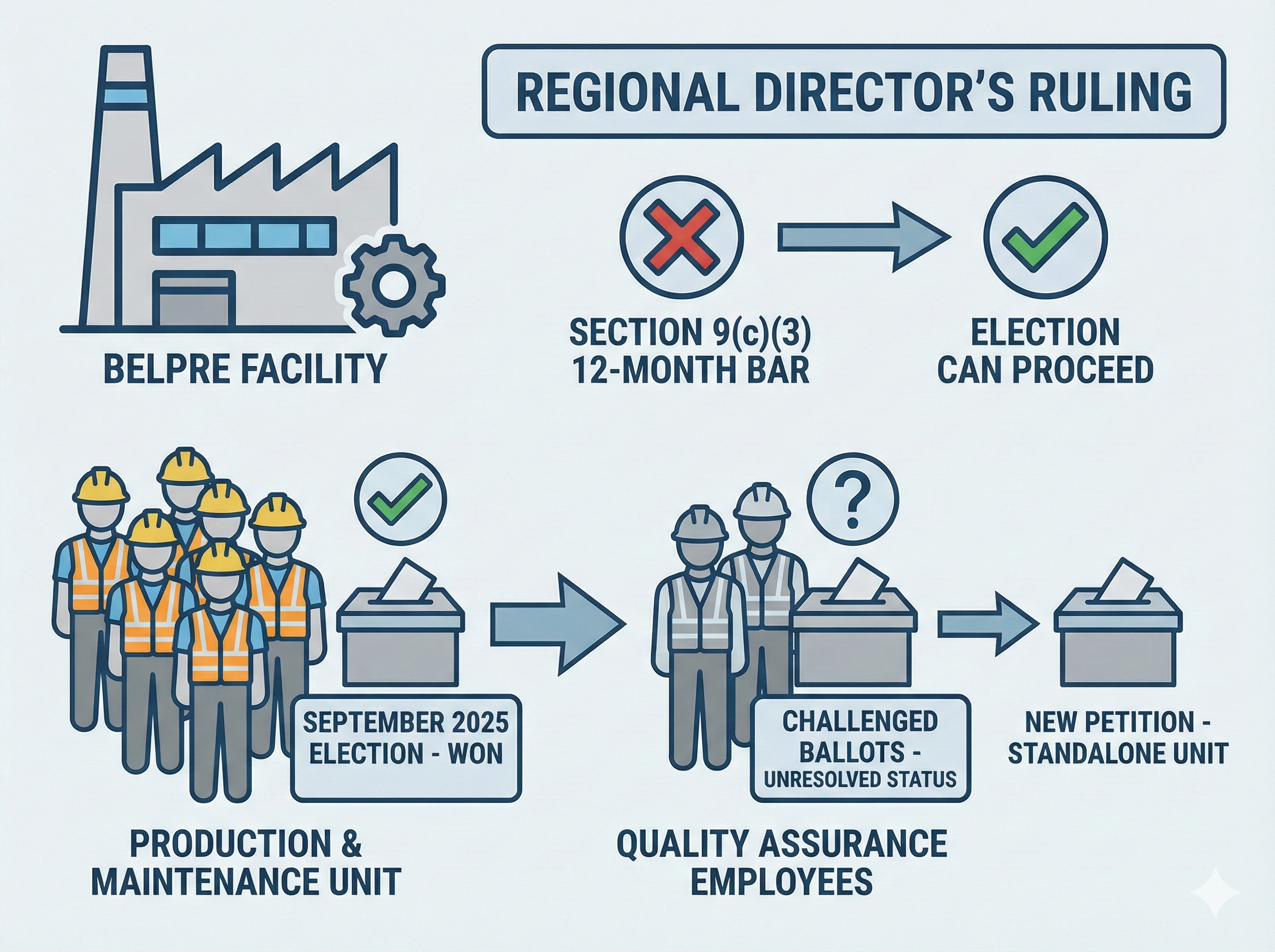
The regional director ruled that a union can proceed with an election for quality assurance employees at Kraton Corporation’s Belpre, Ohio facility, rejecting the employer’s argument that a prior election bars the new petition under Section 9(c)(3) of the NLRA.
In September 2025, the United Steelworkers held an election for production and maintenance workers at the facility and won overwhelmingly. However, 16 quality assurance employees cast challenged ballots because the parties disputed whether they belonged in the unit. Since those ballots weren’t determinative of the election outcome, the issue was never resolved. The November certification explicitly stated that the quality classification was “neither included in nor excluded from” the certified bargaining unit.
When the union filed a new petition in November to represent those same quality assurance employees as a standalone unit, Kraton argued that Section 9(c)(3)—which prohibits elections in the same unit within 12 months of a valid election—barred the petition.
Acting Regional Director Nora McGinley rejected this argument, finding that the quality employees cannot be considered a “subdivision” of a unit that doesn’t include them. The director noted that the challenged ballot agreement and certification left their status unresolved, and that holding them to be part of the prior unit would contradict the employer’s own position in that case. The director also emphasized that the Board allows employees to vote in multiple elections within 12 months when subsequent elections involve larger units, and that the quality employees’ challenged ballots were never opened or counted. Finally, the director observed that this situation doesn’t involve the concern that motivated Section 9(c)(3)—repeated elections after votes against representation—since the prior election resulted in union certification.
An election for the quality assurance unit is scheduled for January 15-16, 2026.
Significant Cases Cited
Brooks v. NLRB, 348 U.S. 96 (1954): Explained that Section 9(c)(3) was added by the Taft-Hartley Act to address the Board’s prior policy of permitting second elections within one year after votes against representation.
Thiokol Chemical Corp., Redstone Division, 123 NLRB 888 (1959): Held that Section 9(c)(3) does not bar an election in a larger unit where there was a previous election in a smaller unit because the subsequent election is not in the same unit or subdivision.
S.S. Joachim & Anne Residence, 314 NLRB 1191 (1994): Held that Section 9(c)(3) does not bar an election among employees who were excluded from the unit in a prior election.
Kolcast Industries, Inc., 117 NLRB 418 (1957): Established that the statutory election bar is in effect from the date balloting ends.
Philadelphia Co., 84 NLRB 115 (1949): Held that Section 9(c)(3) does not bar an election among employees excluded from a prior election unit.
Wilson Paving & Sealcoating Inc., 13-RC-344206 (Regional Election Decision)
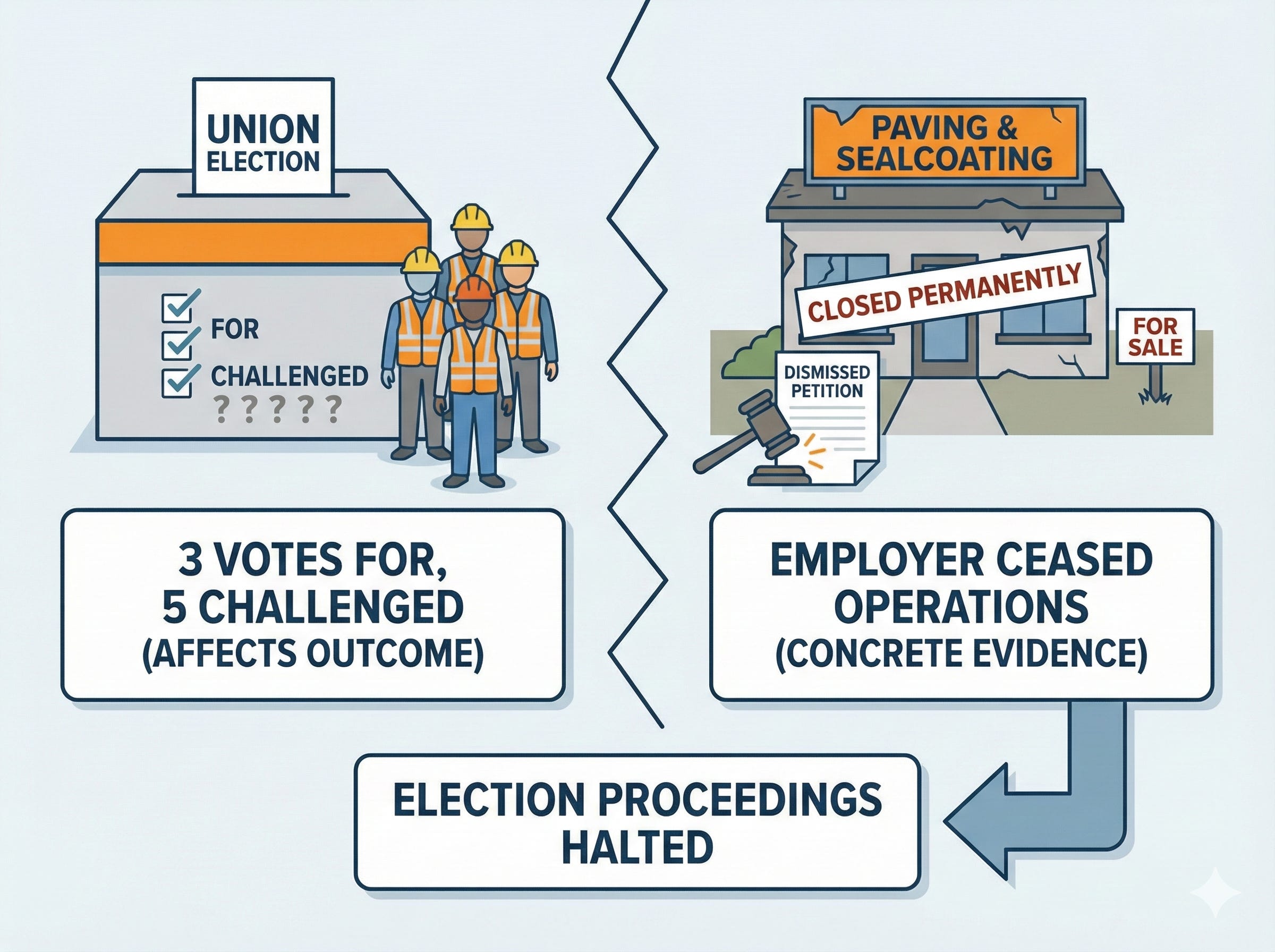
A union representation election at Wilson Paving & Sealcoating resulted in three votes for union representation and zero against, but five challenged ballots were sufficient to affect the outcome. The Regional Director dismissed the petition without resolving the challenged ballots because the employer permanently ceased operations.
The employer was a small seasonal paving and sealcoating business operating from the owner’s residential property in Lemont, Illinois, employing between three and six workers. Following the July 2024 election, the employer notified the NLRB in October 2024 that it was permanently closing. The owner had signed a sale agreement for his property in July 2024, with closing expected in March 2025.
The union challenged the closure claim, arguing the employer failed to provide concrete evidence of cessation and noting the business could relocate to another location where it stored equipment. The Regional Director applied the standard from Retro Environmental, which requires “concrete evidence” such as announcements to employees and the public, employee terminations, or definitive proof of sale or cessation—not merely conjecture about future operations.
The Regional Director found the employer met this burden by providing: documentation of the January 2025 property sale; state records showing termination of unemployment insurance due to no wages paid; payroll records confirming no employees worked during the entire 2025 season; evidence of bank account closure in September 2025; and articles of dissolution filed with Illinois showing corporate dissolution in September 2025. The Director concluded that because the employer’s closure was “imminent and certain,” continuing with the election proceedings would serve no purpose under the NLRA.
Significant Cases Cited
Retro Environmental, Inc./Green JobWorks, Inc., 364 NLRB 922 (2016): The Board will not dismiss an election petition based on conjecture or uncertainty but requires concrete evidence such as public announcements, employee terminations, or definitive proof the employer has determined to sell, cease operations, or fundamentally change its business nature.
Servicios Correccionales de Puerto Rico, 338 NLRB 452 (2002): It would be unnecessarily wasteful of Board resources to determine election objections when the employer’s contract was cancelled and it no longer employed unit employees.
Hughes Aircraft Co., 308 NLRB 82 (1992): The Board may dismiss a petition when an election will serve no purpose because cessation of the employer’s operations is imminent.
Martin Marietta Aluminum, 214 NLRB 646 (1974): The Board may dismiss a petition when an employer completely ceases to operate, sells its operations, or fundamentally changes the nature of its business.
Cooper International, 205 NLRB 1057 (1973): The Board may dismiss a petition when an election will serve no purpose due to cessation of employer operations.