

ExxonMobil Fuels & Lubricants, JD(SF)-01-26, 16-CA-290036 (ALJ Decision)
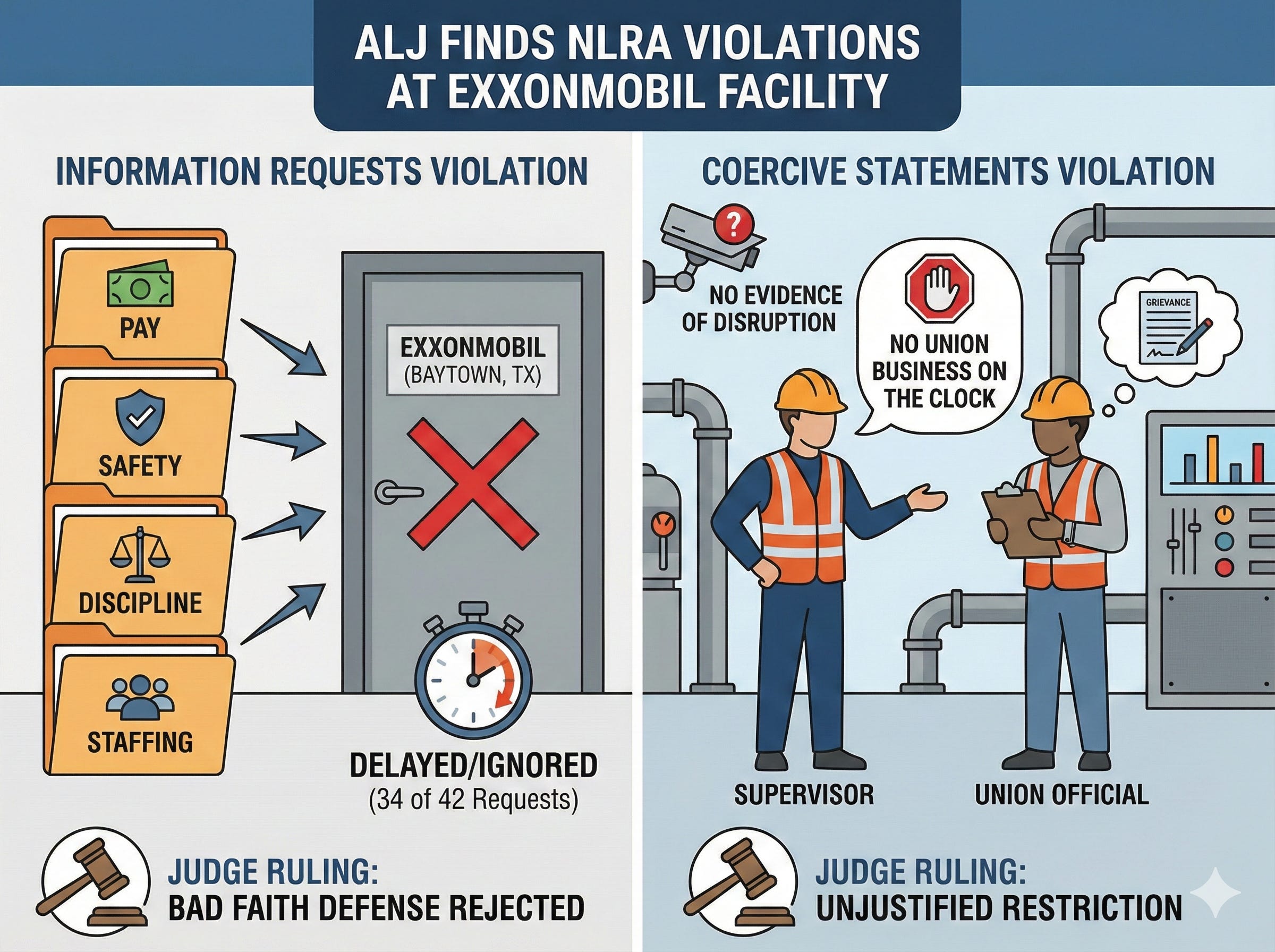
An Administrative Law Judge ruled that ExxonMobil violated the NLRA at its Baytown, Texas facility by failing to provide timely responses to union information requests and making coercive statements to union officials about conducting union business during work hours.
Information Request Violations
Between October 2021 and March 2023, union president Ricky Brooks submitted 42 information requests to the company. The judge found ExxonMobil failed to respond to 34 requests concerning bargaining unit employees and delayed responses to four others by periods ranging from approximately three to six months. The requests covered workplace topics including discipline, pay practices, staffing, scheduling, overtime, benefits, safety practices, and injury investigations.
ExxonMobil defended its non-responses by arguing the requests were made in bad faith to harass the company, pointing to the volume of grievances and information requests filed at Baytown compared to other facilities. The judge rejected this defense, finding the requests sought legitimate information necessary for representing approximately 1,000 bargaining unit employees. The judge noted that Labor Relations Advisor Patrick Fields, who was new to his position, admitted his inexperience and lack of internal cooperation contributed to the failures to respond. The judge concluded that general claims about volume, without evidence that specific requests were duplicative or overly burdensome, did not excuse the company’s obligation to provide relevant information.
Coercive Statements
In August 2022, two supervisors made statements restricting union officials from conducting union business during work time. After union vice president Michael Loy spoke with Brooks at his work location for 5-10 minutes about grievances, supervisor Charles Whitaker told Loy not to visit Brooks at the scale house while Brooks was working, though he could call him or meet elsewhere. Days later, supervisor Wendell Stanley told Brooks during a disciplinary meeting that he couldn’t have visitors or conduct union business “on the clock.”
The judge found these statements violated Section 8(a)(1) because ExxonMobil failed to provide credible evidence of the productivity concerns it claimed justified the restrictions. Despite having surveillance cameras at the location, the company produced no video evidence of the alleged truck backup that supposedly occurred. The judge concluded the restrictions arbitrarily interfered with union officials’ rights to process grievances during work time without legitimate business justification.
Rejected Claims
The judge dismissed three unilateral change allegations. First, while ExxonMobil unilaterally modified its clean-shaven policy in October 2021, the judge found the union had waived its right to bargain through contractual language reserving management’s right to publish working rules and through past practice of accepting similar changes without objection. Second, the judge found no evidence that a drug test administered after a workplace incident departed from established policy. Third, the judge concluded the company’s denial of an employee’s request to designate a non-workday as a floating holiday did not violate the law because the union failed to prove a consistent past practice of allowing such requests despite a written policy prohibiting them.
Remedy
The judge ordered ExxonMobil to provide the 34 outstanding information requests, cease interfering with union officials conducting grievance-related activities, and post notices at the facility. The judge denied requests for extraordinary remedies including training requirements, maintaining an information request log, and awarding litigation expenses.
Significant Cases Cited
NLRB v. Katz, 369 U.S. 736 (1962): Established that unilateral changes to material terms and conditions of employment without bargaining constitute per se violations of the Act.
NLRB v. Acme Industrial Co., 385 U.S. 432 (1967): Held that employers must furnish relevant information to unions upon request to enable them to perform their statutory duties as bargaining representatives.
Endurance Environmental Solutions, LLC, 373 NLRB No. 141 (2024): Reinstated the “clear and unmistakable” waiver standard for determining whether unions have waived their right to bargain over management decisions.
BASF Wyandotte Corp., 278 NLRB 173 (1986): Found that management rights clauses reserving the right to make safety rules, combined with existing safety regulations, can constitute a waiver of the union’s right to bargain over new safety requirements.
Detroit Edison, 440 U.S. 301 (1979): Established that a union’s need for information and an employer’s duty to provide it depend on the probability that the information is relevant and will be useful to the union in carrying out its statutory duties.
Trinity Health-Michigan D/B/a Trinity Health Ann Arbor Hospital, JD-03-26, 07-CA-348449 (ALJ Decision)
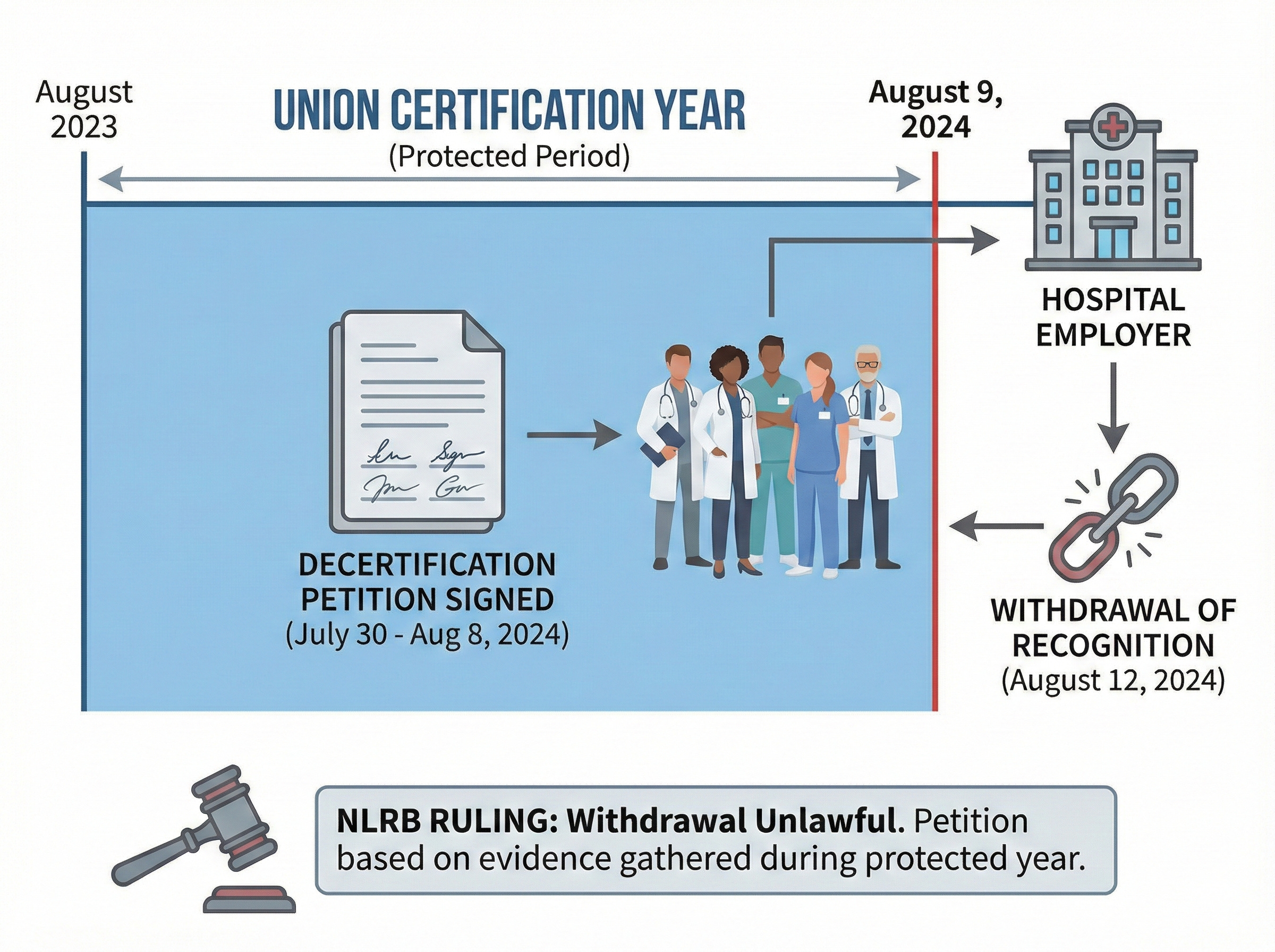
An NLRB administrative law judge ruled that Trinity Health-Michigan violated the NLRA by withdrawing recognition from Service Employees International Union Healthcare Michigan (SEIU) based on a decertification petition signed during the union’s certification year. The hospital operates outpatient laboratory facilities across southeastern Michigan, employing approximately 50 laboratory technicians, patient service representatives, and trainers who voted for union representation in August 2023.
The legal dispute centered on timing. Between July 30 and August 8, 2024—just one day before the certification year ended—28 employees signed a petition stating they no longer wished to be represented by SEIU. Lab Manager Ted Theodoroff received the petition on August 8 and forwarded it to human resources leadership. Over the following days, hospital officials compared the petition signatures against their Workday employee database to confirm the signers were active employees in the bargaining unit. Finding that a majority had signed, the hospital withdrew recognition from the union on August 12, 2024, three days after the certification year concluded.
The hospital argued its actions were lawful under Levitz Furniture, which permits employers to withdraw recognition when they possess objective evidence that the union has lost majority support. Hospital officials maintained they conducted proper verification by checking names against employee records, though they did not authenticate the actual signatures. The hospital further contended that applying Chelsea Industries to this case would impose an “unfair and highly technical burden on employees” who gathered signatures just before the certification year expired.
Administrative Law Judge Renée D. McKinney rejected the hospital’s defense. While acknowledging that the hospital satisfied Levitz Furniture‘s objective evidence standard by confirming that a majority of unit employees “apparently” signed the petition, Judge McKinney found the withdrawal unlawful under Chelsea Industries. That precedent prohibits employers from withdrawing recognition based on evidence gathered during the certification year, even if the withdrawal occurs after the year ends. The judge noted that Chelsea Industries applies regardless of whether the employer otherwise bargained in bad faith, citing Sears, Roebuck & Co. as support.
Judge McKinney declined the hospital’s invitation to overturn Chelsea Industries, explaining that administrative law judges lack authority to overrule Board precedent. The certification year exists to provide newly certified unions a reasonable period to negotiate a first contract without employer challenges to majority status. By relying on a petition signed during this protected period, the hospital violated Section 8(a)(5) and (1) of the National Labor Relations Act.
The decision orders Trinity Health to recognize SEIU and bargain with the union for a reasonable period. This affirmative bargaining order includes an attendant bar preventing the hospital from raising questions about the union’s continuing majority status during that time. The hospital must also post notices at all affected facilities informing employees of their rights and the Board’s findings.
Significant Cases Cited
Chelsea Industries, 331 NLRB 1648 (2000), enfd. 285 F.3d 1073 (D.C. Cir. 2002): Employers cannot withdraw recognition based on evidence of lost union support obtained during the certification year, even if withdrawal occurs after the year ends.
Levitz Furniture Co. of the Pac., Inc., 333 NLRB 717 (2001): Employers must have objective evidence of actual loss of majority support before withdrawing recognition from a union.
Sears, Roebuck & Co., 368 NLRB No. 30 (2019): The Chelsea Industries rule applies even absent other unfair labor practices when an employer withdraws recognition based on evidence gathered during the certification year.
Lee Lumber & Building Material Corp., 334 NLRB 399 (2001), enfd. 310 F.3d 209 (D.C. Cir. 2002): Upon finding unlawful withdrawal of recognition, the remedy requires the employer to bargain with the union for a reasonable period.
Guerdon Industries, Inc., 218 NLRB 658 (1975): An employer need only show that a majority of employees “apparently” signed a decertification petition, without authenticating each signature.
Hoffmann Brothers, JD-01-26, 14-CA-344872 (ALJ Decision)
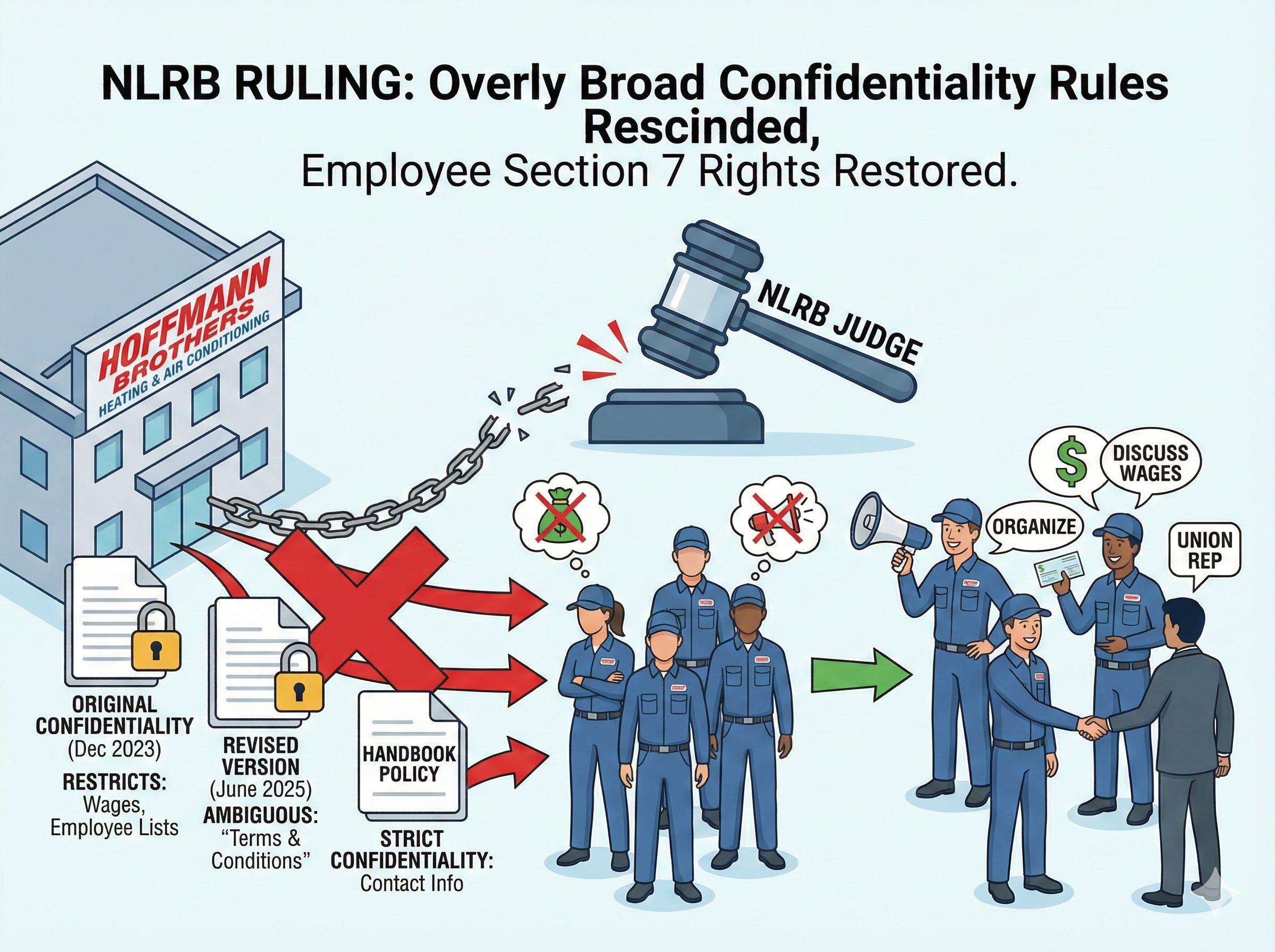
An NLRB Administrative Law Judge ruled that Hoffmann Brothers Heating and Air Conditioning violated the NLRA by maintaining overly broad confidentiality provisions that restricted employees’ Section 7 rights to discuss wages and organize collectively.
The case arose after the International Association of Sheet Metal, Air, Rail, and Transportation Workers filed charges following the company’s cease-and-desist letter to a former employee who had contacted current workers about union organizing. The judge examined three distinct policies: the original confidentiality provision in the company’s non-compete agreement (maintained since December 2023), a revised version issued in June 2025, and a confidential information policy in the employee handbook.
Applying the Stericycle framework, the judge found all three provisions unlawfully chilled employees’ protected activity. The original agreement broadly defined “confidential information” as “any communication” disclosed to employees, explicitly including “compensation and benefit information” and “employee lists,” and prohibited disclosure without prior written consent. A reasonable employee would interpret this as barring discussion of wages with coworkers or sharing contact information with unions.
The company’s June 2025 revisions attempted to cure the violations by adding clarifying language, including that employees could discuss “terms and conditions of employment” with coworkers and use confidential information for NLRB complaints. However, the judge found these modifications insufficient because they failed to address the “broad panoply” of Section 7 rights, created ambiguity about whether wage information could be shared, and didn’t clarify whether employees could disclose information to unions or the public during organizing campaigns.
The employee handbook’s confidential information policy similarly violated the NLRA by requiring “strict confidentiality” over “business-related information” and prohibiting disclosure of “team member contact information” and telephone numbers. The policy’s vague savings clause stating nothing was “intended to infringe upon team member rights” failed to cure the violations.
While the company argued these provisions served legitimate business interests in protecting proprietary information from competitors and maintaining customer confidentiality, the judge ruled the restrictions were not narrowly tailored. The provisions swept too broadly, covering protected employee communications alongside legitimately confidential business information, and could have been drafted more precisely to achieve the company’s stated goals without restricting NLRA rights.
The judge ordered the company to rescind all three provisions and either distribute revised agreements without the unlawful language or provide inserts explaining the rescission to current and former employees.
Significant Cases Cited
Stericycle Inc., 372 NLRB No. 113 (2023): Established the current two-part standard for evaluating facially neutral workplace provisions, placing initial burden on General Counsel to prove reasonable chilling effect on Section 7 rights, then shifting burden to employer to prove legitimate business interest that cannot be advanced through narrower language.
Lutheran Heritage Village-Livonia, 343 NLRB 646 (2004): Held that facially neutral workplace rules violate the NLRA if employees would reasonably construe them to prohibit Section 7 activity, even without evidence of enforcement.
First Transit, Inc., 360 NLRB 619 (2014): Established framework for evaluating whether savings clauses cure otherwise unlawful workplace restrictions, requiring such clauses to address the broad panoply of Section 7 rights and be appropriately placed within the document.
Eastex, Inc. v. NLRB, 437 U.S. 556 (1978): Supreme Court held that Section 7 protects employees’ right to raise workplace issues through channels both inside and outside the immediate employment relationship, including communications with unions, government, media, and the public.
Quicken Loans, Inc., 361 NLRB 904 (2014): Board held that rules restricting employees from sharing employee information including contact lists, phone numbers, and email addresses with labor unions violate the NLRA.
Accurate Metal Fabricating, LLC, JD-02-26, 13-CA-344936 (ALJ Decision)
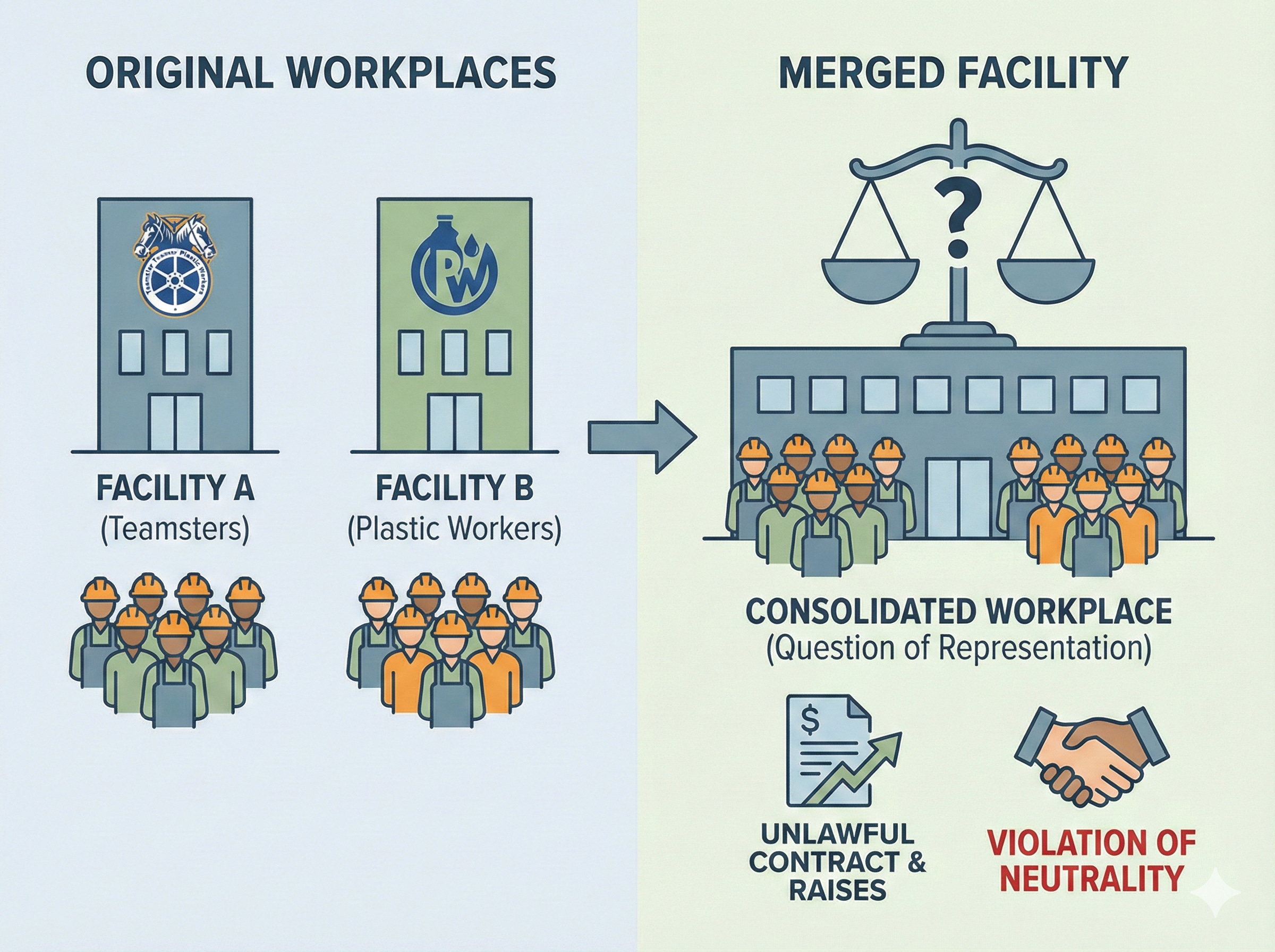
An administrative law judge found that Accurate Metal Fabricating violated the NLRA when it executed a collective bargaining agreement with Plastic Workers Union Local 18 after consolidating two facilities, each previously represented by different unions. The judge ruled that the consolidation created a new merged bargaining unit, eliminating both unions’ incumbent status and triggering a question concerning representation.
The Regional Director had determined that neither union represented a sufficient majority of the approximately 102 employees at the consolidated Cicero facility. Despite a pending representation election, Accurate Metal executed a contract with the Plastic Workers covering only their historical unit members. That agreement provided $1, 80-cent, and 90-cent hourly wage increases over three years—significantly higher than the 40-cent raises Teamsters Local 781 members had last received in December 2022.
The judge rejected the employer’s statute of limitations defense, finding the Teamsters lacked actual or constructive knowledge of the contract before the critical date. The judge credited testimony that the Teamsters’ business agent first learned of the raises in March 2024, and the union acted promptly to investigate and file charges. The judge also found insufficient evidence to impute any employee or steward knowledge to the union itself.
Applying Midwest Piping principles, the judge held that when a consolidation obliterates historical units and creates a new merged unit during a question concerning representation, the employer must maintain strict neutrality between rival unions. The contract execution violated Section 8(a)(2), while the discriminatory wage increases violated Section 8(a)(3) by sending a message that employees would receive better terms if they selected the Plastic Workers. The contract’s union security clause separately violated Section 8(a)(3) and (1) because it applied at a time when the Plastic Workers did not represent an uncoerced majority in an appropriate unit.
The judge ordered Accurate Metal to grant retroactive raises to Teamsters-represented employees equal to those provided under the Plastic Workers contract, make whole employees hired after June 30, 2023, for dues collected under the unlawful agreement, and cease giving effect to the contract unless the Plastic Workers wins Board certification. The judge sustained the Teamsters’ election objections and ordered a third election, finding the contract execution and discriminatory raises were sufficiently severe to affect the election outcome despite the Plastic Workers’ 50-9 victory.
Significant Cases Cited
Midwest Piping & Supply Co., 63 NLRB 1060 (1945): Established that employers must maintain strict neutrality between rival unions when a question concerning representation exists.
Teamsters Local Union No. 206, 368 NLRB No. 15 (2019): When a consolidation substantially changes the nature of prior units and creates a question concerning representation, employers have no duty to recognize any involved union during the pending resolution.
RCA Del Caribe, 262 NLRB 963 (1982): Despite a question concerning representation, employers must continue bargaining with incumbent unions, but this principle does not apply when consolidation eliminates incumbent status.
Bruckner Nursing Home, 262 NLRB 955 (1982): Employers notified of a valid representation petition must refrain from recognizing rival unions and follow strict neutrality to avoid unduly influencing the contest between labor organizations.
Martin Marietta Co., 270 NLRB 821 (1984): When employers merge multiple bargaining units, the Board determines whether historical units retain separate identity or whether changed circumstances have obliterated previous separate identities.